When the Earth Itself Becomes the Table
A new wave of culinary artists is abandoning dining rooms for waterfalls, beaches, and carved-dirt trenches, transforming meals into immersive encounters with the land
The Rock as Canvas
Picture a flat stone beside a rushing waterfall in upstate New York. No chairs. No plates. No tablecloth. Charles Michel, who describes his practice as that of a food futurist, prepares the surface with vinegar before applying broad strokes of vegetable puree - chartreuse, ochre, deep violet - arranging foraged flowers and wild herbs into an abstract composition. The diners, a small group gathered for a retreat, watch in silence. When Michel steps back, they hesitate. Nobody lunges. The moment stretches. Then, tentatively, someone tears a piece of sourdough and drags it through a swirl of puree. The meal has begun.
Michel has been creating these edible paintings for fifteen years, but this iteration marked a departure. No infrastructure. No boundary between art object and eating surface. No separation between the diners and the elements. The leftovers from the previous day's meal - fibrous white asparagus trimmings - had been transformed into a silken velouté, now part of the palette. One brushstroke might taste umami-rich and floral; another, bright and sharp with acidity. The act of eating became exploratory, childlike. "It provoked something," Michel tells us. "Almost none of the rituals resembled the way we normally eat."
At Global Chic Voyage, we've watched a quiet shift unfold over the past few years. Dining, particularly among those who seek immersive travel experiences, is migrating out of enclosed spaces and into landscapes that demand participation. The table is no longer a piece of furniture. It is carved into the earth, painted onto stone, or suspended in water. These are not simply al fresco meals with a view. They are encounters designed to collapse the distance between diner and environment, to make the act of eating inseparable from the place itself.
Dining in the Dirt
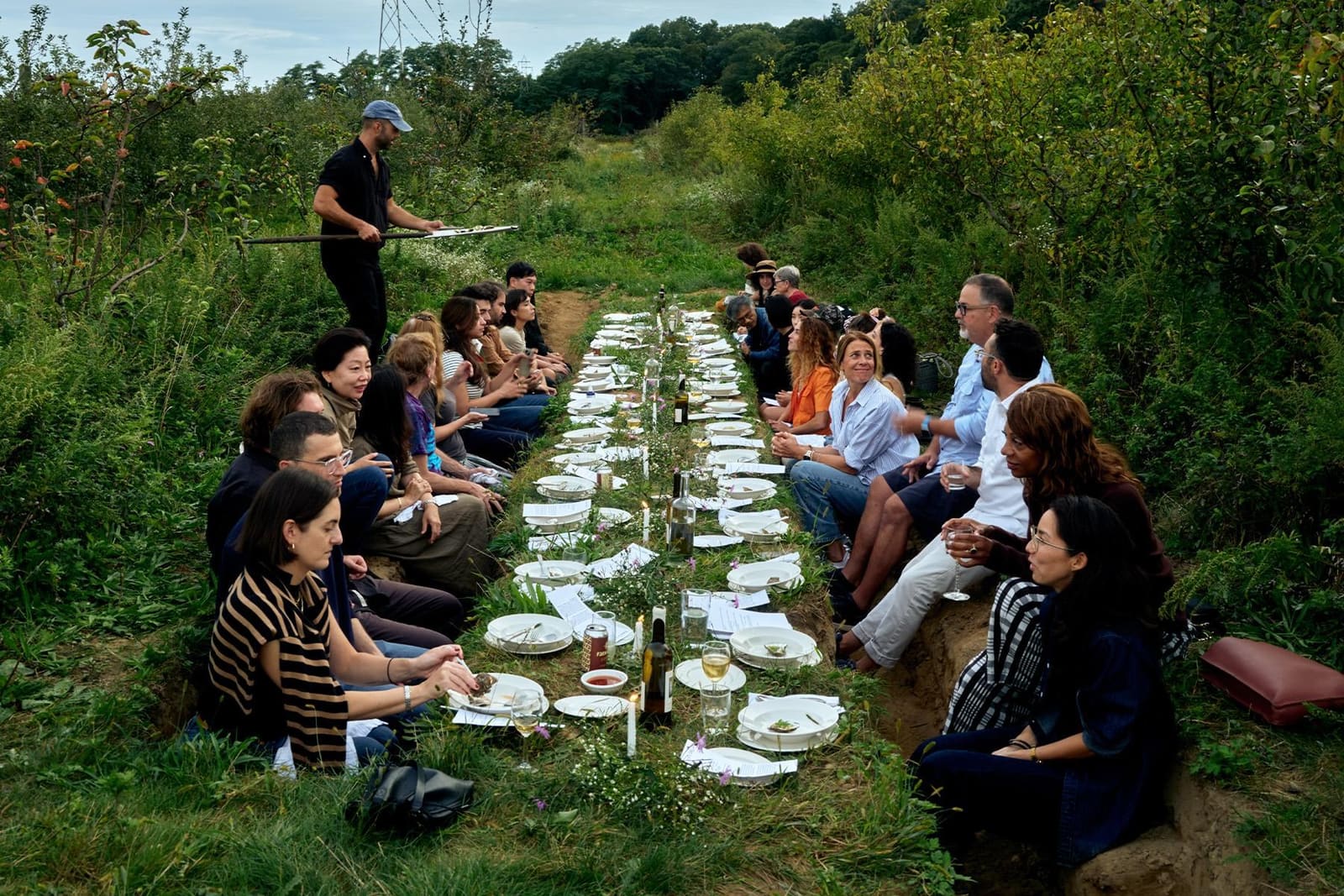
Last autumn, at Treiber Farms on Long Island's North Fork, thirty guests arrived to find no table in the conventional sense. Instead, organizers had excavated two long trenches into the soil, thirty feet each, lined with candles set into drilled holes. Diners sat on the ground, elbows resting on the lip of the earth, plates balanced on their laps or the dirt itself. Local oysters arrived on repurposed irrigation pipes. Delicata squash, mustard greens, tilefish pulled from nearby waters. As the sun dropped and the moon rose, the candlelight flickered along the length of the troughs.
Peter Treiber Jr., who co-runs the farm and co-organized the event, describes it as an exercise in getting people to root level. "It's a pretty simple concept," he says, "but it's effective about getting people grounded." The dinner, titled Farm Is Table, was part of a series building toward the release of a book reinterpreting The Futurist Cookbook, the nearly century-old Italian text that imagined meals as multisensory disruptions. That manifesto proposed Aerofood, a dish eaten with one hand while the other stroked sandpaper or velvet. Farm Is Table channeled that spirit: sensory immersion, social norms upended, the land elevated to co-host.
Artist Allan Wexler, who helped orchestrate the event, recalls the evening as something close to magic. The mix of attendees - artists, New Yorkers, locals - shared a common curiosity about the intersection of agriculture and art. Tickets were priced at one hundred and twenty-five dollars. The menu was dictated entirely by what the North Fork could offer that week. "It all created a bigger picture," Treiber Jr. explains, "of what this place is about through the land and the sea."
Water, Stone, and Bread
In Marseille, a few months ago, diners waded into the Mediterranean and took their seats at a table constructed from the salvaged panels of a fishmonger's cold room. Alix Lacloche, a culinary artist, designed the event as an homage to the sea itself. Every element was locally sourced or upcycled. The menu featured a soup inspired by bouillabaisse, made with foraged seaweed and served with bread baked in recycled leather flip-flops - a playful nod to the Swiss artist Daniel Spoerri. The images circulated widely online, accompanied by assurances that the scene was not generated by artificial intelligence.
The impulse to dine immersed in water, dirt, or stone is not new. Bread & Puppet Theater, the activist puppet troupe founded in the 1960s, has been serving house-made sourdough and pumpernickel in the fields of Vermont for decades. Their philosophy holds that theater, like bread, should exist outside the logic of commerce, treated as a necessity rather than a commodity. The farm-to-table movement of the 1970s reinforced the value of seasonal, local ingredients, setting the stage for larger-scale outdoor dining projects.
Outstanding in the Field, a traveling dinner series launched in 1999 by land artist Jim Denevan, gathers hundreds of diners at a single, impossibly long communal table set in orchards, on beaches, in open fields. The format retains certain conventions - tablecloths, cutlery, chairs - but the setting transforms the experience. This week, the series hosted an eclipse dinner in Menorca. The table becomes a visual counterpoint to the landscape, a ribbon of civilization laid across wild terrain.
Yet the newer wave of earthwork dining strips away even those vestiges of decorum. Michel's rockface picnic had no individual plates, no courses, no clear distinction between audience and participant. Everyone arrived hungry and left nourished, but the path between those two states bore little resemblance to a traditional meal. The Ever-Changing Table, a collaborative dinner series unfolding this month as part of the culinary program for Art Biesenthal, replaces porcelain with leaves, turns vegetables into sculptural centerpieces, and folds the surrounding landscape into the table itself.
The Fertile Ground Between Art and Commerce
The cross-section of art, agriculture, and dining has become, in Treiber Jr.'s words, fertile ground. But it is also ground that has attracted attention from marketers who recognize the viral potential of a table carved into snow or a meal served in a remote stone quarry. Fast-fashion brands and beauty conglomerates have staged dinners in dramatic natural settings, images calibrated for social media circulation. These events, while visually arresting, often lack the low-waste ethos and relational philosophy that animate the work of artists like Michel, Lacloche, and Wexler. They feel less like invitations to reconsider our relationship with food and more like brand activations dressed in the aesthetics of the avant-garde.
Marketing has always mined subcultures and art movements for material. But the stakes feel different here. The earthwork dinners that resonate most deeply are those that ask us to confront something: overconsumption, loneliness, the growing distance between ourselves and the land that sustains us. They are not about exclusivity or luxury, though some command premium ticket prices. They are about presence. About slowing down long enough to notice the texture of stone under your palm, the taste of seaweed pulled from the water that morning, the way candlelight moves across a trench in the dirt.
Nourishment Beyond the Plate
Michel describes food as a Trojan Horse. The meal is the entry point, but the real work happens in the space it creates - the pause before the first bite, the negotiation of how to eat without utensils, the awareness of sitting at root level. These dinners ask us to participate rather than simply consume. They blur the line between guest and collaborator, between art object and sustenance.
We return to that waterfall in upstate New York, to the moment before anyone reached for the food. The collective hesitation. The recognition that something had shifted. This is what earthwork dining offers: not just a meal, but a recalibration. A reminder that the table is not a given, that the rituals we take for granted are choices, and that the land itself can be both host and co-creator. In an era of digital saturation and manufactured experiences, the act of eating off a rock or from a trench carved into soil feels radically simple. It is a return to something elemental, a way of dining that insists we get our hands dirty, that we kneel, that we pay attention.
The earth has always fed us. These dinners simply ask us to meet it halfway.