The Mountain Is Out: Finding Shelter in the Shadow of Rainier
From Nordic saunas among Douglas firs to historic lodges built by lumber barons, the retreats surrounding Washington's glaciated volcano offer more than just proximity to wilderness.
The Constant Presence
There's a phrase spoken across western Washington on those rare cloudless days: "The mountain is out." It refers to Mount Rainier, the glaciated volcano that dominates the horizon when weather permits, visible even from downtown Seattle nearly seventy miles away. Known as Tahoma or Tacoma by the Lushootseed-speaking Coast Salish people, the 14,410-foot peak maintains a gravitational pull on the region's imagination, drawing visitors into its orbit of old-growth forests, alpine meadows threaded with wildflowers, and waterfalls that cascade down ancient rock.
At Global Chic Voyage, we've watched the relationship between travelers and this landscape evolve. The accommodations that now ring Mount Rainier National Park reflect something more nuanced than simple proximity to trailheads. They speak to a desire for immersion, for structures that acknowledge rather than compete with the forest, for wellness rituals that feel indigenous to the place rather than imported. The cabins and lodges scattered through the gateway towns of Ashford and Packwood, and the few historic inns within park boundaries, offer variations on a theme: how to inhabit this landscape without diminishing it.
Elevated Among the Firs
The tree house outside Ashford makes its architectural intention clear. Built around standing Douglas firs rather than clearing them, the structure uses the forest as both frame and ornament. Red cedar cladding weathers to silver in the Pacific Northwest rain. Inside, black walnut countertops warm the minimal interior, where floor-to-ceiling windows erase the boundary between shelter and woodland. The design restraint is deliberate. When your view encompasses towering evergreens and filtered light through needle-laden branches, furnishings become secondary.
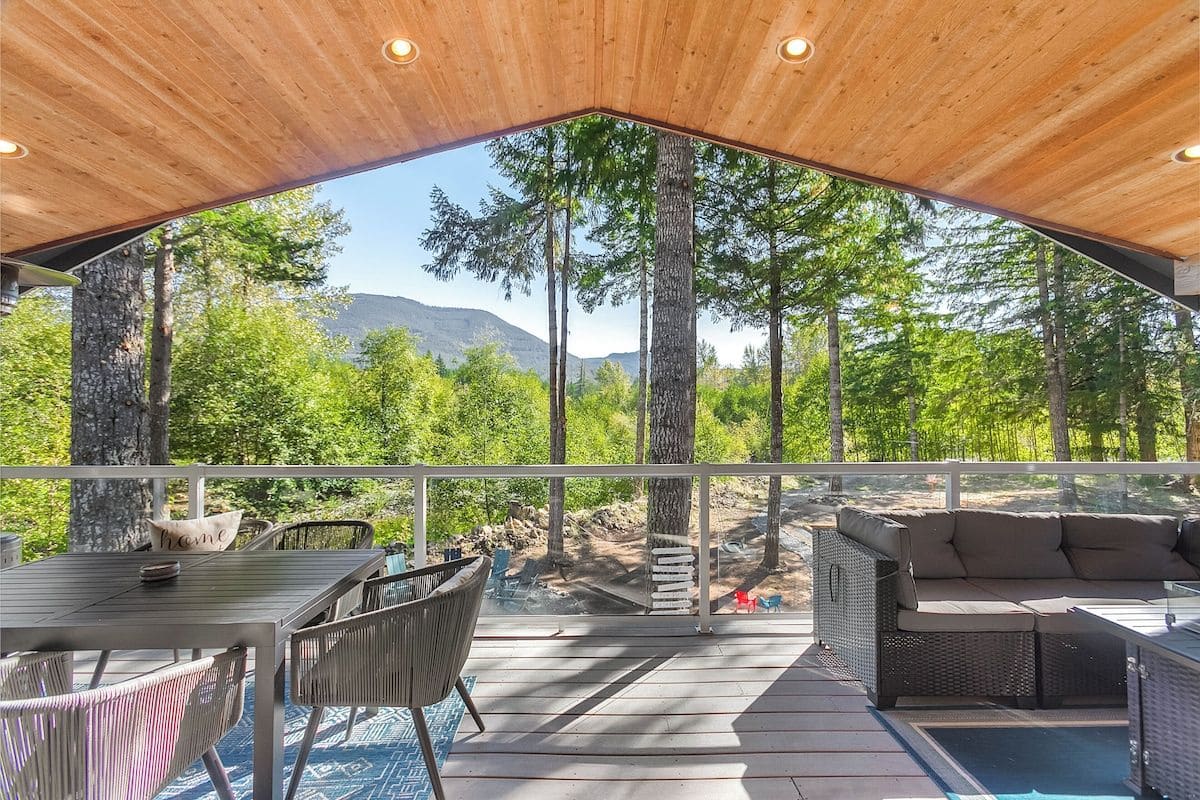
This approach to forest dwelling appears in various forms across the region. Another cabin in Packwood takes the classic A-frame silhouette, that 1960s mountain architecture that has experienced renewed appreciation, and fills it with wood-paneled walls and textiles that reference the Pacific Northwest's weaving traditions. The wide deck extends the living space into the trees. Morning coffee becomes a ritual of observation: the way light moves through branches, the sound patterns of birds, the subtle shift in air temperature as sun reaches the forest floor.
The tree house accommodates two, the A-frame welcomes seven. Both understand that luxury in this context means yielding to the landscape rather than imposing upon it.
The Nordic Translation
Scandinavian design philosophy has found fertile ground in the forests surrounding Rainier. The affinity makes sense. Both regions share coniferous landscapes, long winters, and a cultural appreciation for wood as material and metaphor. Several newer cabins near the Nisqually entrance translate Nordic wellness traditions into Washington terms.
One two-bedroom retreat pairs cedar sauna with outdoor shower and hot tub, creating a wellness circuit that mirrors Scandinavian bathing rituals. The practice of alternating heat and cold, of moving between indoor and outdoor spaces, of treating the body's relationship to temperature as something worthy of attention, these feel native to a region where weather patterns shift dramatically and where snow can linger on Rainier's slopes even as wildflowers bloom in the valleys below.
The interiors follow suit. Natural wood finishes left largely untreated, picture windows that frame rather than dominate, a color palette drawn from forest and stone. The aesthetic avoids the over-designed quality that can plague mountain properties, where every surface announces its carefully considered rusticity. Here, the design recedes. The forest advances.
Gathering Spaces and River Access
Larger properties near Packwood acknowledge a different need: the multi-generational gathering, the friend group seeking shared experience, the family reunion that requires both communal areas and private retreat. A three-bedroom cabin on five acres bordering the Cowlitz River offers the infrastructure for group dynamics. Hot tub and firepit for evening congregation. Game room with ping-pong and shuffleboard for rainy afternoon entertainment. Three bathrooms to prevent the bottlenecks that can strain group travel.
Another property along the same river provides private beach access, that rare commodity in forested mountain terrain. Four bedrooms and a bocce court suggest the leisurely pace of a different sort of mountain experience, one where the park itself becomes optional, where the retreat location holds sufficient appeal to anchor the entire stay.
We've noticed this shift in how travelers conceptualize mountain time. The relentless summit-chasing has given way, for some, to a more contemplative approach. The willingness to spend a full day on the property, to measure the visit in riverside hours rather than trail miles, represents a maturation in how luxury and wilderness intersect.
Historic Timber and Stone
Two lodgings carry the weight of history. Copper Creek Inn, built in 1919 by a lumber baron when the region's old-growth forests were being systematically harvested, now sits beneath towering evergreens that survived that era. The log cabin construction, the sense of a mountain camp from another century, the restaurant that has operated continuously longer than any other in Washington, these elements create a specific nostalgia. The blackberry pie mentioned in local lore functions as edible heritage.
Inside the park itself, Paradise Inn occupies an elevated position both literally and culturally. Built in 1917, the 121-room lodge operates seasonally from May through September, when snow has retreated enough to allow access. The timber beam construction, the massive stone fireplace, the cedar furnishings and historic photographs all preserve a particular vision of national park hospitality. No Wi-Fi penetrates these walls. The absence feels intentional, a reminder that certain landscapes demand full attention.
The location justifies the name. Paradise sits surrounded by the wildflower meadows that draw photographers and botanists each summer, when alpine species bloom in concentrated bursts of color against glaciated backdrop. To stay here is to wake inside the postcard, to have immediate access to trails and waterfalls without the drive from external lodging.
Wellness as Structure
Paradise Village Lodge, despite its name proximity to the in-park location, sits just outside the Nisqually entrance and takes a different approach entirely. The property spreads across leafy acreage as a small village: cabins, A-frames, and lodge rooms clustered but separate. The wood-fired sauna and hot tub heated over open flame return to pre-industrial methods of generating heat, a deliberate rejection of electric convenience in favor of fire and smoke and the labor of tending flame.
The property also offers bee therapy, a practice where guests rest on specially designed beds placed in sealed structures above active hives. The vibration and frequency of bee activity, channeled through the bed frame, purports to offer therapeutic benefit. Whether the science holds or the ritual simply provides permission for profound rest becomes almost secondary. The willingness to experiment with wellness modalities that feel specific to place rather than imported from distant spa traditions marks these properties as something other than standard mountain lodging.
The on-site restaurant serves Ukrainian specialties, an unexpected culinary choice that somehow works. Borsch and sour cherry pierogi after a day hiking Rainier's trails creates the sort of cultural juxtaposition that defines much contemporary travel. We are no longer seeking authentic regional cuisine in every location. We are seeking good cooking, thoughtfully prepared, wherever it originates.
The New Mountain Lodge
Gravity Haus Alta Crystal represents the most contemporary iteration of mountain hospitality in the region. Set near Crystal Mountain Resort, the property functions year-round, serving summer hikers and winter skiers with equal facility. Heated pool and hot tub, reliable Wi-Fi, a camp store stocked with trail provisions, fireplaces in rooms with mountain views. The amenities list reads like a direct response to what modern travelers expect from mountain lodging: comfort without sacrificing access, connectivity without compromising immersion, services that anticipate need without hovering.
The brand operates multiple mountain properties across the American West, each calibrated to its specific location. The Alta Crystal version acknowledges Rainier's dual seasons, the way the landscape transforms from wildflower meadow to snow-covered slope, the way visitor needs shift accordingly. Summer guests prioritize trail access and evening relaxation. Winter visitors want ski-in proximity and warming rituals. The property accommodates both without feeling schizophrenic in its identity.
What the Lodgings Reveal
Taken together, the accommodations surrounding Mount Rainier National Park map a larger conversation about how we inhabit wilderness edges. The tree houses and Nordic saunas suggest intimacy with landscape. The historic lodges preserve a particular vision of mountain heritage. The larger group properties acknowledge that nature experience often happens in social context. The wellness-focused retreats propose that physical restoration and landscape immersion are complementary rather than separate pursuits.
The park itself, with its glaciers and waterfalls and meadows, remains the primary draw. But the lodgings have become more than functional necessity. They represent different philosophies of retreat, various answers to the question of how we position ourselves in relation to a landscape this commanding. Some travelers want to disappear into the forest, to minimize their footprint both literally and architecturally. Others seek gathering spaces where mountain experience becomes shared narrative. Still others prioritize wellness infrastructure, the sauna and hot tub and massage table as essential as the hiking boot and trail map.
Mount Rainier endures through these shifting preferences. The glaciated peak maintains its presence across western Washington, visible on clear days, defining the horizon even when clouds obscure the summit. The mountain is out, or it isn't. The lodgings that ring its base offer shelter and interpretation, places to rest between encounters with a landscape that has outlasted every structure humans have built in its shadow, and will outlast every structure we have yet to build.