The In-Between Seat: A Case for Premium Economy on Long-Range Routes
As business-class fares climb beyond reach, a select group of carriers have reimagined the middle cabin with seat design, dining, and ground perks worth the upgrade
A Window Seat Above the Pacific
Somewhere over the Pacific, thirty-eight thousand feet above dark water, you notice the space around you. Not the sprawling suite of business class, not the pressed-knee geometry of economy, but something measured and intentional. Your legs stretch forward onto a calf rest. A throw pillow the size of a small dog sits beside you. The tray table holds a ceramic plate, not plastic, and the wine list includes vintages you recognize. This is premium economy in 2026, and for travelers who watch their budgets as carefully as their itineraries, it has become the intelligent compromise.
At Global Chic Voyage, we have watched this cabin category mature from afterthought to considered product. Where it once meant an extra inch of legroom and a marginally better meal, premium economy on select carriers now delivers separate check-in, lounge access, seat engineering borrowed from business class, and dining programs curated by name chefs. The question is no longer whether premium economy is worth the surcharge. It is which carriers have built a version worth your money.
The Carriers That Redefined the Middle
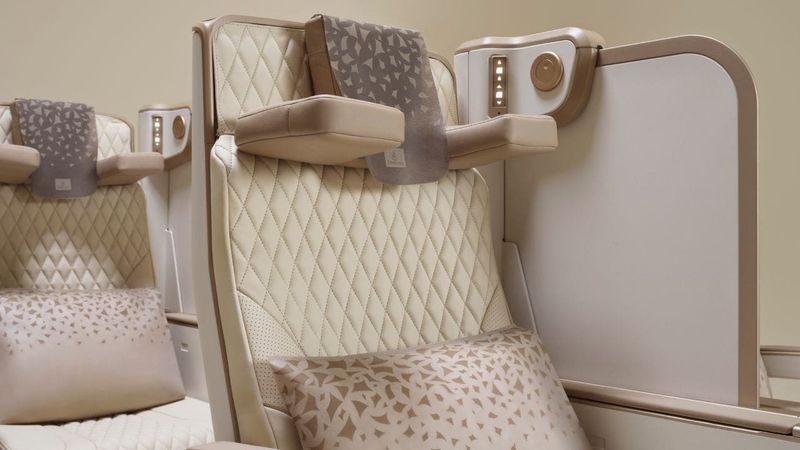
Emirates introduced its premium economy cabin in 2021, rolling it out first on Airbus A380 aircraft and select Boeing 777s. The carrier now offers the product on more than thirty routes connecting Dubai with cities across the United States, including New York, Los Angeles, San Francisco, and Houston. The design borrows directly from Emirates' business class: cream leather with contrast stitching, wood accents, a 13.3-inch entertainment screen, and a side cocktail table. Meals arrive on Royal Doulton china with stainless steel cutlery, and the menu includes a dish tied to the flight's destination, such as Thai pepper beef with jasmine rice. The wine list mirrors business class, including a 2012 vintage Chandon not available in the rear cabin.
Qantas has installed premium economy on its Boeing 787 Dreamliners and Airbus A380s in a dedicated section separate from economy, with thirty-two to forty seats in a two-three-two layout. The seat recline is engineered to move forward and upward rather than simply tilting back, elevating legs and spine into a posture the carrier describes as more ergonomic. Passengers receive noise-canceling headphones, a wool blanket, and meals served on tableware designed by David Caan. The cabin is available from thirteen airports, including Dallas-Fort Worth, New York JFK, and Honolulu.
All Nippon Airways offers lounge access to premium economy passengers at Tokyo Haneda, Tokyo Narita, Osaka Kansai, and Honolulu. The carrier is introducing updated seats on new Boeing 787-9 aircraft beginning November 2026, with forty inches of pitch and nine inches of recline, each an improvement of two inches over the previous generation. The entertainment screen measures 15.6 inches with Bluetooth connectivity and USB-C charging. In-flight service includes selections from the business-class drink menu, among them Champagne, sake, Umeshu plum wine, and shochu, as well as the carrier's homemade bread and access to snacks like petit fours and cup noodles typically reserved for forward cabins.
Virgin Atlantic's Premium cabin, available on Airbus A330 and A350 aircraft as well as Boeing 787-9 Dreamliners, offers seats up to twenty-one inches wide with seven to eight inches of recline and up to thirty-eight inches of pitch. Passengers receive a welcome glass of sparkling wine, a meal service that includes a starter and main course on china, and, on select flights, the carrier's afternoon tea service with sandwiches, tea cakes, and warm scones with jam and clotted cream.
Singapore Airlines has equipped its A350, A380, and Boeing 777 fleets with premium economy seats measuring up to 19.5 inches wide with an eight-inch recline, calf and foot rests, and dual USB ports. The A350-900ULR configuration includes six single seats, approximating the privacy of business class. The carrier extends its "book the cook" service to premium economy passengers on flights from twenty-seven cities, allowing advance meal selection from dishes created by Singapore's International Culinary Panel.
Cathay Pacific's Aria premium economy cabin, introduced in 2025 alongside a redesigned business class, features forty-eight seats in a two-four-two layout with thirty-nine inches of pitch, 19.5 inches of width, and eight inches of recline. Each seat includes a calf rest, foot rest, privacy wings, and a 15.6-inch screen with Bluetooth audio pairing. The cabin has its own lavatory with touchless features, and passengers receive a welcome drink, a menu of Cantonese and international cuisine, priority boarding, and two free checked bags.
Air France renamed its premium economy cabin simply "Premium" in fall 2024 and began installing new seats that recline to 124 degrees with thirty-seven to thirty-eight inches of pitch and an adjustable footrest. The seat foam has been redesigned and topped with herringbone fabric. By the end of 2025, Air France expects the new seats to be installed on eighty percent of its fleet. Meal service includes a glass of Champagne, followed by snacks, a starter, a choice of two hot dishes, cheese, and dessert served on eco-designed tableware with stainless steel cutlery, finishing with French patisserie such as Paris-Brest and chocolate fondant.
Lufthansa's Allegris premium economy seats feature hard-shell backing that allows recline without impacting the passenger behind, thirty-nine inches of pitch, and on average fifty percent more space than regular economy, according to Lufthansa. The twenty-four seats are arranged in a two-three-two layout and include a 15.6-inch 4K monitor, wireless charging, leg rests, and noise-canceling headphones.
What Separates a Real Upgrade from a Marketing Exercise
Not all premium economy cabins justify the fare difference. The best products share certain characteristics: a physically separate cabin, priority check-in and boarding, enhanced meal service with real tableware, and seat design that includes not just additional width and pitch but thoughtful engineering like adjustable headrests, leg and calf supports, and recline mechanisms that preserve space for the passenger behind.
Lounge access remains rare but transformative when offered. All Nippon Airways extends this perk at key hubs, turning a long connection into a civilized interval rather than an endurance test. Similarly, carriers that grant priority baggage handling acknowledge that the premium economy passenger values time as much as comfort.
Dining is where the gap between genuine upgrade and window dressing becomes most visible. A meal on ceramic or porcelain, served with metal cutlery and paired with wine from the business-class list, signals a carrier's commitment to the cabin. So does menu customization, whether through advance selection programs like Singapore's "book the cook" or regional dishes that reflect the flight's destination, as Emirates does.
Seat width and pitch matter, but the quality of recline matters more. Qantas and Lufthansa have both invested in mechanisms that allow deeper recline without encroaching on the passenger behind, a detail that transforms sleep quality on overnight flights.
The Economics of the Middle Cabin
Premium economy exists because airlines need to fill the revenue gap between economy and business class. For the carrier, it extracts higher yield from passengers unwilling or unable to pay business-class fares. For the traveler, it offers a tolerable long-haul experience at a fraction of the cost of a lie-flat seat.
The math works when the fare difference is proportional to the experience difference. A premium economy ticket priced at one hundred fifty to two hundred percent of an economy fare, paired with a product that delivers meaningfully better comfort and service, represents rational value. When the surcharge climbs higher, the argument weakens unless the business-class alternative is priced beyond reason.
What we have observed is that premium economy has pushed carriers to compete on design and service in ways that benefit the entire fleet. The seat engineering, the attention to meal presentation, the acknowledgment that passengers value ground-time efficiency as much as in-flight comfort, all of these lessons migrate across cabin classes.
Choosing the Cabin That Fits the Journey
For routes longer than eight hours, premium economy makes sense when business class is out of budget and sleep matters. The additional recline, the leg support, the quieter cabin, and the better meal all contribute to arriving in a state closer to functional. For shorter flights, the surcharge is harder to justify unless ground perks like lounge access or priority boarding align with a tight connection.
The carriers that have built the strongest premium economy products treat the cabin as a standalone experience rather than an economy-plus add-on. They design dedicated spaces, train crew to deliver differentiated service, and invest in seat hardware that performs across a long flight. Emirates, Qantas, All Nippon Airways, Singapore Airlines, and Cathay Pacific have each built versions worth considering. Air France and Lufthansa are moving in that direction with recent updates.
Premium economy will never replicate the privacy and space of business class. But on the routes where it is done well, it delivers something more valuable: a long-haul flight that does not feel like punishment, at a price that does not require a second mortgage. For travelers who measure value in comfort per dollar, that is the in-between seat worth taking.