The Art of Dining With Grace
Two restaurants on opposite sides of the Atlantic offer lessons in the enduring pleasure of formal service, and why hospitality need not be tangled in nostalgia.
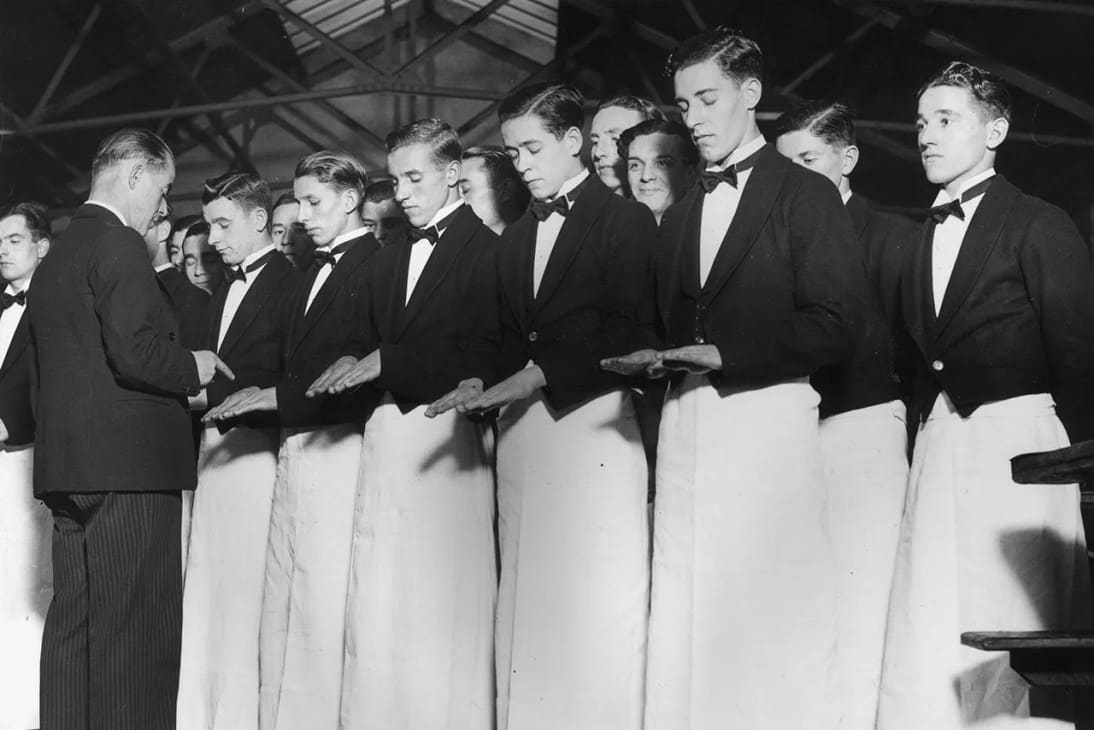
The Return of the Silver Boat
The Dover sole arrives with ceremony. A waiter fillets it tableside, each movement precise, while another portions vegetables with the same quiet attention. A third tilts a silver boat until sauce pools onto the plate, the napkin draped over the vessel's handle a small flourish of tradition. At Oslo Court, the St John's Wood dining room that has operated since 1982, lunch unfolds as a kind of state visit, complete with linen tablecloths, attentive refills, and the conspicuous absence of QR codes.
By the measure of contemporary dining, this ought to feel antiquated. Yet the room hums with a particular pleasure, one that comes from being looked after with skill and without irony. Tony and José Sánchez, who took over the art deco space more than four decades ago, declined to follow the city's shifting fashions. While London cycled through communal tables, casual waiter-diner dynamics, and the aesthetics of stripped-back simplicity, Oslo Court's dessert trolley continued its rounds. Eventually, the city circled back.
The Pendulum Swings Again
Formal service is having a moment. White tablecloths have reappeared across London. Sommeliers are once again in demand, with job listings reflecting the shift. At 45 Jermyn St, caviar and beef Wellington arrive on trolleys. Maison François introduced a steak-tartare trolley to complement its popular pudding service. Simpson's in the Strand has revived its master carvers to critical acclaim.
The enthusiasm is notable, particularly given the recent past. A decade ago, critics declared the era of hushed rooms and starched linen finished. The argument ran that formal hospitality belonged to a time better forgotten, one bound up with empire, exclusion, and outdated hierarchies. Simpson's, after all, barred women from its Grand Divan until 1984. Progress, the thinking went, meant leaving such trappings behind.
But the swift embrace of yesterday's service suggests something more complicated than progress. British dining culture has long struggled to reconcile the pleasure of being served with the social structures that once defined who served and who was served. The result is a kind of oscillation, a lurching between repudiation and restoration. The tablecloth is stripped away in moral correction, then laid back out with a nostalgic wink. Neither position holds, because neither confronts the question at its centre.
A Third Way
Le Veau d'Or, a nearly century-old bistro on East 60th Street in Manhattan, reopened in 2024 under new stewardship. Lee Hanson and Riad Nasr, the restaurateurs behind Frenchette and Le Rock, took over the space and chose preservation over transformation. The lipstick-red banquettes remain. So does the offal-led menu and the gleaming, unabashed hospitality that defines the Upper East Side original.
The service is almost preposterously attentive, the kind that could only thrive in a culture where the question of service has been largely settled. This is not to suggest that American dining has a spotless history. The restaurant industry in the United States grew out of labour systems marked by profound inequality, and traces of that legacy remain visible. But the American ideal, at its best, holds that the circumstances of birth need not dictate one's place in the world. That belief has allowed restaurants to separate the art of hospitality from the class hierarchies it once reinforced.
The result is a dining culture less burdened by guilt. Tremendous care can be lavished upon a guest, from a bistro in Tennessee to a white-tablecloth room on Park Avenue, without the pretence that such attention confers superiority. One waiter described it plainly: the pursuit of hospitality is a commendable one. It is a craft, not a confirmation of status.
What Formality Can Mean
The distinction matters. In London, each new trend in dining is often treated as a moral correction of what came before, as though the choice were binary: either formal service laden with the baggage of empire, or casualness as a statement of egalitarian values. New York suggests a different possibility. A restaurant can reckon with a complicated history, then decide what is worth carrying forward. Formality need not be nostalgic. Attention to detail need not be exclusionary. The act of serving, when divorced from hierarchy, becomes simply what it is: an offering of care.
Oslo Court and Le Veau d'Or operate in different cities, shaped by different histories. But both have committed to a version of hospitality that is unapologetic without being reactionary. The silver boat, the dessert trolley, the waiter who refills a glass before it is empty - these are not relics. They are choices, made deliberately, about the kind of experience a dining room can offer.
The Pleasure of Being Looked After
There is something to be said for being looked after well. For sitting in a room where the choreography of service is so practiced that it becomes invisible, where the work of hospitality is evident only in its effects: a meal that unfolds without friction, a glass that never runs dry, a sense that someone is paying attention. This is not about returning to a past where exclusion was codified in dress codes and membership lists. It is about recognising that the skills involved in formal service - precision, anticipation, care - are worth preserving, even as the social context shifts.
The question is not whether formal service should exist, but how it can exist without dragging along the inequities it once encoded. The answer may lie in a shift of perspective. Hospitality, when understood as a craft rather than a marker of class, can be both rigorous and generous. It can honour tradition without fetishising it. It can offer pleasure without pretence.
Moving Forward Without Lurching
British dining culture has long been caught between two impulses: a desire to shed the past and a longing to return to it. The result is a cycle that feels less like evolution and more like a pendulum swing. But cycles can be broken. A restaurant can choose formality without nostalgia, care without hierarchy. It can lay a white tablecloth and mean only that the meal will be good, the service attentive, the room a place where guests are welcomed rather than ranked.
Oslo Court has been doing this for more than forty years. Le Veau d'Or has been doing it for nearly a century. Both offer a vision of formal service that is neither reactionary nor apologetic. It is simply hospitality, practiced with skill and offered with grace. That, perhaps, is closer to progress than any pendulum swing could achieve.