The Teahouse After Dark
From late-night ritual spaces to cocktail-bar hybrids, a quieter kind of gathering place is taking root across America.
A Loft in Los Angeles, After Seven
The jazz trio begins just as the first steep finishes. In a warmly lit loft with exposed brick and tall ceilings, guests sprawl across plush cushions, cups in hand, while the music drifts through the room. The tea is herbal tonight, the blend chosen by whichever staff member felt moved to compose it that morning. No laptops. No rush. Just the slow accumulation of conversation and warmth that only happens when a space refuses to hurry you along.
This is Tea at Shiloh, a late-night teahouse founded by Shiloh Enoki in 2022. Guests reserve slots from seven until eleven, and the tea flows freely. Enoki, who spent years in the music industry navigating the louder, more performative corners of nightlife, wanted something softer. A place where strangers might meet without the pressure of being perceived, where the evening could unfold at the pace of a long steep rather than a quick pour.
Tea, she realized, carries a different energy than coffee. Coffee suggests motion, productivity, the grab-and-go rhythm of hustle culture. Tea suggests sitting down for hours. It suggests you might actually listen to the person across from you.
The American Tea Deficit
The United States has never been a tea country, not in the way China or India or Morocco are tea countries. For much of the past century, American tea culture meant iced black tea, sweetened and served in tall glasses, or the occasional mug of Lipton at the end of a meal. The ritual, the variety, the regional depth that defines tea in much of the world simply did not translate.
But that is changing. U.S. tea imports have climbed into the hundreds of millions of dollars this decade, far outpacing figures from thirty years ago. Millennials, in particular, have become the most consistent tea drinkers in the country. Matcha, once a niche offering, is now ubiquitous, having overtaken chai as the dominant specialty tea drink in American cafes. And in the wake of that matcha wave, a quieter question is beginning to surface: what else is there?
The answer, increasingly, is being written in the design of new teahouses. Not the grab-and-go chains that have proliferated in recent years, but slower, more intentional spaces that treat tea as the organizing principle of an evening, not just a beverage.
The Social Architecture of Tea
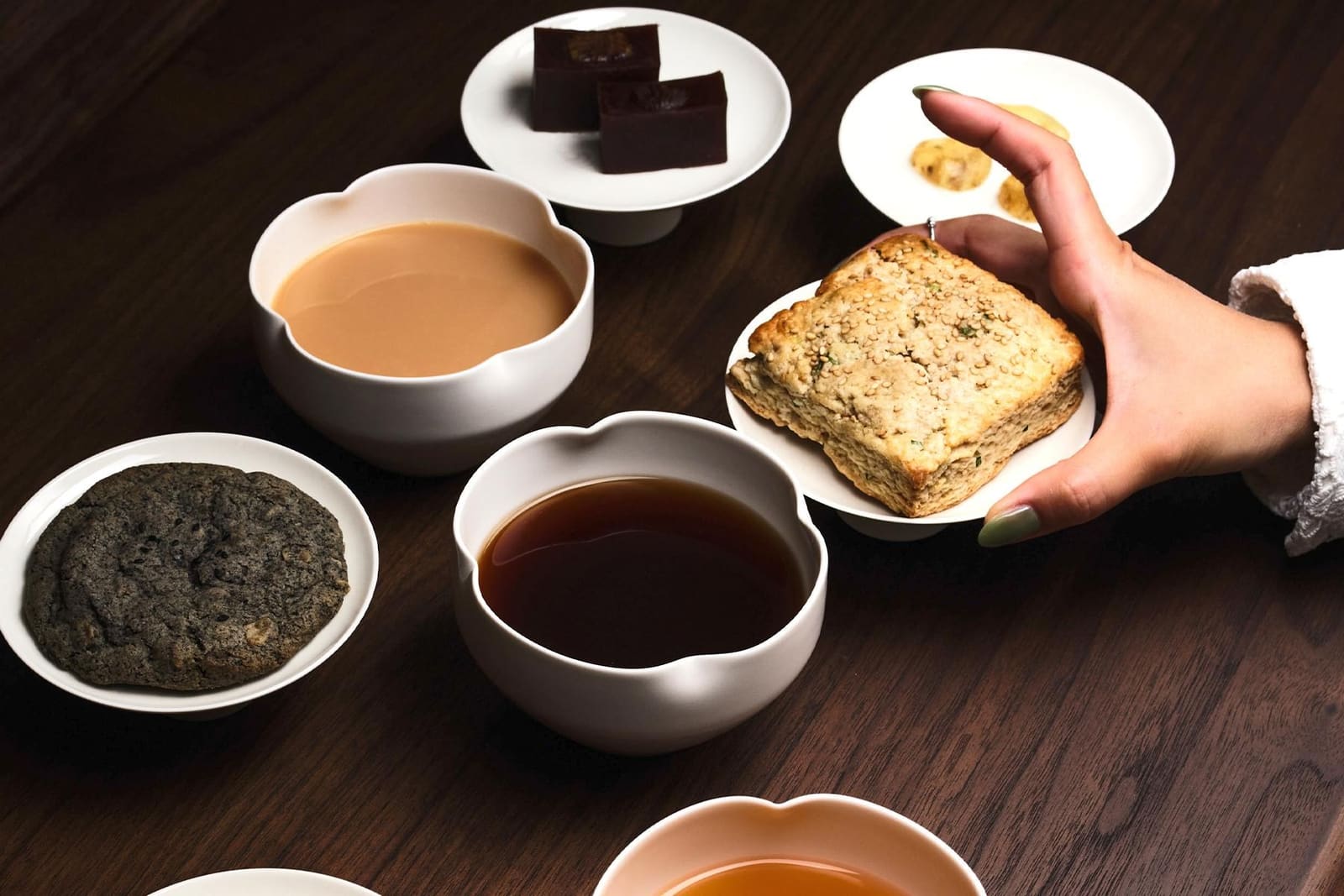
In Chicago, Han Cha opened in July as a tea salon, serving a curated selection of nine teas in the format of British high tea. Guests book two-hour slots and settle in for a procession of small bites and brewed leaves. Taiwanese black tea with notes of quince and orange blossom arrives alongside English cheddar and Korean-style quick pickles. Thai white tea pairs with Japanese curry pimento cheese sandwiches. The format is borrowed from one tradition, the flavors from several others, and the result is something that feels both familiar and entirely new.
Heiji Black, who developed the concept in partnership with artist Theaster Gates, draws inspiration from the teahouses she visited growing up in Korea. Those spaces were never about the tea alone. They were about slowing down, about being social, about the act of sitting across from someone and letting the conversation wander. Han Cha, located in Gates's Stony Island Arts Bank building, attempts to recreate that architecture of attention.
In Manhattan's Chinatown, Soft Hours takes a different approach. The teahouse, which opened in May, is laptop-free by design. Artist Juno Shen built the space around the cultural rituals of the Song dynasty, an era she describes as one in which scholars constructed elaborate practices around the act of slowing down and shifting attention. The menu at Soft Hours is streamlined: jasmine-scented green tea, two styles of oolong (one floral, one roasted over charcoal), black tea with a honey-like body, and a deeply woodsy fermented pu'erh. Every tea can be ordered as an iced latte, a concession to contemporary taste that Shen considers a gentle on-ramp for the uninitiated.
There is no matcha whisked in front of you at Soft Hours, no cold foam, no boba, none of the performance that defines the trendy tea place. What Shen offers instead is range, the suggestion that tea is not a single ingredient but an entire seasonal category with its own geography and history.
From Trend to Terrain
In Kansas City, Missouri, Tian Tea House opened in late 2025. Matcha drinks remain the bestsellers, moving so quickly that co-owner Saranya Hubbard barely needs to advertise them. But Hubbard, who grew up in Bangkok's Chinatown surrounded by the rhythms of Thai tea culture, sees the teahouse as a chance to showcase what lies beyond the matcha moment. Tian brews Chinese gongfu tea, offers classes, and serves lesser-known Thai teas, including one made with hibiscus and bael, a fruit sometimes called golden apple.
At night, the space transforms into Moon, a cocktail bar where tea continues to thread through the menu. Highballs infused with tea, whisky drinks built around matcha. The two concepts share more than a location; they share a premise, the idea that tea can anchor an evening in multiple registers.
The broader expansion of tea culture in the U.S. is perhaps most visible in the rapid growth of Heytea, the Chinese chain that gained international attention for popularizing cheese tea in the late 2010s. The brand did not enter the American market until 2023, when it opened its first store in New York City. It now operates more than forty locations nationwide, offering milk tea boba, fruit teas with inclusions, and black teas finished with fluffy toppings. The chain describes its approach as "new-style" tea, a philosophy that treats tea as a base for experimentation rather than a fixed tradition.
In June, Heytea opened the first U.S. location of its Teabar offshoot, a dine-in concept that serves pots of tea, tea ice cream, and elaborate beverages like jasmine milk tea topped with a "matcha cloud." Unlike the original Heytea shops, which cater to a grab-and-go clientele, Teabar was designed as a place to linger. The crowds that descended on the space in its opening weeks suggest that the appetite for that kind of experience, for tea as ritual rather than refreshment, is real and growing.
Tea Beyond the Cup
The influence of tea is no longer confined to teahouses. Black tea, jasmine, and oolong are reappearing in mainstream chains, not as boba bases but as components of the expanding "refresher" category. Earl Grey, once a staid option in the tea aisle, has experienced a resurgence, showing up as syrups and cream toppings for matcha and coffee drinks. Tea is becoming a freeform flavor element, a note that can be layered into desserts, cocktails, and soft serve.
When Unnecessary, an ambitious new soft serve shop, opened in New York City this summer, its "not-so-plain vanilla" was enriched with osmanthus oolong. Oolong also appears as the grounding base note of the shop's watermelon-mint flavor, developed to be more refreshing than the typical milk tea profile. The choice reflects a broader shift: tea is no longer just a drink to be consumed on its own, but a flavor with enough depth and versatility to anchor entirely new formats.
Nethra Rajendran, a beverage experience developer at Oatly, notes that nearly every culture has a tea tradition worth exploring. The osmanthus and oolong of East Asia. The masala chai and Assam teas of South Asia. The rooibos and kineliba of Africa. The hibiscus of the Caribbean and Latin America. The sweet tea of the American South. What the U.S. is beginning to discover is not tea itself, but the breadth of what tea has always been.
The Living Culture
Back at Tea at Shiloh, Enoki has designed the evening experience around subtle cues. The dim lighting, the communal seating, the presence of games and clay and watercolors, all of it intended to pull people away from their screens and into the room. She does not enforce a no-laptop policy; she simply makes it more appealing to do something else with your hands.
The teahouse, in this sense, is less a business model than a proposal. A suggestion that there might be another way to spend an evening, another kind of space to inhabit, one that does not demand performance or productivity but simply asks you to sit, to steep, to stay a while longer.
Tea has been around for thousands of years, but its American chapter is still being written. What is emerging now is not a single trend but a multiplicity of interpretations, each one testing the question of what tea can become in a culture that has largely ignored it. The late-night loft in Los Angeles. The Song dynasty-inspired sanctuary in Manhattan. The cocktail bar that brews gongfu tea in Kansas City. The chain that treats tea like a cocktail base. The soft serve shop that steeps oolong into its watermelon sorbet.
All of them are part of the same conversation, the same slow realization that tea is not a fixed thing but a living culture, one that changes as it moves through new hands and new geographies. And in a moment defined by overstimulation and the relentless churn of the next trend, the invitation to slow down, to sit with a single cup for an hour or more, feels less like nostalgia than a kind of radical hospitality.