Where Singapore Couples Say I Do: Seven Venues Redefining Island Nuptials
From rainforest canopies to rooftop skylines, the Lion City's newest wedding spaces trade ballroom convention for something far more memorable.
When the Venue Becomes the Vow
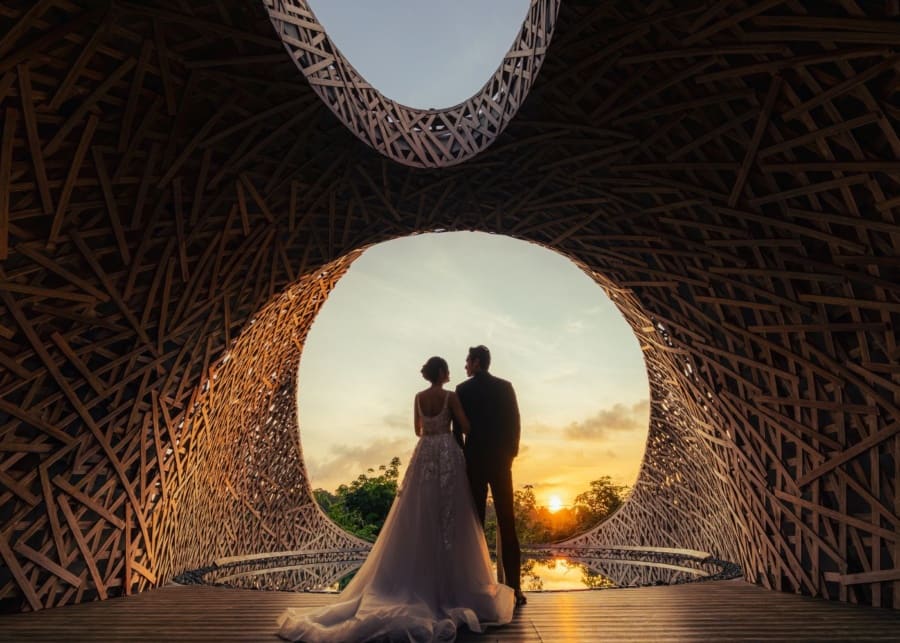
There is a moment, just before the ceremony begins, when a couple stands at the threshold of their chosen space and realizes the setting will shape every memory that follows. In Singapore, that threshold is no longer confined to marble-floored hotel lobbies or predictable banquet halls. Couples are gravitating toward venues where architecture, landscape, and ritual converge in ways that feel less choreographed and more instinctive.
The shift reflects something broader than aesthetic preference. As wedding culture moves away from formulaic grandeur, the venues themselves are being asked to do more than host: they must frame, amplify, and sometimes redefine the experience entirely. What emerges is a new geography of celebration, one that privileges setting as much as ceremony.
The Rainforest as Altar
Mandai Rainforest Resort by Banyan Tree has introduced a wedding proposition that feels less like a hotel booking and more like a passage into another ecosystem. Vows are exchanged beneath a living canopy, with birdsong replacing string quartets and reservoir views stretching beyond the immediate frame. The venue's Meranti Ballroom, designed with the bridal stinkhorn mushroom as architectural muse, features pillarless interiors and four-metre ceilings that allow light and space to breathe.
What distinguishes the offering is its integration with the surrounding wildlife parks. Couples receive exclusive early-morning access to Singapore Zoo, Rainforest Wild Asia, and Bird Paradise for photography sessions among rare species and dense foliage. It is a rare instance where the wedding album becomes a document not just of people, but of place, in its most unvarnished form. The venue accommodates up to 300 guests, with options for rooftop ceremonies overlooking the reservoir, an intimate setting capped at 50.
The River as Witness
Grand Copthorne Waterfront Hotel Singapore has long anchored itself along the Singapore River, but its recent repositioning as a wedding destination leans into that geography with intent. The property offers 33 adaptable spaces, including a pillarless grand ballroom equipped with a 19-metre LED screen and capacity for 550 guests. Smaller ballrooms open onto riverside or city views, framed by expansive windows that blur the line between interior and exterior.
Head banquet chef Ken Poon, drawing on two decades of Chinese culinary tradition, has developed menus that incorporate farm-to-table sourcing, a nod to sustainability that extends to eco-friendly wedding favours. The venue also offers alfresco solemnisations by the water and the option for couples to arrive via river cruise, staging an entrance that is equal parts theatre and geography. Indian and Malay wedding packages, the latter halal-certified, round out the offerings.
The Sky as Backdrop
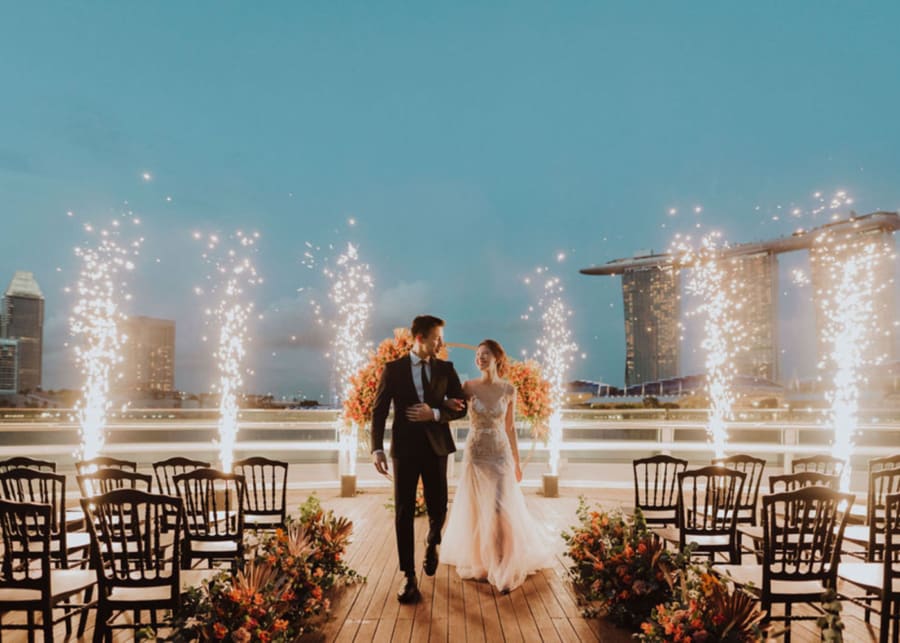
At 34 floors, 1-Alfaro occupies a rare vertical vantage point, where the city skyline and the sea converge without obstruction. The rooftop venue allows for outdoor solemnisations, then transitions guests indoors for a seated meal rooted in Emilia-Romagna culinary traditions. The space holds 150 seated or 320 standing, a flexibility that suits both intimate gatherings and larger receptions.
The venue's appeal lies in its refusal to compete with the view. Decor is minimal, lighting is calibrated to sunset, and the emphasis remains on what unfolds beyond the glass. Event planning, live music, and styling services are available, but the architecture itself does much of the work.
The Orchard Axis
Grand Hyatt Singapore positions itself as a one-stop proposition: ceremony, reception, banquet, after-party, and accommodation under a single roof. Four ballrooms, each with distinct character, offer customisation across scale and aesthetic. The Grand Ballroom features digital panoramic walls; the Grand Salon nods to mansion interiors; the Grand Residence bathes in natural light; and The Gallery leans into artistic minimalism.
Wedding packages span Chinese, Indian, Malay, and Western cuisines, with halal-certified options available. A dedicated planner oversees decor, menu, and logistics, a structure designed to minimize friction. For couples booking the Grand Salon, the package includes a six-course banquet and a one-night stay in the Grand Suite with club access. Intimate celebrations under 100 guests receive tailored perks: customisable layouts, fresh florals, handcrafted cakes, and wedding favours.
The Havelock Corridor
Holiday Inn Singapore Atrium has refurbished its ballrooms with an eye toward versatility. The spaces accommodate up to 40 tables, with AV systems that include laser projections, intelligent lighting, and live streaming capabilities. Themed decor, spanning rustic, romantic, and oriental aesthetics, can be applied for an additional fee.
Xin Cuisine Chinese Restaurant, located within the hotel, handles catering, with signatures like deep-fried soon hock anchoring the menu. Halal-certified and vegetarian options are available. The venue sits three minutes from Havelock MRT station, a logistical detail that matters when guest lists run long. Wedding packages, starting at $1,688 nett per table, include a complimentary bridal suite with breakfast, gown rental discounts, and photobooth services.
The East Coast Enclave
Jia Wei Chinese Restaurant at Grand Mercure Singapore Roxy offers a counterpoint to the grand ballroom model. The second-floor space, warm and understated, caters to smaller gatherings, with the main dining hall holding 120 guests and private dining rooms capping at 25. The restaurant specializes in Nanyang cuisine: braised abalone, roasted chicken, steamed red grouper.
Wedding packages, available for lunch (10am to 4pm) and dinner (4pm to 10pm), include exclusive use of the main hall, a customisable Chinese course menu, wedding favours, a model cake, and a champagne fountain. Private dining rooms double as spaces for solemnisations or tea ceremonies. The venue's proximity to Marine Parade MRT station, directly across the street, simplifies guest logistics. A two-night stay for the couple is bundled into the package.
The Sentosa Shore
Greenwood Fish Market, known primarily for its seafood sourcing, has expanded into weddings at its Sentosa Cove location. The waterfront venue accommodates up to 250 guests, with menus spanning Western, Japanese, and Chinese cuisines, all anchored by fresh seafood. Newlyweds receive a complimentary cruise around the Southern Islands and a one-night stay at the adjacent W Singapore Sentosa Cove.
The venue operates with a network of partners for florals and wedding favours, allowing couples to assemble elements without managing every vendor relationship independently. The appeal is straightforward: a setting where water, food, and celebration intersect without excess ornamentation.
What the Venues Signal
The common thread across these spaces is not luxury, though several qualify, but specificity. Each venue asserts a point of view: the rainforest as ceremony, the river as frame, the rooftop as stage. They resist the templated approach that has long dominated Singapore's wedding industry, where ballrooms blur into interchangeable backdrops.
This is not to suggest that traditional venues have lost relevance. Many couples still gravitate toward the familiar architecture of grand hotels, the predictability of tested logistics, the comfort of knowing exactly what will unfold. But the emergence of these alternatives suggests a growing appetite for settings that carry their own narrative weight, where the venue itself becomes part of the story being told.
As wedding culture continues to fragment and diversify, the role of place becomes less about containment and more about resonance. The question is no longer simply where to host, but what the space itself will say when the vows are spoken and the photographs are framed. In Singapore, the answers are becoming more varied, more ambitious, and less willing to settle for convention.