Singapore's Culinary Constellation Expands in Its Tenth Year
The 2026 Michelin Guide celebrates a decade of dining excellence with new stars, rising talent, and a deeper commitment to sustainability across the island.
A Decade of Stars
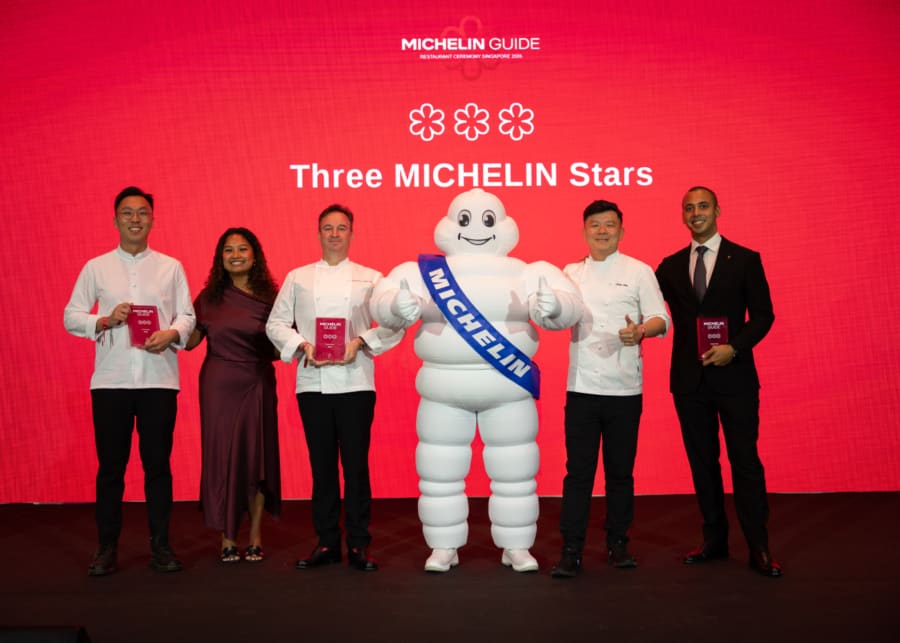
Walk through the doors of Les Amis on a humid Singapore evening, and you step into a room where time seems to slow. For ten years now, this dining room has held three Michelin stars, a feat matched only by Odette, and together they form part of a culinary landscape that has matured from ambitious newcomer to one of Asia's most compelling gastronomic destinations. At Global Chic Voyage, we've watched Singapore's restaurant scene evolve from a city of excellent hawker stalls and hotel dining rooms into something far more textured: a place where tradition and innovation, sustainability and spectacle, coexist in ways that feel uniquely Singaporean.
The tenth edition of the Michelin Guide Singapore arrives with a sense of both celebration and reckoning. The selection now encompasses over 300 dining establishments, a number that speaks not just to quantity but to the island's remarkable culinary density. Among them, 45 restaurants carry the weight of Michelin stars, while 97 Bib Gourmand spots prove that excellence need not come with white tablecloths.
The Pinnacle Holds Steady
At the summit, the three-star tier remains unchanged. Les Amis, Odette, and Zen each retained their highest distinction, a testament to consistency at the most demanding level. For Les Amis and Odette, this marks an unbroken decade at the top, a rare achievement in any culinary capital. Zen, with its kaiseki discipline and seasonal precision, completes a triumvirate that spans French technique, contemporary European expression, and Japanese tradition.
The two-star category, however, saw movement that signals both ambition and recognition. Seven restaurants held their positions: Cloudstreet, Jaan by Kirk Westaway, Meta, Saint Pierre, Shoukouwa, Sushi Sakuta, and Thevar. Each of these kitchens has carved out a distinct voice, from Cloudstreet's Australian-accented inventiveness to Thevar's bold reinterpretation of Indian flavors.
The real drama unfolded with two notable ascents. 1887 by Andre made an extraordinary debut, leaping directly into the guide with two stars and claiming the Opening of the Year award. It's a rare entrance that speaks to the vision of its team and the maturity of Singapore's dining audience. Seroja, meanwhile, earned its promotion after three consecutive years as a one-star restaurant, its elevated tribute to Malay archipelago cuisine now recognized at a higher tier.
New Voices Enter the Conversation
Six restaurants earned their first Michelin star this year, each bringing a different perspective to the table. Cherry Garden by Chef Fei continues the evolution of Cantonese cooking in Singapore, while Jin Ting Wan adds another dimension to the city's Chinese fine-dining landscape. Loca Niru, helmed by young chef Shusuke Kubota, who also received the Young Chef Award, represents a new generation's take on Japanese cuisine. Sushi Kimura+ joins the ranks of starred sushi counters, alongside Tenshima, both contributing to Singapore's deepening appreciation for edomae technique.
Perhaps most telling is the promotion of Yong Fu from the Michelin Selected category directly into the one-star tier, a trajectory that demonstrates how the guide's lower rungs can serve as a proving ground. The remaining one-star restaurants all retained their status, creating a roster of 33 establishments that now define the accessible edge of starred dining in Singapore.
Twelve restaurants have appeared in every edition since 2016, a group that includes names like Candlenut, Cut by Wolfgang Puck, Hill Street Tai Hwa Pork Noodles, and Waku Ghin. This continuity matters. It suggests that Singapore's culinary identity is no longer purely transient, no longer dependent solely on imported talent or fleeting trends.
Sustainability as Standard, Not Statement
Fiz and Seroja both retained their Michelin Green Stars, awarded to establishments that embed environmental responsibility into their operations. These are not restaurants that treat sustainability as marketing, but rather as foundational philosophy. Seroja's regional ingredient sourcing and waste-reduction initiatives, for instance, are inseparable from its culinary identity. The fact that it now holds both a Green Star and two Michelin stars suggests that fine dining's future may lie in this integration, where provenance and technique are equally weighted.
At Global Chic Voyage, we've long argued that luxury and sustainability are not opposing forces. The Green Star category, still modest in Singapore with only two recipients, points toward a broader shift. As diners become more conscious of supply chains and environmental impact, restaurants that lead in this space will likely define the next decade of fine dining.
The People Behind the Plates
Beyond the stars themselves, the guide's special awards shine a light on the individuals who shape the dining experience. Maryjoy Lim of Restaurant Jag received the Service Award, recognition that front-of-house excellence is as vital as kitchen craft. Joe Yang of Jin Ting Wan earned the Sommelier Award, a nod to the increasingly sophisticated wine programs emerging in Singapore's restaurants. Shusuke Kubota's Young Chef Award underscores the arrival of a new generation, one trained in traditional techniques but unafraid to reinterpret them.
These awards matter because they decenter the chef-as-auteur narrative that has dominated fine dining for decades. Great restaurants are collaborative endeavors, and acknowledging service, beverage expertise, and emerging talent broadens our understanding of what makes a meal memorable.
Affordable Excellence Expands
The Bib Gourmand category, dedicated to high-quality food at accessible prices, now includes 97 establishments. Ten new entrants joined this year, spanning hawker centers, kopitiams, and modest shopfronts. Boon Keng Road Fish Head Bee Hoon, Hup Kee Fried Oyster Omelette at Newton Food Centre, and Xiangyee represent the kind of cooking that has always defined Singapore's food culture: ingredient-focused, technique-driven, and deeply rooted in place.
Seventeen establishments have held their Bib Gourmand status across all ten editions, a remarkable record that speaks to both consistency and the enduring appeal of Singapore's hawker traditions. This is not food that chases trends or reinvents itself seasonally. It is food that knows what it is, executed with precision day after day.
The Michelin Selected category, with 165 restaurants, rounds out the guide. These are establishments that may not hold stars or Bib Gourmand distinctions but have earned the guide's endorsement. New additions this year include Belimbing, Gaston, Ingleside, and Sushi Oono, among others. This tier functions as both a discovery tool and a quality benchmark, particularly useful for travelers navigating a city with thousands of dining options.
What a Decade Reveals
A decade is long enough to see patterns. Singapore's Michelin Guide has matured from a validation exercise into something more nuanced: a portrait of a city's evolving culinary identity. The continued prominence of hawker stalls alongside fine-dining temples suggests a food culture that refuses to choose between tradition and ambition. The rise of sustainability-focused restaurants indicates a shift in values. The recognition of young chefs and service professionals points to a deepening talent pool.
At Global Chic Voyage, we've traveled to Michelin-starred cities across the globe, and what strikes us about Singapore is its density of excellence. In a city-state of fewer than six million people, the concentration of high-level cooking, across price points and cuisines, is extraordinary. The tenth edition of the guide doesn't just celebrate individual restaurants. It documents a moment when Singapore's dining scene has fully come into its own, no longer derivative of other capitals but distinctly, compellingly itself.
Whether you're planning a meal at one of the three-star temples or hunting down a Bib Gourmand gem in a neighborhood hawker center, the 2026 guide offers a map to a city where food remains the most democratic form of luxury. And as the guide enters its second decade, the question is no longer whether Singapore belongs in the conversation about global culinary capitals. It's what the city will do with that position, and how its chefs, servers, sommeliers, and hawkers will continue to redefine what it means to eat well.