
Shadow Lovers: The Travelers Who Plan Their Lives Around Eclipses
From Singapore to Spain, a growing tribe of umbraphiles is rewriting the rules of celestial travel - chasing fleeting moments of totality that last seconds but linger for lifetimes.
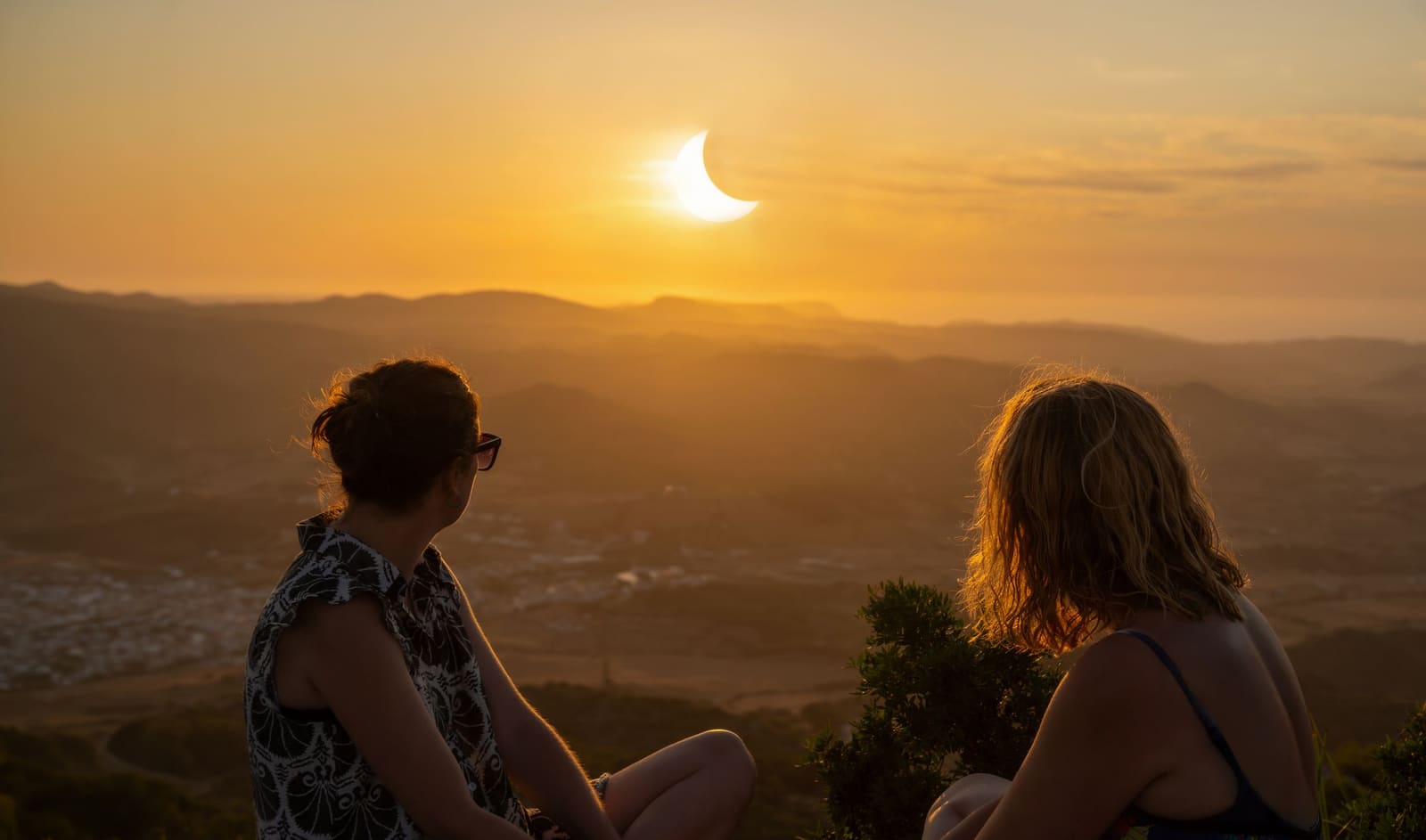
The First Glimpse Changes Everything
Koh Joo Beng stood somewhere in China eighteen years ago, watching the moon edge between Earth and sun. He had come as an astronomy enthusiast, curious but measured. What happened next wasn't scientific. The sky dimmed, the temperature fell, and he felt something shift inside him - a recognition that this was not simply a phenomenon to observe but an experience that demanded witness. Since that August day in 2008, Koh has traveled to fourteen eclipses across the globe and co-authored a book with his son about the 2026 total solar eclipse. He has joined the ranks of what umbraphiles call themselves: shadow lovers, people who organize their calendars and passports around the precise moments when the moon covers the sun.
At Global Chic Voyage, we've watched this tribe grow. These are not casual sky-gazers. They are travelers who book flights a year in advance, who study cloud-coverage data like sailors reading tide charts, who will miss their children's first day of school or reroute honeymoons to stand in the path of totality. The August 12 eclipse, visible from east Greenland, western Iceland, and northern Spain, has drawn an estimated 460,000 overseas visitors to Spain alone, with another 128,000 heading to Iceland. Flight bookings are up twenty-five percent year-on-year for both destinations. Bilbao, a city more accustomed to Guggenheim pilgrims, is bracing for an astronomical surge.
The logic seems absurd on its face. Travel thousands of miles, navigate congestion, pay premium rates - all for an experience lasting ninety seconds in some locations. Yet those who have stood beneath totality describe it with the language of conversion. Once you see one, they say, you want to see them all.
A Sun You've Never Known
Most of us encounter the sun in its gentler hours, at dawn or dusk when it softens into orange and can be admired without pain. Totality offers something else entirely. When the moon's disk slides perfectly in front of our star, it reveals the corona - the sun's outer atmosphere, a fiery halo invisible under normal conditions. Only then can you remove your eclipse glasses and stare directly at what is usually forbidden.
Astrophotographer Marc Rassel, based in Minnesota, has chased eclipses since 2017. He describes the sensory cascade: the light turns strange, a three-hundred-sixty-degree sunset encircles the horizon, the temperature drops sharply, birds begin their evening songs in the middle of the day. For his first chase in Wyoming, Rassel made a deliberate choice. He left his camera in the bag. As a professional astrophotographer, the decision felt radical, but he knew the advice was sound: see the first one with your eyes, then photograph the rest. The instinct to document can eclipse the experience itself.
Cardiff-based astronomy journalist Jamie Carter, who co-authored a book on eclipse culture, has pursued these alignments from Chile to Australia since his first in 1999. This year he's lecturing aboard a cruise to east Greenland, hoping to witness totality surrounded by Arctic wilderness. The corona, he says, is what you come to see - the most beautiful thing, a sight that justifies the journey no matter how inconvenient the path.
The Human Constellation
The astronomical marvel is only half the story. Umbraphiles speak just as passionately about the human dimension - the collective gasp, the strangers who become companions in awe, the children who skip school for a science lesson no classroom can offer.
Allyson Bieryla, an astronomer at Harvard's Center for Astrophysics, recalls her first eclipse in Wyoming in 2017. People cheered, cried, stood with jaws open. The emotional weight surprised her. She has since worked to co-launch LightSound, an open-source device that translates the eclipse's shifting light into sound, making the phenomenon accessible to blind and low-vision communities. The project expands the circle of who can participate in this particular form of wonder.
Chicago-based astrophotographer Jeff Pfaller leads eclipse-chasing trips and brought his children to the 2017 event in St. Louis. They missed their first day of school, but the trade felt more than fair. Watching from a bird sanctuary, they observed animals behaving strangely as false dusk descended - a real-time ecology lesson unfolding alongside the celestial one.
For nurse practitioner Jessica Madow in Orlando, eclipse chasing entered her life through her astrophotographer husband. Their toddler daughter attended her first chase during the 2023 annular eclipse in New Mexico, delighted by the moon-shaped shadows and the novelty of eclipse glasses. Now the family reads eclipse books together in preparation for Spain, hoping their daughter will begin to understand what they're witnessing, though the trip will be worthwhile regardless.
Koh's eclipses have become full family productions. In 2023, he, his wife Janet, and their sons traveled to Exmouth, Australia, for totality - a trip that ended with one son proposing to his now-fiancée beneath the shadowed sun. This August, Koh is aboard a cruise in the Bay of Biscay off Spain's northern coast with over a dozen family members and friends. Passing on the sense of wonder, he says, has become the most rewarding part of the chase.
The Geography of Totality
Eclipse paths care nothing for convenience. They trace narrow bands across oceans and deserts, tundra and farmland, pulling travelers to places they might never have considered otherwise. This accidental geography is part of the appeal.
The 2027 eclipse, already generating buzz, will stretch over six minutes of totality - the longest duration until the twenty-second century. Its path crosses Luxor, Egypt, a city with ancient ties to sun worship, now preparing for a modern pilgrimage. Carter will be there as part of a specialized tour, while his 2028 itinerary takes travelers deep into the Australian outback, another astrotourism hotspot where the sky is vast and the light pollution minimal.
Rassel is eyeing northern Morocco for 2027. Pfaller is leading a group to southern Spain for the same event, then pivoting to New Zealand in 2028. Madow and her family are planning their first trip to Sydney for the 2027 Australian eclipse - a dream destination made urgent by the celestial calendar.
These are not destinations chosen for their Michelin stars or UNESCO sites, though many possess both. They are chosen because the moon's shadow will pass over them at a specific time, and that singular fact reorganizes everything else.
The Choreography of the Chase
Veteran umbraphiles have developed a body of practical wisdom. Book early - usually immediately after one eclipse ends, when attention turns to the next. Prioritize group tours, flights, and hotels within the path of totality so you don't need to drive on eclipse day, when roads become parking lots and small towns swell to ten times their normal population.
Arrive several days early to beat the congestion and scout your viewing location. Study historical cloud-coverage data for the eclipse date, though this is more art than science. Weather remains the great unknown, the variable no amount of planning can control. Koh has been clouded out of three of the fourteen eclipses he's chased. Even then, he insists, the experience holds value. The sudden plunge into midday darkness, the rapid temperature drop, the eerie quiet that sweeps over the landscape - these remain memorable even when the corona stays hidden.
Carter emphasizes the importance of positioning yourself within the path of totality, not merely near it. Partial eclipses, however impressive, do not produce the same phenomenon. It's the difference between standing in the rain and standing in the ocean. The corona only reveals itself in totality, and totality demands precision.
The Lure of the Unrepeatable
At its core, eclipse chasing is about embracing the ephemeral. These are not experiences you can revisit at will, not monuments that will stand for centuries or museums with regular hours. They happen once, in one place, for a span of time measured in seconds or minutes. Then they're gone.
This scarcity breeds a particular kind of urgency. Umbraphiles speak of their chases with the intensity of people who understand that opportunities do not repeat, that the alignment of moon and sun and self requires action, not intention. The next total solar eclipse visible from the contiguous United States won't occur until 2044. Spain and Iceland's moment is this week. Egypt and Australia's turn comes in 2027 and 2028. Each path is singular, each totality unrepeatable in that exact configuration.
The hobby - if something this consuming can be called a hobby - creates a strange inversion of travel priorities. The destination doesn't choose the traveler; the shadow does. You go where the eclipse goes, adapting your life to the moon's orbit rather than the other way around. It's a form of surrender, a willingness to let celestial mechanics dictate your movements.
What Returns After Darkness
The umbraphiles we spoke with struggle to articulate what makes totality worth the expense and effort. They reach for metaphors: spiritual, emotional, transformative. They describe physiological responses - tears, chills, a sense of smallness and vastness at once. They talk about the quality of light, the strangeness of the landscape under false dusk, the way time seems to dilate in those final seconds before the sun reemerges.
Perhaps the difficulty of description is part of the draw. In an age when nearly every experience can be photographed, streamed, and shared in real time, totality resists full translation. You can capture images of the corona, record the gasps of the crowd, document the 360-degree sunset. But the thing itself - the felt experience of standing in the moon's shadow - remains stubbornly irreducible.
This is what keeps umbraphiles returning. Not the perfect photograph or the social media validation, but the pursuit of a moment that cannot be fully possessed or replicated, only witnessed. The shadow passes, the sun returns, and you're left with the memory of having stood in the right place at the right time, aligned with forces vastly larger than yourself.
The next eclipse is already on their calendars. The flights are booked, the hotels reserved, the weather data consulted. They will go where the shadow goes, these travelers who have organized their lives around fleeting alignments, who have learned to measure time not in seasons or years but in the intervals between totalities. The moon will slide between Earth and sun, the corona will flare into view, and for ninety seconds or six minutes, the world will be exactly as it should be - strange, beautiful, and worth every mile traveled to witness it.