When Grand Ballrooms Become Tennis Courts: How Luxury Hotels Are Redefining Sport
From courtside Champagne to Olympic coaching sessions, the world's finest properties are transforming athletic fandom into immersive theatre.
The Chandelier Court
Picture a ballroom in Manhattan where chandeliers have witnessed a century of galas, where gilt mouldings frame memories of society weddings and diplomatic dinners. Now imagine that same space transformed overnight into a regulation tennis court, its parquet floor marked with crisp white lines, its air thick with the percussive thwack of felt meeting catgut. This past August, the Waldorf Astoria New York converted nearly 10,000 square feet of its Grand Ballroom into precisely that, a full-size court where professional players rallied beneath crystal while guests in evening wear clutched flutes of Champagne and waited their turn for coaching sessions. The occasion coincided with the US Open, but the real draw was proximity: to the athletes, to the game's kinetic grace, to the communal thrill of watching excellence unfold at arm's length.
It was theatre, certainly. But it was also indicative of a broader recalibration in how luxury hospitality approaches sport. No longer content to simply point guests toward a stadium or arrange tickets, the world's leading hotels are embedding themselves inside the athletic experience itself, offering not observation but participation, not fandom but apprenticeship.
The Economics of Passion
The numbers tell part of the story. The sports-tourism market was valued at $1.16 trillion in 2025, representing roughly 10 per cent of the global tourism economy, according to industry data. But figures alone cannot capture what drives travellers to book a suite in the Maldives not for the lagoon but for a chance to volley with a former Grand Slam contender, or to choose Aspen not for the powder but for the opportunity to cycle mountain passes alongside an Olympian.
What these journeys represent is a convergence of impulses: the pursuit of wellness, the hunger for mental stimulation, the desire for stories worth retelling. Sport, in this context, becomes a medium through which guests can access something increasingly scarce in an age of digital ubiquity: embodied, unrepeatable encounter.
Access as Architecture
At Aspen's The Little Nell, Olympic cyclist Christian Vande Velde leads multi-day camps where altitude becomes both obstacle and pedagogy, the thin mountain air forcing participants to reckon with their own aerobic limits. At The Ritz-Carlton Oahu, Turtle Bay, a collaboration with the Jamie O'Brien Surf Experience allows guests to paddle out to breaks made famous by decades of competition footage, guided by a champion who knows every reef and rip current by name. Tennis enthusiasts can curate their itineraries around personalities: Andy Roddick rallies with guests at Rancho Valencia Resort & Spa in San Diego, while Feliciano López holds court at the St. Regis Maldives Vommuli Resort, his forehand slicing through humid Indian Ocean air.
These are not celebrity cameos. They are structured engagements designed to collapse the distance between spectator and participant, to transform admiration into apprenticeship, however brief. The appeal lies not in autographs but in adjacency, in the chance to inhabit, for a few hours, the same physical and psychological space as someone who has mastered a discipline.
The Suite as Stadium
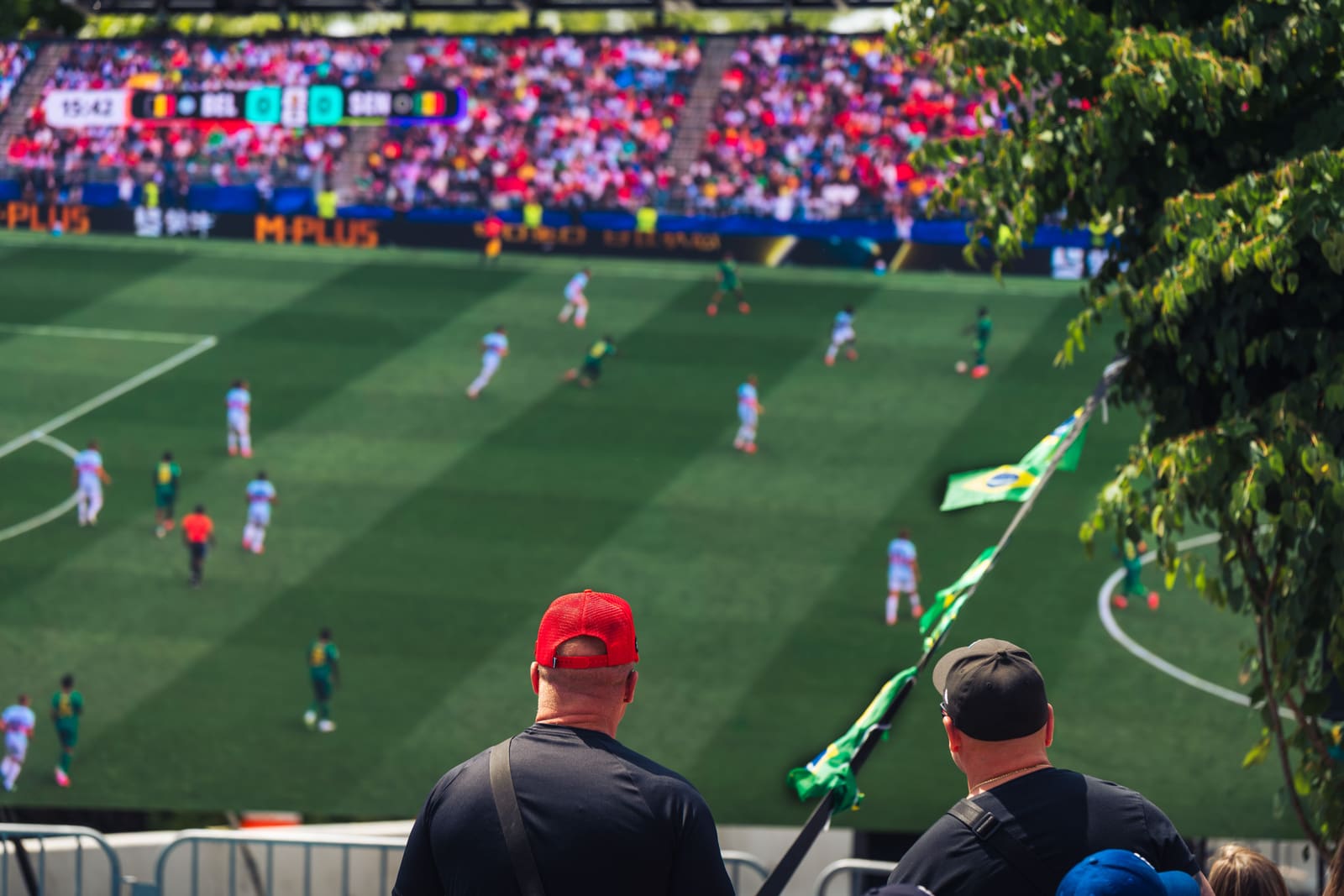
This summer, The Ritz-Carlton New York, NoMad, offered a package that bundled two nights in its 2,100-square-foot suite with four tickets to a FIFA World Cup match between Brazil and Morocco, complete with chauffeur service to the stadium in New Jersey. The suite itself featured a compact gym and a Peloton bike, ensuring that the athletic narrative threaded through every moment of the stay, from pre-match training to post-match recovery.
The logic here is spatial as much as experiential. By anchoring the sporting event within the architecture of the hotel, properties create a seamless continuum: the suite becomes an extension of the stadium, the lobby a kind of pre-game lounge, the restaurant a place to dissect tactics over wine. The hotel, in other words, becomes the frame through which the entire sporting experience is mediated and remembered.
Grass, Whites, and Wimbledon's Ghost
Cultural resonance matters. Jamie Kerr, vice president of luxury marketing strategy at Hilton, speaks of plans to expand tennis programming with the launch of the Waldorf Astoria Racquet Club at the forthcoming Waldorf Astoria London Admiralty Arch, scheduled to open in March 2027. The vision, she explains, is rooted in a specific aesthetic tradition: grass courts, tennis whites, strawberries and cream, long drinks in hand. It is, unmistakably, an invocation of Wimbledon, the tournament that draws half a million spectators annually and whose imagery has come to define a particular strain of English summer elegance.
What Hilton is proposing is not merely a tennis programme but a kind of cultural theatre, an opportunity for guests to inhabit, however briefly, the codes and rituals of a storied sporting institution. "We want to give guests something they can participate in and feel part of," Kerr says, "whether they're holding the racket, watching from courtside, or simply drawn to the energy around the game."
It is that final clause that perhaps best captures the shift underway. Not everyone who books these experiences will be a competent player, or even a particularly passionate fan. What they are purchasing is atmosphere, the chance to be near something vital and kinetic, to feel the pull of collective attention focused on a single point of contact.
The New Spectacle
There is a long tradition of sport as spectacle, of stadiums as modern amphitheatres where thousands gather to witness feats of speed, strength, and strategy. What luxury hotels are now offering is a more intimate variant: spectacle at boutique scale, where the audience is small, the access is close, and the line between performer and observer blurs.
This is not democratisation. These experiences remain expensive, exclusive, designed for travellers who measure luxury not in thread count but in the rarity of encounter. Yet within that narrow band, something genuinely new is emerging. Hotels are becoming curators not just of comfort but of narrative, architects of moments that guests will carry forward as markers of identity and taste.
The Grand Ballroom at the Waldorf Astoria will host galas again, its tennis lines erased, its chandeliers once more illuminating waltzes rather than backhands. But for those who were there that August evening, the memory will persist: the improbable collision of sport and elegance, the sensation of standing courtside while a professional serve whistled past, the knowledge that for one night, at least, the ballroom belonged not to tradition but to motion.