When the Moon Rises: Pan Pacific's Hai Tien Lo Bridges Heritage and Artistry in Mooncake
Executive Chinese chef Edden Yap reimagines Mid-Autumn tradition through lotus paste, tea infusions, and the King of Fruits
A Ritual Worth Returning To
There's a particular quality to late summer in Singapore - a heaviness in the air that signals the approach of the Mid-Autumn Festival, when families gather beneath lantern light and the scent of baked pastry fills homes across the island. At Global Chic Voyage, we've observed this annual pilgrimage toward mooncakes with fascination, not merely as seasonal commerce but as edible tradition, each pastry a compact meditation on heritage.
This year, our attention settles on the collection emerging from Hai Tien Lo, the Cantonese dining room that crowns Pan Pacific Singapore. Under the direction of executive Chinese chef Edden Yap and his brigade, the offering reads less like a product line and more like a carefully considered dialogue between what endures and what evolves in Chinese pastry craft.
The Architecture of Tradition
Begin with what has persisted through generations: the double-yolk white lotus paste baked mooncake. To encounter this pastry is to meet Chinese culinary orthodoxy in its most unapologetic form. The lotus seed paste - laboriously milled, sweetened, and cooked until it achieves that particular yielding density - surrounds not one but two salted egg yolks, their amber centers a study in umami richness against floral sweetness.
The kitchen at Hai Tien Lo also prepares a single-yolk variation, a gesture toward those who prefer their indulgence measured rather than extravagant. Both versions respect the fundamental grammar of Cantonese mooncake making: thin golden crust, dense filling, the interplay of salt and sugar that defines the form.
What strikes us about these traditional offerings is not novelty but integrity. In an era when pastry chefs race toward ever more baroque flavor combinations, there remains something quietly radical about perfecting the template itself, about understanding that certain formulas have endured precisely because they balance on a knife's edge of texture and taste.
Where Tea Meets Pastry
Yet tradition need not mean stasis. Among Hai Tien Lo's more compelling offerings this season is a baked mooncake infused with the restaurant's signature No. 1 Tea, a proprietary blend of leaves and herbs whose exact composition remains closely guarded. The result is a pastry that carries faint aromatic notes - bergamot, perhaps, or chrysanthemum - woven through the filling like a whisper rather than a shout.
Equally intriguing is the roselle with wolfberries and white lotus paste mooncake, where the tart floral character of hibiscus meets the subtle sweetness of goji. This is not fusion for its own sake but a thoughtful exploration of the Chinese medicinal and culinary pantry, ingredients that have appeared together in soups and teas for centuries now finding their way into pastry form.
We appreciate the restraint here. These are not mooncakes that announce their innovation loudly; they require attention, a willingness to notice the layers beneath the initial bite.
The Durian Question
Then there is durian, that polarizing tropical fruit whose creamy, pungent flesh inspires either devotion or revulsion with little middle ground. Hai Tien Lo's snow skin mooncake filled with Mao Shan Wang durian paste - a returning favorite, we're told - represents a distinctly Southeast Asian interpretation of Mid-Autumn tradition.
The snow skin format itself, with its soft, slightly chewy exterior and chilled filling, offers textural contrast to the baked varieties. When that filling consists of premium durian, the experience becomes almost decadent, the fruit's natural custard-like consistency requiring minimal manipulation to become mooncake filling.
This is a pastry that speaks to place, to Singapore's position as both inheritor of Chinese tradition and tropical crossroads where local ingredients inevitably reshape inherited forms. It's also unabashedly not for everyone, which is part of its charm.
The Ritual of Gifting
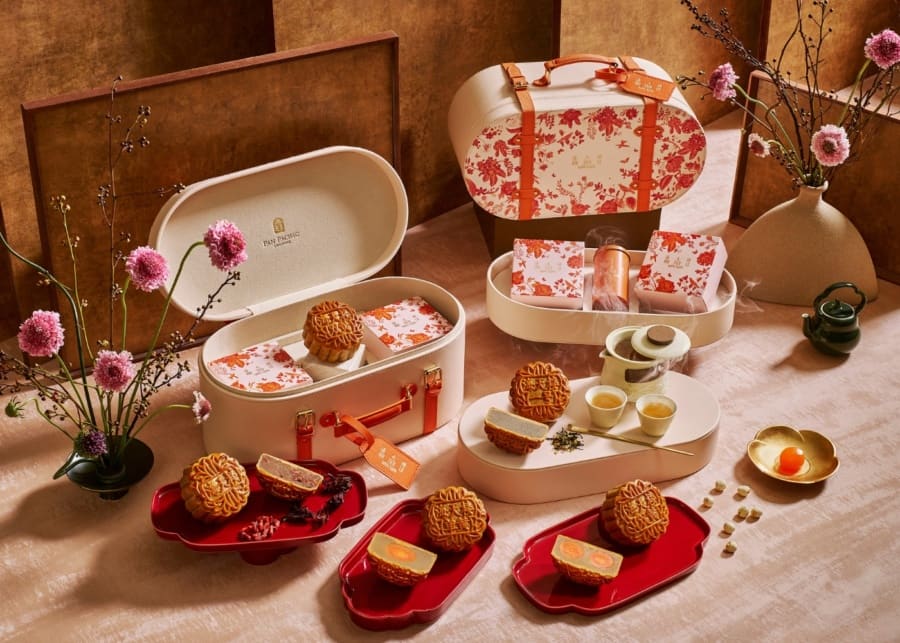
Mid-Autumn has always been as much about exchange as consumption, the giving of mooncakes a gesture that reinforces social bonds and professional relationships. Hai Tien Lo acknowledges this with curated gift sets: a Premium Four Treasures collection that arrives in a two-tiered box accompanied by a teapot, cups, and packets of the restaurant's house tea blend, and a more accessible Classic Four Treasures set in a keepsake container.
Both include one of each baked mooncake variety, a sampler approach that allows the recipient to navigate the full spectrum of the kitchen's work. The Premium version, in particular, stages the entire tea-and-mooncake ritual, providing not just pastry but the implements and leaves to prepare the traditional pairing.
There's something thoughtful in this completeness, an acknowledgment that luxury lies not only in ingredients but in the creation of experience, in enabling a moment of pause and appreciation that might otherwise be rushed or overlooked.
Packaging as Cultural Signifier
We should note the visual language of this year's collection. The boxes bear intricate floral motifs rendered in vibrant hues - a design vocabulary borrowed from traditional Chinese decorative arts but executed with contemporary clarity. This is packaging that understands its dual role: to protect the pastries within and to serve as visual ambassador, the first encounter a recipient has with the gift.
In the luxury hospitality space, where presentation often threatens to overwhelm content, Hai Tien Lo's approach strikes a balance. The packaging announces quality without resorting to ostentation, a restraint that feels increasingly rare.
A Calendar Built on Anticipation
The collection becomes available in mid-August, with orders accepted through late September according to Pan Pacific Singapore. Early reservations receive discounts of up to twenty-five percent, a practical incentive that also serves to manage production flow during what is inevitably the kitchen's most compressed season.
Pick-up occurs either through delivery or at a dedicated booth on the hotel's ground level, operational daily through the festival period. This logistical choreography - the advance ordering, the designated collection window - has become its own ritual, a secular liturgy of urban luxury consumption that marks the season as surely as any lantern.
Why Mooncakes Still Matter
At first glance, the annual mooncake frenzy might seem purely commercial, another manufactured occasion for consumption. But to dismiss it thus would be to miss the deeper currents. These pastries, however commercialized their production has become, remain tethered to something older: harvest celebration, lunar observation, family reunion.
What executive chef Yap and his team at Hai Tien Lo understand - what the most thoughtful practitioners in this space grasp - is that their work exists in dialogue with memory. Each mooncake carries not only lotus paste or durian filling but the accumulated weight of previous Mid-Autumns, childhood tastes, family gatherings beneath the full moon.
To create a contemporary mooncake collection, then, is to navigate between honoring that emotional freight and acknowledging present palates, present aesthetics, the reality that tradition itself has always been a moving target, constantly absorbing new influences while claiming continuity with the past.
As we approach another Mid-Autumn, lanterns already beginning to appear in windows across the city, Hai Tien Lo's collection offers one possible answer to that perennial question: how do we carry forward what matters while remaining alive to the moment we actually inhabit? The response, it seems, arrives in a box - gilded, floral-adorned, filled with pastries that taste of both memory and now.