Where Copenhagen's Two Worlds Meet: A Family Legacy Rebuilt in Glass and Terrazzo
Hotel Hans anchors itself between Nørrebro's creative pulse and Frederiksberg's quiet elegance, turning a 19th-century brick shell into a study in urban observation.
A Threshold Between Neighbourhoods
Stand at the intersection of Åboulevard on an autumn evening and you inhabit two Copenhagens at once. To the north, Nørrebro spills over with experimental kitchens, wine bars tucked into converted shopfronts, and the kind of street energy that pulses through bicycle spokes and late-night conversations. To the south, Frederiksberg arranges itself more quietly: brasseries with linen napkins, concept stores that close at six, tree-lined avenues where the pavement stays dry under canopies of chestnut and linden.
Hotel Hans sits precisely on this seam. The newest property from the Brøchner Hotels group, it occupies a red-brick building designed in the 19th century by Emil Blichfeldt, the architect behind Tivoli Gardens' whimsical pavilions. But where Blichfeldt's amusement park celebrated fantasy, this hotel turns its gaze outward, toward the real theatre of the street.
Named for Hans Brøchner, the family patriarch who co-founded the group's first property in the 1980s, the hotel is both memorial and manifesto. It positions itself deliberately away from the city centre where two other Brøchner properties operate, embracing a neighbourhood scale and a correspondingly accessible price. What it offers instead of central-district polish is proximity to the way Copenhageners actually live: the morning queue at the bakery, the rhythm of commuter traffic, the hum of a city that doesn't perform for tourists.
The Lobby as Urban Stage
Norrøn Architects made the defining move early in the design process: they tore open the lobby facade and installed floor-to-ceiling windows that dissolve the boundary between interior and street. The reference point was Edward Hopper's Nighthawks, that iconic painting of a late-night diner where glass becomes a frame for solitude and connection in equal measure.
Inside, grey terrazzo spreads underfoot, cool and industrial. Above, custom metal light fixtures echo the form of Nørrebro's streetlamps, as if the design had simply invited the neighbourhood's vocabulary indoors. The furniture orchestrates a careful social choreography. A glossy black lacquered oak bench invites conversation. Soft leather booths cradle solo travellers nursing espresso. Walnut chairs, designed by Ari Prasetya to mimic the silhouette of a black cat, cluster around low tables. A canary yellow sofa by Carl Hansen anchors one corner, a chessboard waiting on the surface beside it.
The real performance, though, unfolds at the glass. Copenhagen passes by in waves: the morning parade of cargo bikes loaded with children, the afternoon lull when sunlight slants across the terrazzo, the evening blur of headlights that streak across aluminium wall panels like accidental light art. The city's rhythm becomes meditative here, a backdrop that shifts with the hours.
Graphic neon portraits of Hans Brøchner glow in the windows, designed by his granddaughter Laura Brøchner, now a third-generation hotelier. In the courtyard and corridors, Danish designers Pettersen & Hein assembled sculptures from materials salvaged from Hans's former workshop, small altars to craft and continuity.
Rooms That Remember Vintage Copenhagen
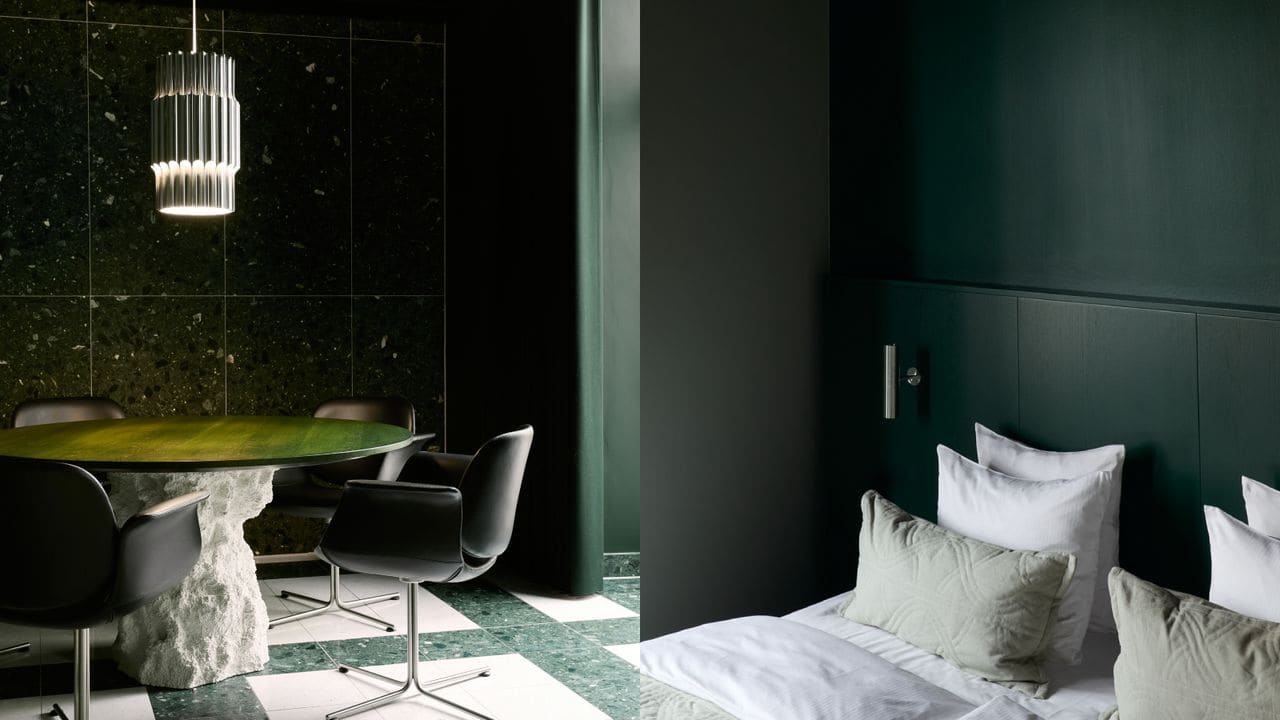
The hotel's 91 rooms and suites channel the aesthetic of older Copenhagen apartments, the kind you might find behind heavy wooden doors in Vesterbro or Østerbro. Dark green ceilings press gently downward. Sage-green walls soften the light. Lacquered cabinets catch reflections without shouting about it. Ege Carpets, patterned with organic motifs, muffle footsteps and add textural warmth.
Poul Hoilund, co-founder of Norrøn Architects, describes the atmosphere as "Negroni-inducing," a phrase that captures the mood better than any checklist of amenities. These are not rooms designed to impress with technology or marble; they are designed to slow you down, to make you want to sit by the window with a drink and a book as the evening settles over the rooftops.
The suites push this domestic fantasy further. Some include mezzanine levels and private roof terraces, transforming the guest experience into something closer to borrowing a friend's apartment than checking into a hotel. Five rooms open onto balconies. Two suites claim their own terraces, small urban gardens suspended above the street.
The simplicity is intentional. In-room services remain minimal. The hotel invests its energy instead in the communal spaces, betting that travellers will prefer the lobby's sociability to the isolation of minibar logistics and room service menus.
The Nightly Rituals
Morning at Hotel Hans begins with a Nordic breakfast buffet that leans generous: barista-pulled coffee, green smoothies thick with kale and ginger, baskets of rye bread still warm, and for those inclined toward celebration, a glass of sparkling wine before noon.
But the lobby truly awakens in the evening, when the hotel introduces its nightly rituals. From five to six, guests receive a complimentary glass of house wine. From nine to ten, the offer shifts to cocktails, including that Negroni Hoilund promised with his colour palette. These aren't marketing gimmicks; they're social architecture, gentle nudges that draw guests out of their rooms and into the shared space where strangers might become acquaintances over a chessboard or a shared observation about the cyclist who just rode past with a cello strapped to her back.
The effect is cumulative. By the third evening, the lobby feels less like a hotel and more like a living room you share with a rotating cast of temporary neighbours.
Nørrebro on Foot
Step out the hotel's front door and Nørrebro unfolds in concentric circles. Within minutes, you can reach Baka d' Busk, where the menu experiments with plant-based ingredients in ways that challenge the category's usual boundaries. Jatak, which earned its Michelin star through disciplined technique and a refusal to over-complicate, sits close enough for a spontaneous reservation. Pompette wine bar offers natural wines and the kind of unpretentious expertise that makes you want to ask questions.
A longer walk, pleasant rather than strenuous, leads through Assistens Cemetery, where Hans Christian Andersen rests beneath a modest stone. The path continues to Jægersborggade, a street that has become shorthand for Copenhagen's independent retail spirit: delis selling house-cured meats, small-batch chocolate makers, restaurants that change their menus with the seasons because they have no choice, sourcing everything within a 50-kilometre radius.
Nørrebro's central park draws locals on weekends, the perimeter lined with pizza counters, beer gardens, and bakeries that sell cardamom buns by the dozen. The neighbourhood wears its creativity lightly, without the self-consciousness that can plague districts trying too hard to be "authentic."
Frederiksberg's Quieter Charms
Turn south instead and the mood shifts. Frederiksberg arranges itself with more restraint: cosy brasseries where the lighting is always flattering, Italian restaurants that take their cacio e pepe seriously, concept stores that curate their shelves like gallery exhibitions. The pace slows. Conversations lower. The streets widen and the architecture gains a certain formality, as if the neighbourhood had agreed on a dress code sometime in the early 20th century and never revised it.
Hotel Hans benefits from this duality. Guests can choose their Copenhagen depending on the day's mood, toggling between Nørrebro's creative ferment and Frederiksberg's composed elegance without ever needing a taxi.
The Materials That Matter
The hotel's material palette speaks to Nordic priorities: quality over flash, durability over trend. Fredericia Furniture and Møbel Copenhagen supply pieces built to last decades, not seasons. The terrazzo, the lacquered oak, the aluminium panels, all carry the matte sheen of things made well and maintained carefully.
This is not minimalism for minimalism's sake, the sterile aesthetic that can make Scandinavian design feel cold. Instead, it's a kind of edited richness, where every object earns its place through function or beauty, ideally both. The canary yellow sofa punctuates the grey and black palette without disrupting it. The neon portraits of Hans glow warmly rather than garishly. The sculptures made from workshop scraps honour craft without sentimentalizing it.
A Hotel for Watchers
Hotel Hans rewards a particular kind of traveller. Solo guests will find it ideal: the lobby offers endless people-watching, the rooms provide refuge without loneliness, and the nightly rituals create low-stakes opportunities for conversation. Families and small groups benefit from the spaciousness, the sense that the hotel can absorb their energy without asking them to whisper or tiptoe.
But perhaps most of all, it suits those who travel to observe rather than to check boxes. The hotel's windows frame Copenhagen as an ongoing performance, one that shifts with the light and the hour and the weather. You could spend an entire afternoon in the lobby, watching the city move past, and feel you'd travelled more deeply than a rushed sprint through landmark after landmark.
The building remembers its 19th-century origins even as it inhabits the present. The family behind it honours its patriarch without turning the hotel into a shrine. The design invites the street inside without sacrificing the guest's need for retreat. These balances, maintained across architecture and hospitality, give Hotel Hans its particular resonance.
Where the City Meets Itself
Copenhagen has long mastered the art of the threshold, those spaces where one thing becomes another without announcement or apology. Canal meets pavement. Royal history meets bicycle infrastructure. Hygge's inward focus meets a cosmopolitan openness. Hotel Hans adds another threshold to the city's collection, a place where two neighbourhoods blur and where the hotel's interior becomes a lens for the urban life beyond its glass.
It's a hotel that understands watching is not passive. To sit in that lobby as the autumn light fades and the streetlamps flicker on, as cyclists stream past and the aluminium panels catch and scatter their passing, is to participate in the city's daily choreography. The hotel doesn't just provide a room for the night. It provides a vantage point, a frame, a way of seeing Copenhagen that feels both intimate and expansive, rooted in a specific corner of Åboulevard yet open to everything the city contains.