A Fireplace of Snow Leopards and Apples: Chef Medeu Rewrites the Mountain Dining Room
In the foothills above Almaty, a 112-square-meter restaurant channels the quiet domesticity of a 19th-century country estate, where ceramic art meets historical recipes and the landscape enters through tile and timber.
A Country House in the Foothills
There is a particular quality to restaurants that feel like homes - not the staged domesticity of a boutique hotel, but the layered accumulation of a space lived in over decades. Chef Medeu, the second address from Almaty's original Chef restaurant, occupies 112 square meters in the foothills near the city's high-altitude skating rink, and it has been designed to feel exactly like that: a 19th-century country estate, compact and collected, where the mountain landscape outside is translated into the objects and surfaces within.
The original Chef has spent over a decade working from an 1881 recipe book, and this second location carries that historical thread forward, though not as nostalgia. Designer Alexandra Tsipkun of Tsipkun Interiors has used the date as a design brief, shaping the interior around the domestic scale and material richness of that period. The result is a room that reads as both historical and entirely present, where the architecture itself becomes a kind of regional storytelling.
The Ceramic Fireplace as Architecture
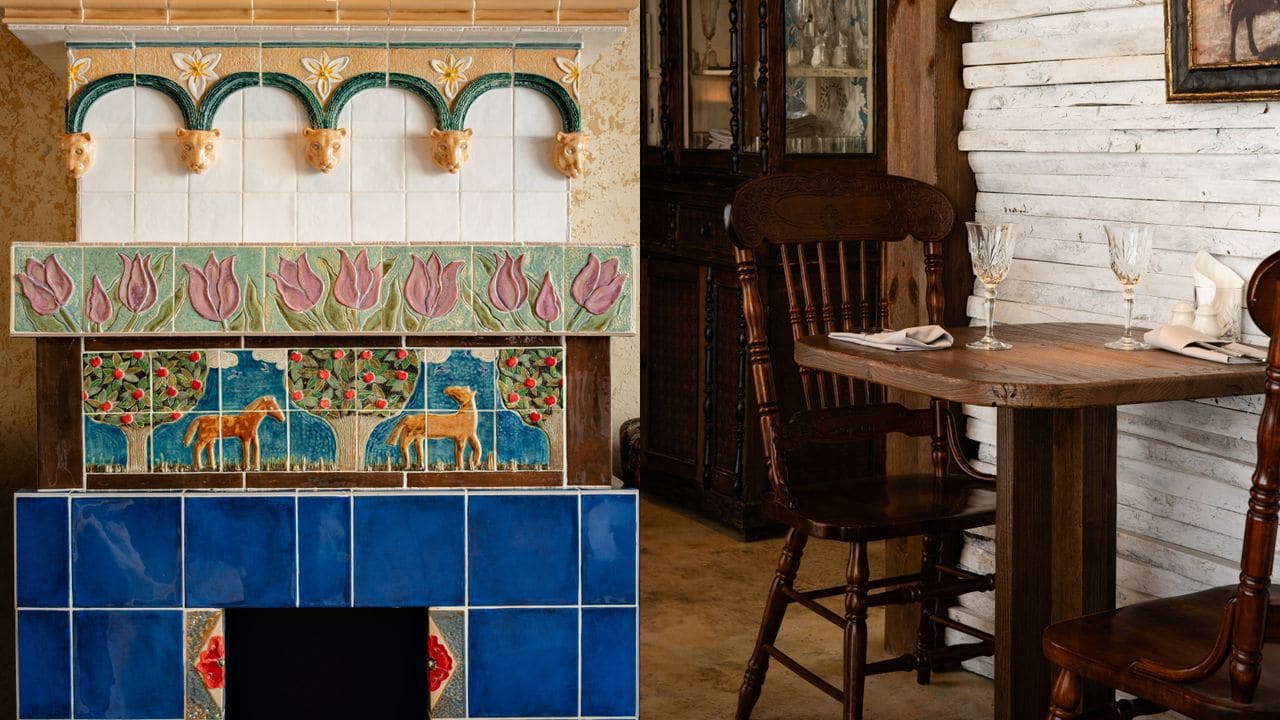
At the centre of the main dining room stands a 2.6-meter ceramic fireplace, and it is the room's anchor. Conceived as an oversized version of a traditional tiled stove, it was assembled from tiles formed and painted by hand by ceramic artist Svetlana Plotnikova. The surface is saturated: blue, green, red. Snow leopards appear alongside apples, swallows, horses, poppies - symbols and fauna drawn directly from the Almaty landscape.
We have watched, over the past few years, a renewed interest in regional craft entering high-design interiors, but this fireplace does something more specific. It does not reference the landscape; it embodies it. The tiles function as a kind of visual compression, pulling the foothills, the endangered cats, the orchards and the steppe into a single vertical plane. It is architecture that narrates place without a single word.
The main room accommodates 32 guests across sofas, armchairs, and tables of varying sizes. An eight-seat communal table can be divided, allowing the floor plan to shift between intimate groupings and shared dining without compromising circulation. Lighting is layered: a chandelier, wall sconces, illuminated shelving, and discreet technical fixtures that direct pools of warm light toward tables and pathways. The effect is less restaurant than drawing room, where the lighting follows the logic of conversation rather than service.
Materials That Mark Time
The custom bar combines metal, beveled mirrors, and an oak marquetry panel. Open shelving holds glassware, tableware, and collected objects, each contributing to the sense that this room has been assembled over time rather than installed in a single moment. Lime plaster marked with patina and craquelure sits alongside brushed timber, rough-sawn decorative beams, and hand-painted window reveals. These are not finishes chosen for their newness but for their ability to carry age, to suggest use and weather and the passage of seasons.
This approach - prioritizing materials that mark time - is something we see more often in European restoration projects than in new-build hospitality. But here, in a restaurant that opened recently, the decision to work with surfaces that acknowledge wear feels deliberate. It aligns the interior with the historical recipes being served, both operating on the principle that age and process add depth.
A Menu Drawn from 1881 and the Steppe
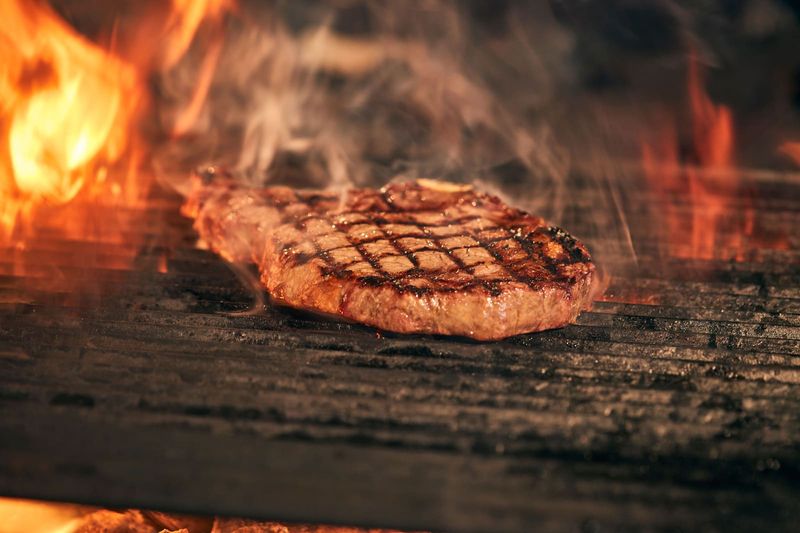
The 1881 cookbook provides the conceptual spine, but the menu itself is wide-ranging. Regional notes emerge most clearly in the game assortment: air-dried and lightly smoked roe deer, venison, and saiga antelope. Pelmeni are filled with veal and horse meat. Horse rib is marinated for 24 hours in spiced broth, then cooked for eight. Oxtail is treated with a contemporary hand, cooked sous-vide, finished on the grill, and glazed with an 18-hour veal jus.
Breakfast arrives as a silver tray composition: pancakes, gravlax, red caviar, whipped butter, scrambled eggs, and a glass of sparkling wine. Later in the day, the restaurant offers its interpretation of a "happy meal" - a truffle burger with potato boats, truffle sauce, sparkling wine, and fresh truffle shaved over everything. It is indulgent in the way that mountain dining often is, where richness is earned by altitude and cold.
Beverages extend the regional thread. Kazakh tea is served with milk and roasted millet. Conifer tea is made with spruce-cone preserve. House infusions range from sea buckthorn to horseradish and garlic. These are drinks that speak to foraging traditions, to preservation methods developed in climates where the growing season is short and every ingredient must be stretched across months.
Why a 19th-Century Estate Still Resonates
At Global Chic Voyage, we have long argued that the most compelling restaurant interiors are those that resist the tyranny of the new. Chef Medeu does this by building its identity around a historical date and a specific landscape, then allowing those two anchors to dictate every material choice, every craft commission, every menu decision. The result is a room that feels both singular and rooted, where the design and the food are in conversation with the same sources.
The use of a hand-painted ceramic fireplace as the room's centrepiece is particularly telling. In an era when many high-design restaurants rely on minimalist restraint or industrial rawness, Chef Medeu opts for maximalism - but a maximalism grounded in regional symbolism and artisan process. The snow leopards and poppies on Plotnikova's tiles are not decorative flourishes; they are a visual language specific to this place, legible to anyone who knows the foothills and the steppe.
This kind of specificity is what separates a restaurant with a strong sense of place from one that simply borrows aesthetic tropes. Chef Medeu does not look like a 19th-century country estate because Tsipkun copied a historical blueprint. It looks like one because she absorbed the principles - domestic scale, layered materials, collected objects, warm light - and then reinterpreted them through contemporary craft and regional symbols.
The Broader Implications for Mountain Hospitality
The opening of Chef Medeu arrives at a moment when mountain dining is undergoing a quiet evolution. Across the Alps, the Caucasus, the Andes, and now Central Asia, we are seeing a shift away from the rustic-chic formula - exposed beams, fur throws, fondue - toward interiors that engage more seriously with regional history, craft traditions, and the specific ecology of their locations.
Chef Medeu is part of that shift. It does not flatten the mountain dining experience into a generic alpine aesthetic. Instead, it draws on the particular history of Almaty, the symbols of Kazakhstan's steppe and foothills, and the material culture of a 19th-century country estate to create something that could only exist in this location. The 1881 cookbook is not a gimmick; it is a framework that allows the restaurant to operate with historical continuity while still serving oxtail sous-vide and truffle burgers.
For travelers, this kind of specificity matters. It signals a restaurant that has done the work of understanding its place, rather than importing a successful formula from elsewhere. It also makes the dining experience more legible - the tiles on the fireplace, the game on the menu, the spruce-cone tea - each element connects back to the landscape outside, creating a coherent narrative that enhances rather than distracts from the meal.
A Room That Narrates Place
In the end, what makes Chef Medeu compelling is not its size or its ambition, but its coherence. Every decision - from the scale of the fireplace to the choice of rough-sawn beams to the inclusion of horse rib on the menu - feels like it emerged from the same set of principles. The restaurant has a clear point of view, and that point of view is rooted in a specific place and a specific historical moment.
This is the kind of restaurant we return to: not because it chases trends or offers the most Instagram-ready composition, but because it has something to say about where it is. The snow leopards on the fireplace tiles, the pelmeni filled with horse meat, the conifer tea made from spruce cones - these are not details chosen for novelty. They are the vocabulary of a landscape, translated into a dining room that feels both intimate and inevitable, as though it had always been there, waiting in the foothills.