Canvas, Cast Iron, and the Statue of Liberty: A Western-Themed Tent on Governors Island
Where antler chandeliers meet harbor views, and a cowboy fantasy unfolds eight minutes from Lower Manhattan.
A Ferry Ride to Somewhere Else
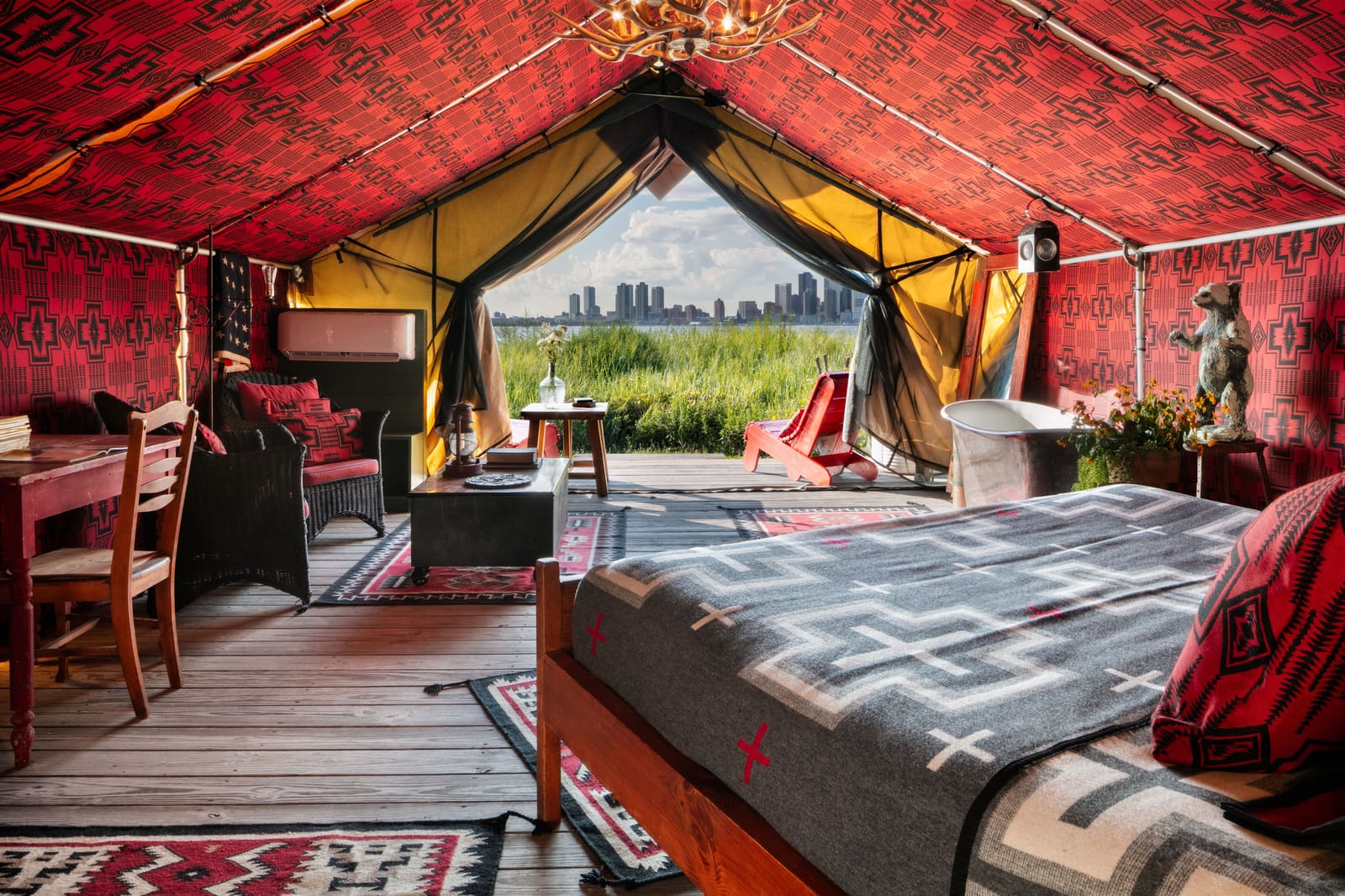
The canvas walls are wrapped in red Pendleton fabric, the kind that suggests high-altitude mornings and woodsmoke. Saddle blankets cover the floor. An antler chandelier hangs overhead. And then you part the tent flap and there she is: the Statue of Liberty, standing in the harbor as ferries carve white lines across the water. The dissonance is delicious. You are eight minutes by boat from Lower Manhattan, but the room insists you are somewhere considerably farther west.
This is the Urban Cowboy Tent at Collective Retreats Governors Island, a 325-square-foot seasonal accommodation that opened for reservations in mid-August for stays through November 2026. It is the only one of its kind among the retreat's 29 tents and container suites, and it represents a collision of two distinct hospitality vocabularies: Collective's breezy, minimal glamping aesthetic and Urban Cowboy's highly curated Western Americana. The result is a space that feels both transported and hyper-specific, a cowboy camp dropped onto an island in New York Harbor.
The Architecture of Nostalgia
The tent was designed by Lyon Porter, cofounder and creative director of Urban Cowboy, through his studio Cowboy Creative, with custom elements by Kevin Jacob Design, including hand-painted stencil work and mounted antlers. The interior is dense with vintage objects: 1920s canteens, a deconstructed camera, old books, a small bear statue. El Paso saddle blanket rugs layer the floor. The headboard is upholstered in the same Pendleton Harding pattern that lines the walls and ceiling, creating a sense of total immersion.
What prevents the space from reading as theme-park pastiche is the deliberateness of the curation. Every object was sourced from regional flea markets, including Beacon Flea Market and Elephant's Trunk, and each carries the patina of actual use. The vintage finds are not props but artifacts, chosen for their texture and history. Above the entrance, a small plaque reads "Camp Cowboy." A pair of horns crowns the doorway. The private deck holds red Adirondack chairs with patterned pillows, positioned to face the water.
The tent sleeps two, with a king-size bed and an en suite bathroom tucked into an adjoining canvas structure. The bathroom itself continues the Western narrative: tribal-patterned robes, more antlers, and a framed desert landscape hung across from the shower, evoking the wide-open geology of New Mexico.
The Tub with a View
The centerpiece of the tent is an antique French cast-iron soaking tub, its surface oxidized and greenish, positioned so that bathers look directly at the Statue of Liberty. A vintage-inspired speaker hangs above. On a nearby chair, handcrafted bath products from Species by the Thousands sit alongside a rubber duckie wearing a tiny cowboy hat.
The tub is both functional and theatrical, a piece of furniture that doubles as a framing device. Open the outer canvas flap, leave the screen zipped, and the harbor becomes part of the interior architecture. The tent sits close to the water's edge, and the effect is one of permeability: the boundary between inside and outside softens, and the city skyline reads less as backdrop than as co-conspirator in the fantasy.
This is luxury stripped of marble and chandeliers, replaced by iron and fabric and the carefully orchestrated interplay of vintage objects. It is also deeply photogenic, designed to reward the eye at every angle. The tent understands that part of the experience is the image of the experience, the story you will tell afterward.
Eating, Drinking, and the Logistics of Canvas
Collective Retreats Governors Island operates Three Peaks Lodge, a restaurant with harbor views where Staten Island ferries drift past in shades of orange. The menu leans coastal and seasonal: crudo, cheeseboards, heirloom melon with prosciutto, roasted chicken. A bottle of wine can be carried back to the tent, where an oversized Yeti cooler waits.
In the evening, firepits on the Great Lawn are set up for s'mores, alongside oversized Jenga and cornhole. Breakfast is a casual buffet: hard-boiled eggs, bagels, pastries, coffee. The food is competent but not the reason to visit. The retreat functions more as a stage set than a culinary destination, a place where the accommodation itself is the experience.
Practical considerations: the tent is air-conditioned, a necessity in August humidity. Sound travels, as it does in all canvas structures. Boats occasionally moor nearby, and music can drift across the water. Earplugs are provided. Lights may need to be plugged in upon arrival, and one outlet sits awkwardly in the middle of the room. Staff circulate the property in golf carts and are available for assistance. Morning departures are easily coordinated; a golf cart can be summoned to ferry guests to the landing in time for the early boat.
The Americana Industrial Complex
The Urban Cowboy Tent is part of a broader cultural fascination with Western aesthetics, a design language that has been extracted from its geographic origins and deployed across a range of luxury hospitality contexts. Pendleton blankets, vintage canteens, antler chandeliers: these objects have become shorthand for a certain kind of rugged authenticity, even when they appear in a canvas tent on an island in New York Harbor.
What makes the tent compelling is not its fidelity to any actual Western experience, but its willingness to lean fully into the fantasy. It does not apologize for its theatricality. It does not hedge. It commits to the bit, and in doing so, it creates a space that feels genuinely transporting, even as the Statue of Liberty insists on the reality of your location.
The tent is available for booking through November 2026 and is expected to return for the full 2027 season, from May through November. It joins a growing roster of highly designed, Instagram-ready accommodations that blur the line between hospitality and art installation, where the room itself is the attraction.
Why It Works
The success of the Urban Cowboy Tent lies in its embrace of contradiction. It is a Western fantasy planted in the middle of New York Harbor, a space that refuses to resolve its own tensions. The antler chandelier and the Statue of Liberty coexist, and neither cancels the other out. The tent does not try to make you forget where you are; it makes you see where you are differently.
This is the logic of luxury glamping in 2026: not escape, but recontextualization. The city is still there, visible through the canvas. The ferries still run. But for a night or two, the story you are living shifts. You are not a New Yorker taking a short ferry ride to an island. You are someone in a cowboy camp, somewhere wooded and far away, who happens to have a very good view.