The Mountain Village Where Travelers Trade Postcards for Hand-Tapped Ink
In Buscalan, a remote Kalinga settlement in the northern Philippines, generations of women preserve an ancient tattooing tradition that turns skin into living archives of place.
A Different Kind of Souvenir
The corrugated roof drums with rain, though it is meant to be the dry season. Fog sits thick over the rice paddies, erasing the horizon. Inside a modest homestay in Buscalan, a village carved into the Cordillera mountains of northern Philippines, a sheet of tribal designs lies spread across a wooden table. Each symbol carries meaning: intersecting arrows for direction, zigzagging triangles for peaks, hourglasses that mark the passage between day and night.
This is not a museum visit. The designs are not relics behind glass. They are options, templates for living marks that will be tapped into skin using methods unchanged for centuries. For a growing number of travelers, the journey to this remote Kalinga settlement represents a pilgrimage of sorts, one that replaces the acquisition of objects with the permanence of embodied memory.
The Architecture of Pain and Beauty
Traditional Kalinga tattooing, practiced by artists known as mambabatok, follows a rhythm dictated by hand and thorn. The instrument is elemental: a single pomelo thorn lashed to a slender bamboo reed. The artist strikes the reed with a wooden baton, driving the thorn into skin in measured, deliberate taps. Charcoal soot mixed with water provides the pigment, rubbed into each fresh puncture.
The sensation moves between sting and electricity. Between taps, there is only the brush of fingers clearing ash, the scent of wet earth and coffee drifting through open windows, the sound of rain against metal. Pain becomes secondary to presence. The process demands stillness, and in that stillness, the village itself settles into focus: the narrow trails lined with palmlike ferns, the mist that clings to every surface, the rhythm of daily life unfolding at a pace the outside world has long abandoned.
A Living Lineage
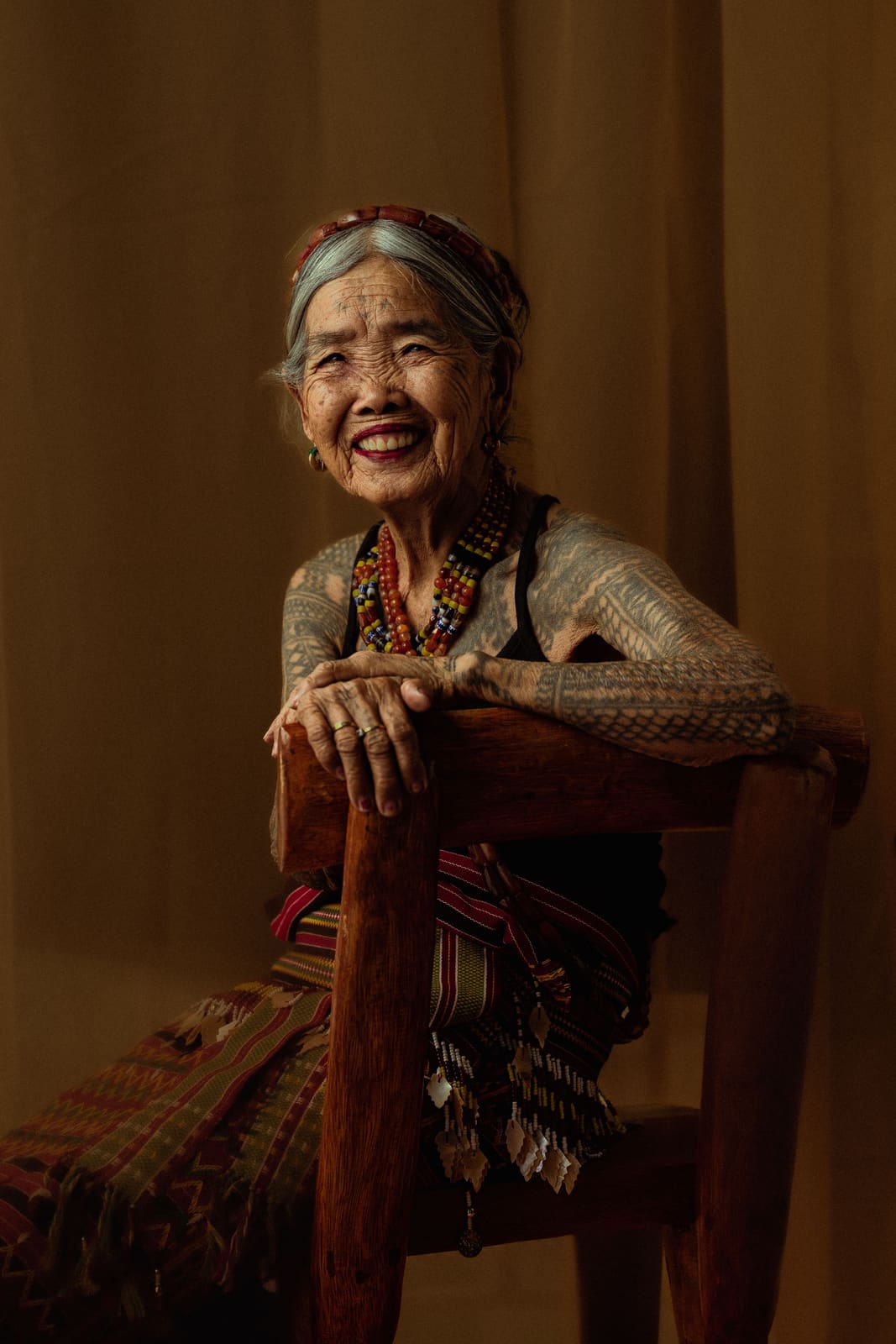
Buscalan is home to Maria Oggay, known universally as Apo Whang-od, who at 109 years old remains the country's oldest living mambabatok. She has practiced the craft for more than nine decades, her arms a canvas of twisted black patterns that testify to a lifetime of dedication. Whang-od learned the art in an era when it was reserved for men, used to adorn warriors' chests as markers of valor and achievement. Her father recognized her talent and guided her training, an exception that would eventually transform the tradition itself.
Her signature motif, a cluster of three dots, represents herself and her two grandnieces, the next generation of artists who have apprenticed under her. This simple mark has become a symbol of continuity, evidence that knowledge passes not through institutions but through hands and observation, repetition and correction.
The Kalinga Office of Provincial Tourism estimates that the province now receives approximately 40,000 visitors annually, many drawn specifically to receive tattoos in Buscalan. Yet there are no appointment systems, no guarantees. Whang-od's health fluctuates; she may be unavailable for days or weeks. Visitors arrive with hope rather than certainty, a gamble that adds weight to the journey itself.
The Language of Symbols
Kalinga tattoo designs function as a visual grammar, combining patterns that reference both the natural world and spiritual dimensions. Triangles with serrated tops evoke the ferns that crowd the mountain trails, symbols of fertility and health. Honeycomb hexagons mimic snake skin, invoking strength and resilience. A circle surrounded by dots and waves represents the sun, signifying life itself.
These are not arbitrary decorations. Each symbol carries associations rooted in the environment and cosmology of the Kalinga people, a way of encoding relationship to place into the body. The designs layer and intersect, creating compositions that resemble woven textiles, another art form central to Kalinga culture.
For travelers who arrive seeking these marks, the tattoo becomes a form of cultural translation. The symbols retain their original meanings while also acquiring personal significance, a double encoding that turns skin into a site where different narratives overlap.
The New Generation
Princess Sarah Baydon is in her twenties. She learned the craft by watching Whang-od, then practicing on friends, a training method unchanged across generations. She works with the same tools, the same pigments, the same patient tapping rhythm. When asked about her teacher, her answer is simple: "She taught me. She taught all of us."
This apprenticeship model ensures that the tradition adapts without breaking. Younger artists like Baydon bring their own sensibilities to the work while maintaining the technical foundations that define mambabatok practice. They are not copying Whang-od; they are continuing a lineage that predates her and will outlast her.
The village has quietly reorganized itself around this influx of visitors. Homestays offer basic accommodation. Small shacks sell rice and pork to hikers at scenic lookouts. The economy remains modest, rooted in subsistence agriculture, but tattooing has introduced a new current of exchange. Travelers bring cash and curiosity; the village offers access to something increasingly rare, a craft still embedded in daily life rather than performed for tourists.
The Pilgrimage Itself
Reaching Buscalan requires commitment. The journey from Manila spans twelve hours by road, a stomach-testing drive through switchbacks and fog. Then comes a one-hour descent into a ravine thick with laurel trees, followed by a crossing via a narrow wooden tram, a supply pulley system powered by a stationary Jeep. The route filters out casual interest, ensuring that those who arrive have already invested effort and discomfort.
This difficulty is not incidental. It functions as a threshold, a way of separating genuine seekers from those motivated by novelty alone. The village has not been made accessible; accessibility has been granted grudgingly, shaped by geography and infrastructure that resists easy tourism.
For some travelers, the tattoo serves as a counterpoint to the disposability of modern travel, where experiences are photographed, geotagged, and filed away. A tattoo cannot be lost or discarded. It ages with the body, fading and blurring, a permanent record that changes over time. In this sense, it mirrors memory itself, vivid at first, then softening into something less precise but no less meaningful.
Where Tradition Meets Longing
There is a particular irony in outsiders traveling vast distances to receive marks that were once reserved for local warriors, symbols of achievement and belonging within a specific cultural context. The tattoos now function as bridges, or perhaps as translations, their original meanings intact but accompanied by new layers of interpretation.
For diaspora travelers, the experience carries additional resonance. To receive a Kalinga tattoo is to claim a connection, however tenuous, to the land their ancestors inhabited. The symbols become a form of homecoming, a way of inscribing return onto the body.
Yet this dynamic also raises questions. What happens when a sacred or ceremonial practice becomes a service industry? How does meaning shift when symbols are detached from the cultural systems that produced them? Buscalan offers no easy answers. The village has not commodified the tradition so much as opened it, allowing outsiders to participate while maintaining control over the process itself. The artists decide when to work, whom to tattoo, how to price their labor.
After the Tapping Stops
The tattoo heals over days, scabbing and itching as the skin repairs itself. What remains is a cluster of black dots and lines, slightly raised, a texture that can be felt before it is seen. In bright light, the design sharpens. In shadow, it recedes, merging with the body.
Leaving Buscalan, the fog has lifted. The overnight rain has cleared the air, revealing the full sweep of the mountains, the terraced fields stepping down the slopes, the village perched above it all. Each step away from the village is also a step toward carrying it elsewhere, embedded now in skin, part of the traveler's physical archive.
The tattoo will be explained to friends, photographed, touched absently during moments of reflection. It will serve as proof of the journey, but also as a reminder of what cannot be fully translated: the cold mist, the sting of the thorn, the quiet focus of the artist, the knowledge that some experiences cannot be purchased, only earned through presence and patience.