Bilgin Unveils Its Largest Superyacht Yet, Dressed in Art Deco Drama
At 269 feet, Project Bond marries cinematic scale with a design language borrowed from the golden age of ocean liners.
A Vessel Built for Villains and Visionaries
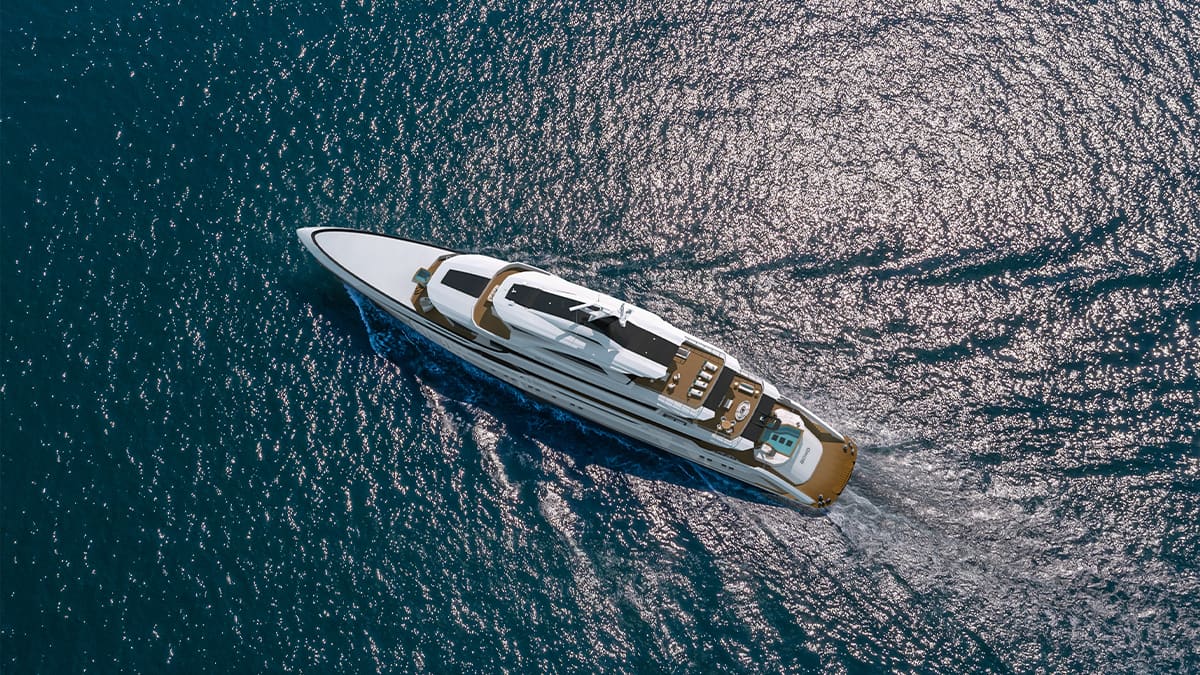
There is a particular thrill in seeing a superyacht that refuses to apologize for its ambition. Project Bond, the newest launch from Turkish builder Bilgin Yachts, stretches 269 feet across the water, a sleek steel silhouette that seems to have sailed straight out of a screenplay. The name alone invites speculation, but it is the interior that truly delivers on the promise of cinematic excess.
Step aboard and the references become unmistakable. The main salon unfolds in a series of geometric planes: lacquered panels, mirror-polished brass fittings, and furniture upholstered in velvet the color of old Bordeaux. This is not minimalism. This is the design language of 1930s ocean liners, of the Normandie and the Rex, when Art Deco was shorthand for modernity and glamour in equal measure. Bilgin Yachts has chosen to lean into that vocabulary with conviction, creating interiors that feel less like a floating villa and more like a stage set for intrigue.
The bar in the main salon anchors one end of the space, its backlit shelves and zigzag marquetry recalling the cocktail lounges of interwar Paris. Forward, a low-slung seating area frames floor-to-ceiling windows, offering uninterrupted views of the horizon. The palette throughout is restrained but rich: cream, charcoal, bronze, with occasional flashes of deeper color in the upholstery and rugs. It is a careful balance, one that nods to historical precedent without tipping into pastiche.
The Owner's Domain
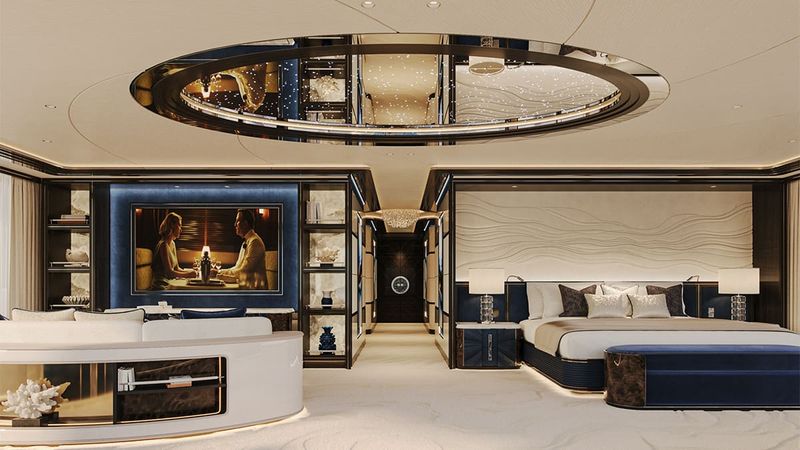
The owner's suite occupies the forward section of the main deck, a sprawling private apartment that includes a bedroom, lounge, study, and dual bathrooms. Here, the Art Deco motifs soften slightly, giving way to a more residential warmth. Pale woods line the walls, their grain visible beneath a satin finish. The bed is centered beneath a custom headboard framed by symmetrical sconces, their design echoing the stepped forms of Chrysler Building spires.
The ensuite bathrooms are exercises in material restraint. Marble slabs in muted tones cover the walls and floors, punctuated by fixtures in brushed nickel. One features a freestanding tub positioned to face the sea; the other, a walk-in shower enclosed in glass. Both spaces feel more like private spas than functional facilities, a hallmark of contemporary superyacht design that prioritizes ritual over utility.
Guest Quarters and the Question of Palette
Project Bond accommodates additional guests across several VIP cabins, each styled with its own tonal identity. One cabin leans into neutral beiges and taupes, its centerpiece a large-scale artwork mounted above the bed. Another introduces cooler tones, with blue-gray textiles and silver accents that shift the mood toward something more contemplative. The variety suggests a recognition that not all guests seek the same atmosphere, a subtle acknowledgment that a vessel of this scale must offer choice, not uniformity.
The question of how much thematic consistency a yacht should maintain is an old one in nautical design. Too much, and the interiors risk monotony; too little, and coherence dissolves into a series of unrelated rooms. Bilgin and its design team have opted for a middle path, allowing each space to breathe while maintaining a thread of visual continuity through materials, proportions, and detailing.
Exterior Lines and the Problem of Scale
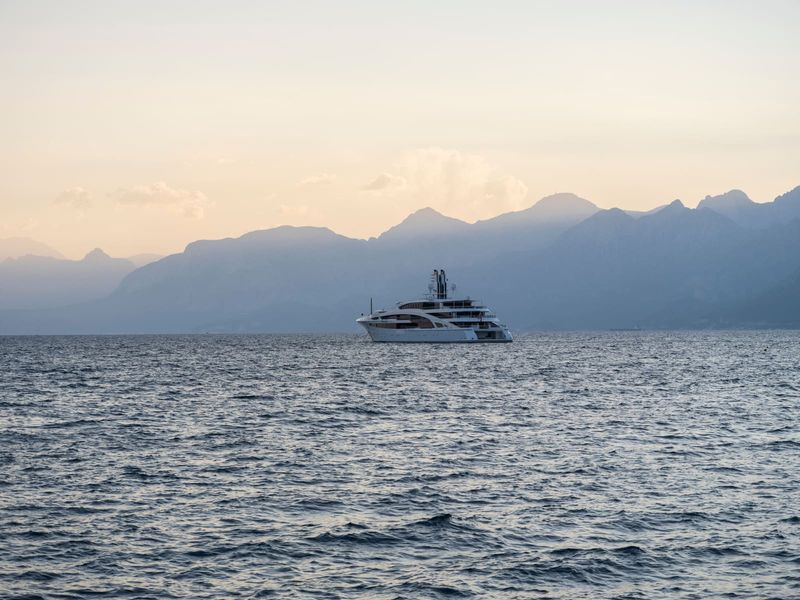
From the water, Project Bond presents a profile that is both muscular and refined. The hull is painted in a pale metallic gray, a shade that shifts with the light, appearing almost white at midday and pewter at dusk. The superstructure rises in clean, horizontal bands, with large expanses of glass that hint at the volumes within. There is a restraint to the exterior design, an avoidance of the sculptural flourishes that have become common in recent superyacht launches. This is a vessel that prioritizes elegance over novelty.
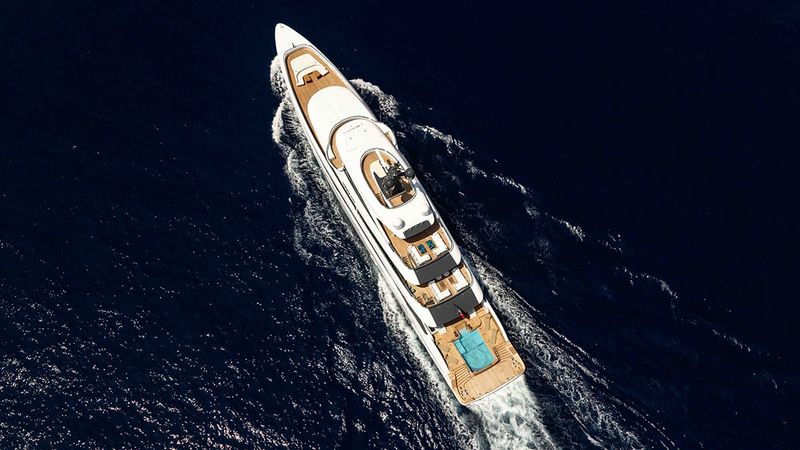
At 269 feet, Project Bond is the largest yacht Bilgin has delivered to date, according to the builder. Scale brings its own challenges: how to ensure that a vessel of this size retains a sense of intimacy, how to manage proportions so that the exterior does not read as a stack of decks but as a unified form. The shipyard has addressed these concerns through careful detailing, particularly in the fenestration and the way the decks step back as they rise, creating a tapered silhouette that lightens the visual mass.
The Art Deco Gambit
Choosing Art Deco as a design foundation in 2026 is a deliberate gambit. The style has cycled in and out of favor for nearly a century, its associations shifting with each revival. In the 1980s, it signaled corporate excess; in the early 2000s, retro chic; today, it reads as a nostalgia for an era when craftsmanship and ornamentation were not yet at odds with modernity. On a superyacht, where clients often seek to distinguish their vessels from the prevailing aesthetic, Art Deco offers a ready-made vocabulary of luxury that feels both familiar and distinct.
Yet there is a risk inherent in this approach. Art Deco interiors can veer quickly into theme-park territory if the execution falters. The success of Project Bond's interior depends on the quality of the materials, the precision of the joinery, and the restraint exercised in applying decorative elements. From the renderings and photographs released by Bilgin Yachts, the interiors appear to have threaded this needle, favoring subtle references over heavy-handed homage.
A Vessel in Context
Project Bond arrives at a moment when the superyacht industry is increasingly bifurcated. On one side, a push toward sustainability, hybrid propulsion, and reduced environmental impact; on the other, a continued appetite for vessels that prioritize scale, luxury, and unabashed opulence. Bilgin's latest launch sits firmly in the latter camp, a reminder that for a segment of the market, the primary function of a superyacht remains what it has always been: a floating assertion of taste, wealth, and individuality.
The vessel will likely spend its seasons in the Mediterranean and Caribbean, the traditional circuits for yachts of this size. It will anchor off Capri and Mustique, its profile recognizable from shore, a subject of speculation and admiration in equal measure. And perhaps that is the point. A yacht like Project Bond is not built to disappear; it is built to be seen, to provoke conversation, to serve as a backdrop for the kind of life that most will only ever glimpse from a distance.
The interiors, with their layered references and meticulous detailing, suggest a client who understands the history they are invoking, who sees the yacht not merely as a means of transport but as a statement of aesthetic values. Whether that statement will resonate beyond the narrow world of superyacht enthusiasts remains to be seen. But within that world, Project Bond has already achieved what it set out to do: it has made an entrance.