Beyond Bali: The High Art of Curated Travel Through Indonesia's Archipelago
Three decades after backpackers first discovered these islands, a new generation of specialists is unlocking Indonesia's 17,000 fragments of paradise for travellers who prefer choreography to chance.
The Archipelago Problem
When you scatter 17,000 islands across three time zones and call it a country, geography itself becomes the challenge. Indonesia stretches wider than the continental United States, yet lacks the tourism infrastructure of, say, the Greek Cyclades, where ferries run on schedules and luxury is a known quantity. The question for anyone considering the 30-hour journey from North America isn't whether the archipelago rewards curiosity - it does - but whether you're willing to let someone else solve the logistical puzzle whilst you experience it.
Christopher Wilmot-Sitwell, co-owner and director of London-based agency Cazenove & Loyd, first arrived in the late 1980s to find Bali thick with backpackers and little else on offer for Western travellers. Today he arranges three-week itineraries that weave traditional water blessings, private access to UNESCO World Heritage sites, and island-hopping by helicopter into a single coherent narrative. The transformation reflects not just Indonesia's maturation as a destination, but the emergence of specialists who understand that true luxury in such dispersed terrain is seamlessness.
The Infrastructure Question
Adrian Zecha opened Aman resorts in Indonesia in 1989 and 1992, establishing a beachhead for high-end hospitality. Yet even now, decades later, the country resists easy categorisation. Edita Sgovio, who leads Ultraluxe, a newly launched division of Kensington Tours focused on land expeditions, villas, and yacht charters, puts it plainly: Indonesia doesn't flow like more established luxury destinations. The distances are real, the connections sometimes improvised, the risk of a poorly planned itinerary high.
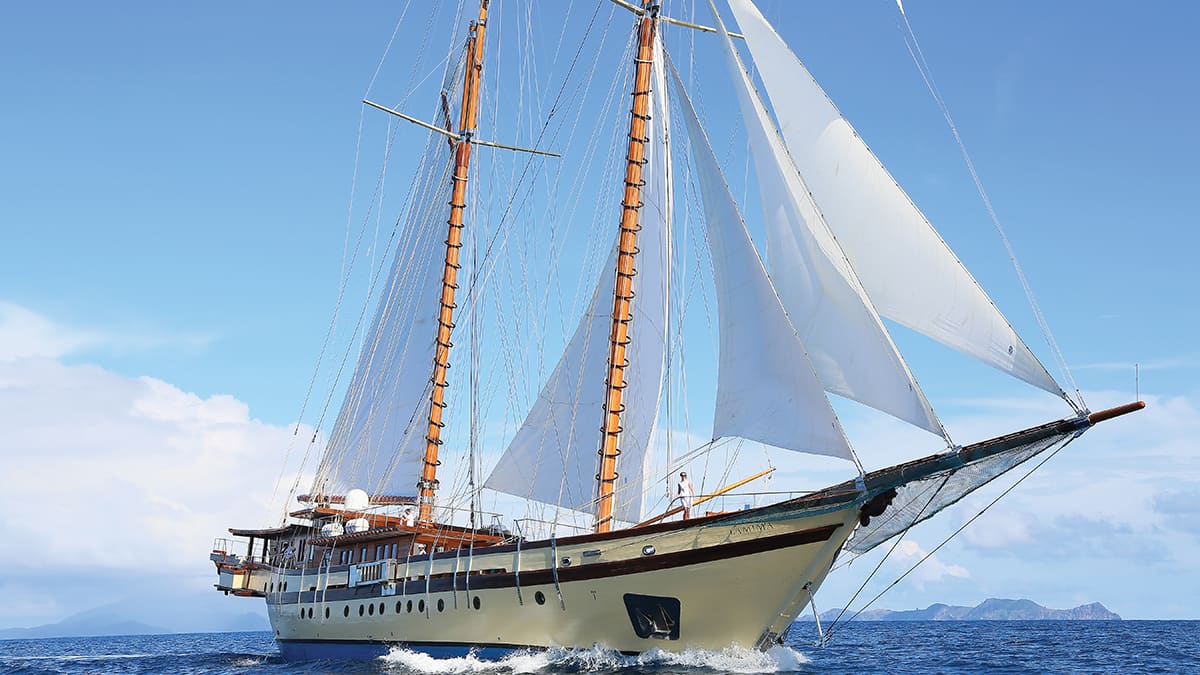
What changes the equation is expertise. Ultraluxe's nine-day Indonesia Odyssey, priced at approximately 70,000 US dollars per person excluding international flights, begins in Ubud at Mandapa, a Ritz-Carlton Reserve whose pool villas offer the kind of hushed serenity that erases jet lag. Four days follow aboard Lamima, a traditional phinisi sailing vessel that navigates the Lesser Sunda Islands with a crew known for breaking into song when guests return from shore excursions. Possible detours include Komodo, where the island's eponymous dragons lumber through dry forests, and Misool, home to stingless jellyfish that drift like ghosts through turquoise water.
The final leg lands at Nihi Sumba, a resort where mornings begin with surf breaks and afternoons dissolve into massages overlooking the Indian Ocean. The itinerary strings together boats, helicopters, and private planes without friction, a feat that Sgovio attributes to vetting rather than hoping. The goal isn't simply to visit these places but to move between them as though the archipelago were a single, coherent estate.
The Craft Landscape
Bali remains Indonesia's tourism capital, and its southern coast now hosts a roster of luxury properties, including Bulgari's resort in Uluwatu. The government is developing an international airport for the island's north side, expected to be operational within several years, which will further distribute visitor flow. Yet Bali's appeal extends beyond its hotels.
The island is headquarters to jewellery brand John Hardy, whose silver bracelets employ techniques that make metal look like woven rope. Visitors can learn the craft in Seminyak, though Reed Krakoff, the brand's creative chairman, suggests that the real draw lies elsewhere. He points to the proximity of beaches, forests, and differentiated environments compressed into a geography small enough to traverse in an afternoon. Bali offers variety at a scale rare in island destinations, a fact that becomes apparent only when someone familiar with the terrain points you toward the less obvious corners.
The Curation Imperative
What separates a curated Indonesian journey from a self-planned one is the difference between knowing a place exists and knowing how to reach it, when to go, and what happens once you're there. The country's scale and fragmentation make improvisation costly, both in time and in missed opportunities. A traveller who books a villa in Bali and a yacht charter in Raja Ampat without understanding the connecting tissue risks spending more time in transit than in experience.
Specialists like Wilmot-Sitwell and Sgovio function as choreographers, not merely concierges. They know which islands reward extended stays and which serve best as day excursions. They understand that a traditional phinisi crew's enthusiasm for welcoming songs isn't a gimmick but a cultural signature. They recognise that Nihi Sumba's surf breaks and spa treatments form a rhythm, not a menu.
The Zig Principle
Wilmot-Sitwell's advice to "zig when people zag" applies literally in Indonesia. Whilst Bali absorbs the majority of international visitors, the outer islands remain comparatively quiet. Raja Ampat's reefs teem with marine life largely undisturbed by snorkelers. Sumba's coastline unfurls for kilometres without a resort in sight. Komodo's dragons roam freely, indifferent to the handful of boats that anchor offshore each day.
The trick is knowing that these places exist and having the means to reach them comfortably. A yacht charter solves the former; a specialist solves the latter. The result is access to Indonesia's most compelling landscapes without the crowds that define its most famous one.
The Return Calculation
Whether Indonesia justifies the 30-hour journey depends on what you do once you arrive. A week in a Bali resort, however elegant, might not. Three weeks moving through multiple islands, guided by someone who has spent decades learning the terrain, almost certainly does. The archipelago rewards depth over breadth, patience over haste, and curation over spontaneity.
The country's tourism infrastructure will continue to develop. More luxury properties will open, more airports will come online, and the distances between islands will feel incrementally smaller. But the essential challenge - how to navigate 17,000 islands without wasting time or missing the best parts - will remain. That's where the specialists come in, turning geography into narrative and logistics into luxury.
Indonesia has always been there, scattered across the equator like a puzzle waiting to be solved. What's changed is the number of people who know how to put the pieces together.