The Georgetown Alley Where Massaman Curry Meets Rib-Eye
At Alfie's, a decade-long journey from Petworth pop-up to permanent kitchen ends in a space where northern Thai tradition shares the menu with five nightly steak frites.

A Decade in Motion
The alleyway entrance gives nothing away. Inside, chefs Justin Ahn and Alex McCoy are breaking down rib-eye, carving green papaya by hand, and tending a pot of pork belly curry that has been simmering since morning. The kitchen at Alfie's moves with the unhurried precision of cooks who have spent years perfecting a very specific repertoire - first as a Petworth pop-up in 2017, then in temporary residencies across New York and London, and now, since earlier this year, in this narrow Georgetown space that feels less like a dining room and more like a place where borders dissolve.
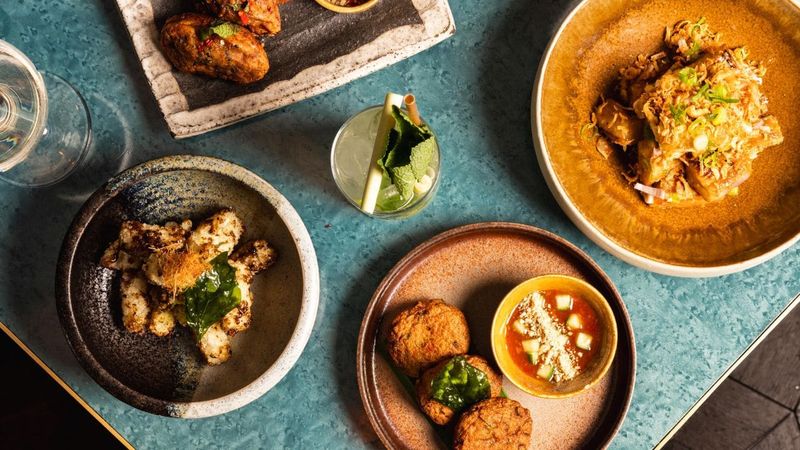
The menu draws from the heat-driven cooking traditions of northern Thailand, but the ingredients come from farms and purveyors around the District, Maryland, and Virginia. It is a restaurant built on translation rather than replication, where technique travels and locality dictates the final flavour.
The Steak That Exists in an Edition of Five
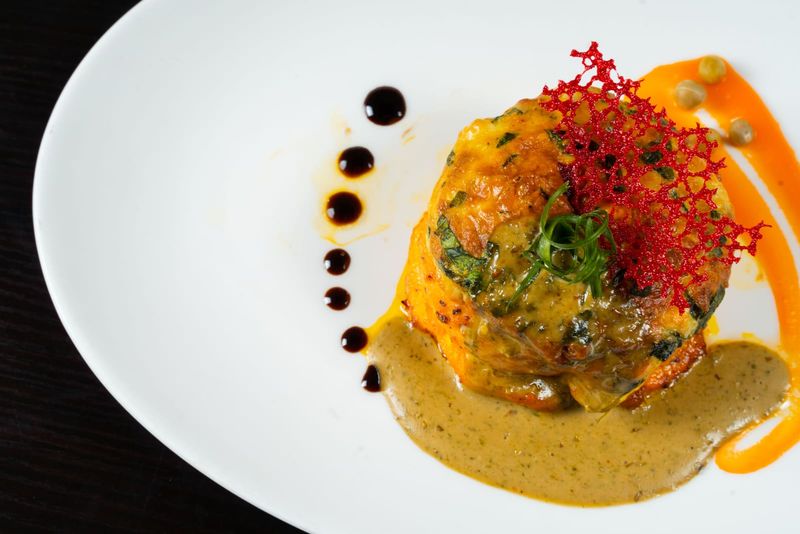
Each evening, the kitchen prepares exactly five orders of Thai steak frites. The dish begins as a 26-ounce rib-eye, trimmed and portioned earlier in the day. When the order comes in, the steak is seared to temperature, and the pan - still heavy with rendered beef fat - becomes the vessel for the sauce. Massaman curry paste, black peppercorns, and a handful of aromatics finish in that fat, creating a hybrid of French technique and Thai spice structure. The frites are cooked in the classic bar style: twice-fried, golden, salted.
It is a dish that belongs to no single tradition, which is precisely the point. The limit of five is not artifice; it reflects the kitchen's capacity to execute the dish properly within the rhythm of a full service.
Papaya, Carved to Order
Across the line, another cook works through a crate of green papayas. Each one is hand-carved into irregular slices - no mandoline, no uniformity. The texture matters here; the rough edges hold the dressing differently than machine-cut ribbons would. For each order of som tam, the papaya is tossed with fresh tomatoes, roasted peanuts, and a dressing built on palm sugar and tamarind. The balance skews funky and sharp, with enough heat to make the dish difficult to ignore.
One of the kitchen team describes it as the most labour-intensive item on the menu. The papaya must be carved close to service to retain its crispness, and each portion is mixed individually to ensure the dressing coats every piece without drowning the texture.
Pork Belly in Gaeng Hung Lay
In a wide, shallow pot near the back burners, large cuts of pork belly soften in gaeng hung lay, a northern Thai curry that privileges time over intensity. The curry paste is tempered with tamarind and fish sauce; pickled garlic and chunks of pineapple cut through the richness of the pork fat. The dish cooks for hours, the belly breaking down until the fat layer yields with almost no resistance.
This is the kind of cooking that cannot be rushed. The flavour develops in stages, and the kitchen begins the process well before the dining room opens.
Sticky Rice and the Rhythm of Prep
Just before service, the cooks retrieve trays of sticky rice that have been soaking overnight. The grains are steamed quickly, transforming into a glutinous, pliable mass that will be served in small woven baskets alongside most of the menu. Fresh herbs - Thai basil, sawtooth coriander, mint - are trimmed and arranged in cups, ready to be passed to the line as orders begin to stack.
McCoy describes the rhythm of restaurant work as something closer to a way of living than a job. The satisfaction, he explains, comes not from the pace or the acclaim, but from the moment a diner pauses mid-bite, momentarily removed from wherever they were before they walked in. The goal at Alfie's is not to transport guests to Thailand - it is to create a space where the food itself becomes the geography, and where the experience is untethered from expectation.
A Kitchen Without Borders
What makes Alfie's compelling is not novelty, but coherence. The menu does not ask diners to choose between authenticity and invention; it assumes both can coexist when the cooking is confident and the sourcing is intentional. The massaman curry steak frites and the gaeng hung lay share the same mise en place, the same attention to timing, the same respect for ingredients that have travelled - whether from a farm in Virginia or a culinary lineage that stretches back centuries in northern Thailand.
The restaurant is small enough that the kitchen is visible from most seats, and the line cooks work without theatre. There is no performance here, only process. The alleyway location reinforces the sense of discovery, of finding something that does not announce itself but rewards those who make the effort to look.
In a city where dining trends cycle faster than seasons, Alfie's offers something rarer: a menu rooted in a decade of itinerant cooking, now anchored in a permanent space where every dish - whether it exists in an edition of five or in infinite nightly repetition - is made with the assumption that this might be the meal someone remembers long after they leave Georgetown.