
Where the Current Leads: Two Unmarked Reefs Redefine Diving at Manami Resort
A chance drift into uncharted water has opened a quieter chapter in Sipalay's marine story — one measured in depth, restraint, and the patience required to reach it.
SI
2 Jun 2026 · 5 MIN READ · UPDATED 17 AUG 2026
When the Sea Decides the Route
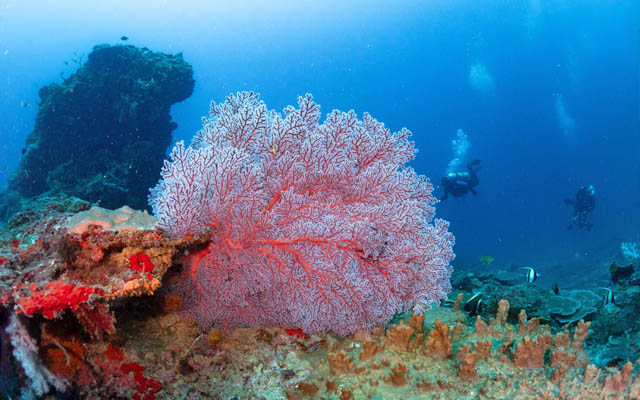
Sometime in March, a dive group launched from Manami Resort slipped beneath the surface west of Sipalay and was carried, mid-descent, by a current they hadn't anticipated. The drift pushed them beyond the known reef perimeter — past the coordinates marked on laminated cards, past the sites named and logged over years of operation — and into a stretch of coral architecture no one at the resort had formally documented. What they found wasn't dramatic in the cinematic sense: no shipwreck silhouette, no bioluminescent trench. Just a reef doing what healthy reefs do when left to their own rhythms. Dense, structured, alive with the kind of biodiversity that suggests limited interference. They surfaced, compared notes, and returned the following day to map it properly. By the end of the month, Manami had christened two new dive sites — Jonel's Garden and G A P — and quietly added them to the roster of marine experiences available exclusively to resort guests.
At Global Chic Voyage, we've watched dive tourism bifurcate over the past decade. On one end: high-volume operations that treat reefs like theme parks, complete with underwater selfie stations and guide-led fish-feeding theatres. On the other: a smaller cohort of properties that view access as a privilege earned through certification, restraint, and an understanding that some ecosystems function best when visited sparingly. Manami's approach to these two sites falls decisively into the latter camp. Both are restricted to Advanced Open Water divers and above. Both enforce a strict no-touch, no-take protocol. And both are reached not by mass tender but by small-group excursions launched from the resort's own dock, less than a kilometre offshore, within five to ten minutes by boat.
A Reef System Shaped by Depth and Distance
Jonel's Garden sits at eighteen to twenty-five metres, a depth range that filters out casual snorkellers and keeps the site largely insulated from surface chop. The topography is defined by foliose Montipora corals — plated, overlapping structures that grow outward in thin, fan-like layers — interspersed with hard coral formations that anchor the reef's skeletal framework. Visibility here fluctuates seasonally, ranging between five and twenty metres depending on plankton bloom cycles and tidal pull, but the best conditions reliably occur from April through June, when the water clears and the light penetrates deep enough to render the coral's chromatic range in full.
Marine life at Jonel's Garden reads like a census of mid-depth reef health: snappers cruising in loose formations, barracuda holding station in the blue, reef fish species — wrasses, anthias, damselfish — flickering through the coral interstices. The presence of pygmy seahorses, nudibranchs, and green sea turtles suggests a habitat that still supports the quieter, more vulnerable end of the biodiversity spectrum. These are not the marquee species that drive bucket-list tourism, but they are the canaries in the coal mine — the organisms that vanish first when reefs are overfished, overtouched, or simply over-visited.
G A P, the site discovered first by accident, descends further: twenty-five to thirty metres, where the light dims and the coral structures grow larger, more sculptural, shaped by stronger currents and colder upwellings. Here, the reef attracts pelagic species — giant trevally, groupers, emperors — fish that patrol the deeper channels and hunt in the open water beyond the coral wall. Schools of fusiliers pass through in silver clouds, and if the current is running strong, divers report sightings of larger predatory fish whose presence, according to Manami, indicates a reef system with relatively low levels of human disturbance. It's a metric worth noting: apex predators don't linger where nets are dragged daily or where dynamite fishing has fractured the substrate. Their continued presence here is less a guarantee than a provisional endorsement — one that depends entirely on how this reef is managed in the years ahead.
Access as Editorial Policy
Manami Resort has framed its relationship to these sites not as discovery in the colonial sense — the triumphant planting of a flag — but as documentation and controlled access. The sites remain exclusive to resort guests, a decision that limits daily dive traffic and allows Manami to enforce protocols that might be harder to police in a multi-operator environment. Guided dives are led by professionals with deep local knowledge and Advanced certifications, and the resort has made clear that these are not beginner sites. The depth alone requires decompression awareness; the currents demand buoyancy control; the no-touch policy assumes a level of discipline that only comes with experience.
Cristina Corro, who founded Manami Resort, described the discovery as a reminder of how much remains to be protected and understood. Her language was measured, absent the hyperbole that often accompanies new dive site announcements. Giro Solatorio, the resort's general manager, used the word "undisturbed" — a term that, in marine tourism, has become both aspiration and liability. Undisturbed reefs are rare. They are also fragile. And the moment they are named, mapped, and opened to guests, they begin the slow process of becoming something else.
Why It Matters Beyond Sipalay
The Philippines has long been caught between two competing visions of its underwater wealth. One sees the reefs as infinite, resilient, capable of absorbing endless tourist traffic as long as the boats keep running and the revenue keeps flowing. The other recognises that resilience is conditional — that reefs recover slowly, that overfishing and climate stress have already pushed many systems past their tipping points, and that access, if not carefully managed, becomes extraction by another name. Manami's model — small-group, certification-gated, protocol-driven — offers a template for how marine tourism can operate at the higher end of the market without compromising the ecosystems it depends on.
What makes Jonel's Garden and G A P significant is not their novelty but their relative intactness. In a region where blast fishing, cyanide poisoning, and unregulated tourism have degraded vast stretches of reef, the presence of a thriving, biodiverse system less than a kilometre from shore is an anomaly worth safeguarding. The question is whether Manami's exclusivity model can be sustained as word spreads, as demand grows, and as other operators inevitably seek access to the same coordinates. Reef systems don't respect resort boundaries. And once a site is known, it becomes harder to keep it quiet.
The Longer Drift
We return often to the idea that the best travel experiences are those that require something of the traveller — preparation, patience, a willingness to meet the destination on its own terms rather than demanding it conform to expectation. Diving Jonel's Garden and G A P requires an Advanced certification, a tolerance for variable visibility, and an acceptance that some days the current will be too strong, the plankton too thick, the conditions simply wrong. It is not diving for the Instagram grid. It is diving for the slow accumulation of observation: the way a barracuda holds its line in the current, the texture of Montipora coral under oblique morning light, the silence that settles when you descend past twenty metres and the surface noise fades.
Manami Resort has opened a door. Whether it remains ajar or swings wide will depend on how carefully that threshold is guarded — not just by the resort, but by the divers who pass through it. Some reefs are meant to be shared widely. Others are meant to be visited sparingly, documented carefully, and left as close to undisturbed as human presence will allow. The current led divers to G A P once. The task now is ensuring it doesn't carry too many back too soon.
Spot something wrong? Email editors@globalchicvoyage.com. We log every correction publicly.
RELATED
SEE ALL →
8 Aug 2026 / 5 min

8 Aug 2026 / 5 min
8 Aug 2026 / 5 min
7 Aug 2026 / 5 min