
Sleep Inside a Wine Barrel at Portugal's Quinta da Pacheca
In the Douro Valley, a historic estate invites guests to spend the night within oversized barrels overlooking terraced vineyards.
CG
8 Aug 2026 · 5 MIN READ · UPDATED 17 AUG 2026
A Room Shaped Like the Landscape Itself
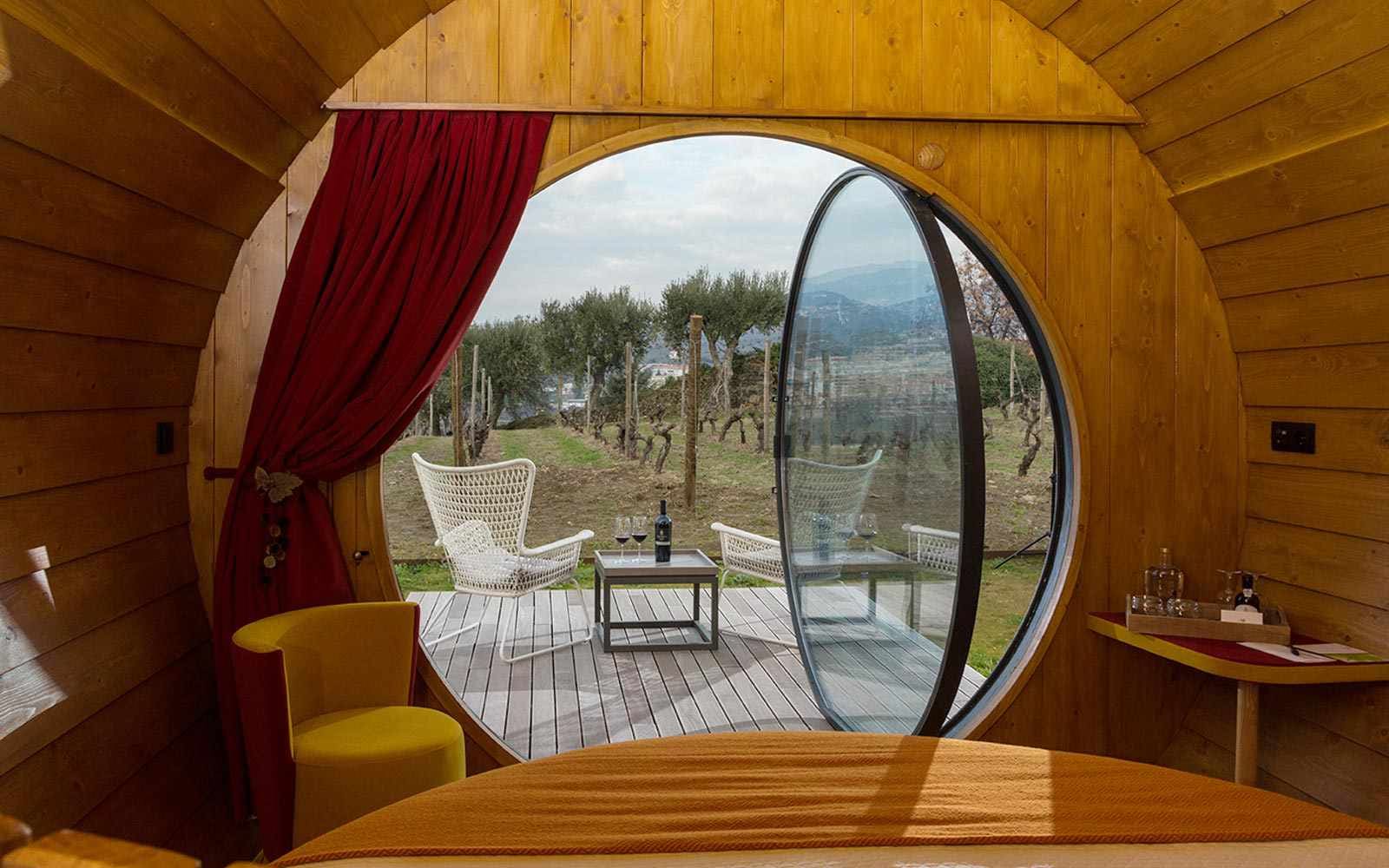
There is something quietly absurd about crawling into a barrel meant for wine and finding, instead of fermenting grapes, a queen-size bed and a window framing row after row of terraced vines. At Quinta da Pacheca, a winemaking estate deep in Portugal's Douro Valley, guests do exactly that. The property has transformed ten oversized wooden barrels into standalone accommodations, each one perched among the vineyards like sculptural punctuation marks in a sentence written by centuries of viticulture.
At Global Chic Voyage, we have long admired accommodations that resist the urge to merely observe their setting and instead become part of it. These barrel rooms, introduced by Quinta da Pacheca, achieve that rare balance. They are not merely themed; they are structurally honest, built from the same French oak that once held the estate's port and table wines, now repurposed into lodging that smells faintly of tannin and wood resin even after renovation.
The Architecture of Immersion
Each barrel measures roughly nine feet in diameter, large enough to contain a double bed, compact en-suite bathroom, air conditioning, and a skylight that transforms the curved ceiling into a frame for stars. The design is spare but not ascetic. Pale linens contrast with dark wood staves held together by black iron hoops. A circular window at one end opens onto the vineyards, offering a view that changes with the season: spring green, summer gold, autumn rust.
What strikes us most is the restraint. There are no unnecessary flourishes, no gilded fixtures or faux-rustic clutter. The barrel is allowed to be what it is, a container reimagined, a functional object elevated by context. The architects understood that in a landscape as visually commanding as the Douro, the best design decision is often subtraction.
A Landscape Written in Slopes and Stone
The Douro Valley, a UNESCO World Heritage site, is one of the world's oldest demarcated wine regions, its steep terraces carved by hand over generations. Quinta da Pacheca sits within this topography, its vines planted on schist slopes that absorb the day's heat and release it slowly through the night. The estate has been producing wine since 1738, and its cellars still hold barrels from the 19th century, some so large they required entire trees to construct.
Sleeping in a barrel here is not simply a novelty. It is a form of architectural storytelling, a way of making the guest complicit in the rhythm of harvest and aging. You wake to the same light that ripens the grapes. You hear the same wind that dries the leaves. The barrel becomes a lens through which the landscape is not just seen but felt.
The Ritual of Arrival
Guests arrive at the estate through gates flanked by century-old plane trees, then follow a gravel drive that winds past the main house, a whitewashed manor with blue trim, before reaching the barrel cluster. Check-in includes a tour of the cellars, where the original barrels still in use dwarf their repurposed cousins. The contrast is instructive: the working barrels are stained dark with wine, their wood swollen and fragrant, while the guest barrels are lighter, scrubbed clean, their interiors sealed and fitted with modern amenities.
Dinner is often taken at the estate's restaurant, housed in a former warehouse with stone walls and high ceilings. The menu leans heavily on regional ingredients: bacalhau, cured meats, sheep's cheese, bread baked in wood-fired ovens. Wine pairings are drawn from Quinta da Pacheca's own production, including their flagship red, a blend of Touriga Franca and Tinta Roriz aged in barrels identical to the ones now serving as guest rooms.
The Experience of Enclosure
To sleep in a barrel is to reconsider the relationship between shelter and exposure. The space is small, almost womb-like, yet the window and skylight prevent any sense of confinement. You are enclosed but not hidden, private but not isolated. The curved walls amplify sound in unexpected ways: rain becomes a drumbeat, wind a low hum, morning birdsong a chorus that seems to originate from within the wood itself.
We have noticed, in our years of tracking unusual accommodations, that the most memorable are those that make the guest aware of their own presence in a place. The barrel rooms at Quinta da Pacheca do this without effort. You cannot forget where you are or why. The architecture will not let you.
Why This Matters for the Valley
The barrel rooms have become a draw for travelers who might not otherwise venture deep into the Douro. They attract a different kind of visitor: younger, more design-conscious, eager for experiences that can be shared but not easily replicated. In doing so, they have helped diversify the valley's tourism economy, which has long been dominated by river cruises and cellar tours.
But the success of Quinta da Pacheca's experiment also raises questions about scale. How many novelty accommodations can a region absorb before the novelty itself becomes the landscape? For now, the barrels remain singular, a well-executed idea that has not yet been copied to exhaustion. The estate has resisted the temptation to expand beyond ten units, preserving the sense of exclusivity and intimacy that makes the experience worth seeking.
Beyond the Barrel
Quinta da Pacheca offers more than its headline attraction. The estate includes traditional rooms in the main house, a swimming pool overlooking the river, and hiking trails that wind through the vineyards and into the surrounding hills. Wine tastings are held daily, often led by the winemakers themselves, who speak with the unsentimental clarity of people who have spent their lives coaxing complexity from difficult soil.
For those who prefer their accommodations less metaphorical, the main house provides a more conventional luxury: high ceilings, antique furniture, views of the same vineyards from a slightly greater distance. But we suspect most guests, having seen the barrels, will choose them. The pull of the unconventional is strong, and in this case, it is backed by thoughtful design and a genuine connection to place.
A Final Note on Context
We return often to the idea that the best travel experiences are those that could not happen anywhere else. A wine barrel in a vineyard in Portugal is not the same as a wine barrel in Napa or Bordeaux, not because the object itself is different, but because the landscape, the history, and the cultural context are distinct. Quinta da Pacheca understands this. The barrels are not imported whimsy. They are local material, local craft, local memory made tangible.
In an era when so much of luxury travel has become interchangeable, when the same architect designs hotels on three continents and the same menu appears in a dozen cities, there is something quietly radical about sleeping in a barrel. It is specific. It is odd. It is exactly where it should be.
Credit: Quinta da Pacheca
Spot something wrong? Email editors@globalchicvoyage.com. We log every correction publicly.
RELATED
SEE ALL →
31 Jul 2026 / 5 min
15 Jul 2026 / 5 min
7 Aug 2026 / 5 min
28 Jul 2026 / 5 min