
Where History Meets the Glass: Inside Singapore's Bar Kap at Tan Yeok Nee Mansion
A cocktail bar inhabits Singapore's last surviving Teochew grand mansion, weaving 140 years of stories into every drink and dish.
YN
22 Jul 2026 · 5 MIN READ · UPDATED 17 AUG 2026
A Monument Opens Its Doors
The carved wooden eaves catch the late afternoon light differently when you know they've stood for nearly a century and a half. At Global Chic Voyage, we've watched Singapore's heritage properties evolve from shuttered relics into living, breathing spaces, but few transformations carry the weight of the House of Tan Yeok Nee. For 140 years, this Teochew mansion sat behind closed gates, cycling through incarnations as a British officer's residence, a convent school, a traditional Chinese medicine clinic. Now, for the first time, its doors swing open to anyone who wishes to step inside, and within its walls, Bar Kap has carved out a space that honours the past while pouring drinks decidedly rooted in the present.
The mansion itself is the sole survivor of what Singaporeans once called the Four Grand Mansions, a quartet of opulent homes built by merchant princes during the island's golden age of trade. Tan Yeok Nee made his fortune in gambier, pepper, and the less savoury enterprises of spirits and opium farms stretching from Singapore to Johor. That a bar now occupies part of his former estate feels less like irony and more like a homecoming, a nod to the spirits that once funded these soaring rooflines and intricate qian ci mosaics, Teochew artworks fashioned from broken ceramics that still glitter along the mansion's facades.
Architecture as Prologue
Walking through Bar Kap requires walking through history first. The mansion's exhibition spaces unfold like chapters, each room annotated with the lives it has sheltered. Traditional Teochew architectural principles govern every sightline: courtyards designed to capture rain and light, timber beams joined without nails, ceramic shards arranged into phoenix and peony motifs that have survived wars and monsoons. The restoration team has threaded modernity through these bones with a light hand, preserving the wood carvings and tilework while introducing contemporary lighting that makes the old craftsmanship legible to twenty-first-century eyes.
We recommend arriving early, not for the bar but for the house itself. Thirty minutes spent wandering these halls provides context that no cocktail menu can supply. You'll understand why the drinks that follow carry names like Lights Out and Pepper Peddler, why the space feels less like a bar grafted onto a monument and more like a natural extension of the mansion's many lives. Bar Kap shares the premises with fine-dining restaurant Loca Niru and teahouse Jing Studio, a trinity of hospitality concepts that together animate the house without overwhelming its quiet dignity.
Cocktails That Map a Life
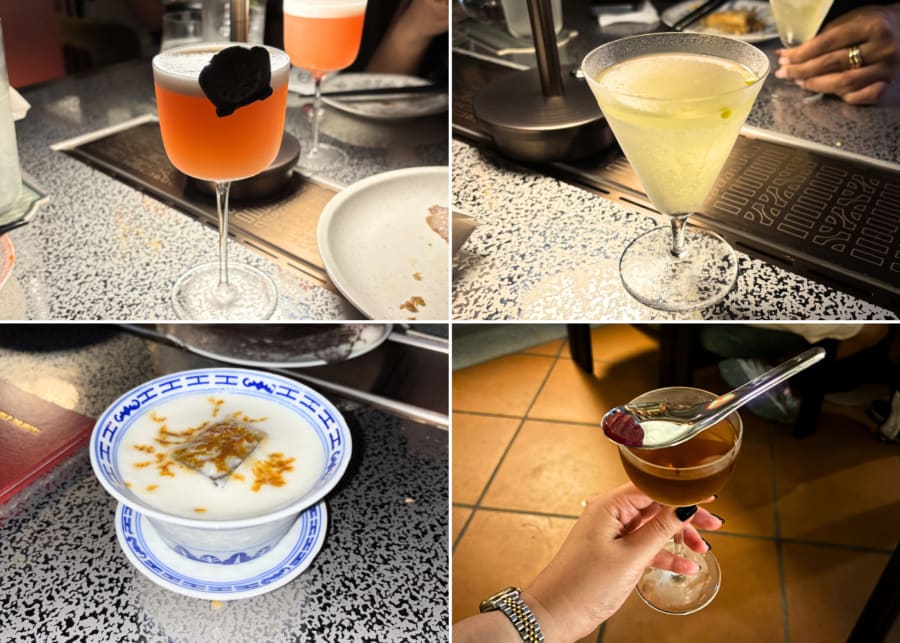
Bar Kap's menu reads like a biography told in liquid form, each drink corresponding to an era in the mansion's timeline. Lights Out, a frozen martini masquerading as a gimlet, arrives in a glass so cold it fogs on contact with the humid Singapore air. The bartender anoints it tableside with drops of pandan oil, though the botanical note plays a supporting role rather than the lead we might have hoped for. Still, the drink possesses the kind of clean, bracing strength that makes you sit up straighter, the gin cutting through with precision.
The Pepper Peddler takes its cue from Tan Yeok Nee's trading ventures, blending baijiu, gin, and makgeolli into something that ought to be punishing but instead unfolds with unexpected refreshment. The baijiu announces itself boldly, that distinctive sorghum funk blooming at the back of the palate, followed by a warmth that lingers without burning. It's a drink for those who appreciate spirits with character, who don't mind when their cocktails speak with an accent.
For those steering clear of alcohol, TCM Drawer No. 3 offers a zero-proof option that doesn't feel like a consolation prize. Soy milk, ginger, honeydew, and gula melaka combine into something that tastes like childhood desserts remembered through an adult lens, sweet but not cloying, comforting without being heavy. It arrives with a side of coconut rum, an optional spike that deepens the drink's complexity if you choose to add it. We did, and the rum brought out nutty undertones we hadn't noticed before, proof that sometimes the best drink is the one you finish building yourself.
The cocktail program here won't leave you gasping at molecular theatrics or avant-garde flavour collisions. What it offers instead is technique, a quiet confidence in execution that favours balance over bombast. These are drinks designed to satisfy rather than shock, cocktails that pair as easily with conversation as they do with contemplation. In a city where bars often compete to be the loudest voice in the room, Bar Kap opts for a lower register, and the choice feels deliberate.
A Menu That Wanders
The food at Bar Kap charts a curious course, steering away from the Teochew culinary traditions you might expect given the setting and toward a Chinese-Indonesian fusion that caught us off guard. The Mee Kapitan, a deconstructed dumpling featuring minced pork and sakura ebi, quickly became the table favourite. House-made noodles deliver that elusive bouncy texture, the kind that makes you chew more slowly to savour the snap, while the umami depth comes from layers of pork fat and dried shrimp, a combination that feels both indulgent and somehow essential. A vegetarian Green Kapitan offers a meat-free alternative, ensuring the dish's pleasures aren't limited to carnivores.
The Bar Kap Bao reads as bao on the menu but arrives as something closer to a curry puff, its flaky shell cradling a filling of beef rendang that's been stewed to the edge of falling apart. Pickled mango on the side cuts through the richness, its acidity a necessary counterpoint to the rendang's coconut-heavy gravy. It's a hearty dish meant for sharing, though we observed more than one diner guarding their portion with fork and knife.
Even the spicy tempeh tots, a dish that might send tempeh skeptics running, manage to win converts. The sweet soy glaze and marinade bury any trace of fermentation funk, though we wished for a crispier exterior, something with more textural contrast against the soft interior. Still, we watched plates come back empty, always a more honest review than any written assessment.
The disconnect between the mansion's Teochew heritage and the menu's Indonesian leanings remains the evening's one unresolved question. We kept waiting for a dish that would tie the food more directly to Tan Yeok Nee's origins, a nod to the cuisine his household kitchens might have produced. Instead, the menu wanders south and west, drawing from traditions adjacent to but distinct from the house's roots. It's not a fatal flaw, the food succeeds on its own terms, but the missed opportunity for deeper thematic resonance lingers like a note that didn't quite resolve.
The Calculus of Worth
Bar Kap has been open barely a month, yet reservations already stretch weeks into the future, a scarcity that speaks to both the bar's appeal and Singapore's perpetual hunger for the next destination. The question of whether it's worth the effort to secure a table depends partly on what you're seeking. If you want a bar that will rewrite your understanding of what cocktails can be, you may leave satisfied but not transformed. If, however, you're drawn to the idea of drinking in a space that has never before admitted the public, of sitting beneath eaves that have sheltered merchants and missionaries and schoolchildren and healers, then Bar Kap offers something rarer than innovation: it offers access to a living piece of Singapore's architectural memory.
We found ourselves lingering longer than planned, not because the drinks demanded it but because the space itself invited a slower pace. The mansion absorbs sound in a way modern buildings cannot, the thick walls and high ceilings creating pockets of quiet even as the bar fills. You can hear the clink of ice in shakers, the low murmur of conversations, the occasional creak of old timber settling into its nightly routine. These are the textures that make a bar memorable beyond its menu, the atmospheric details that turn a single visit into a story you'll retell.
Looking Forward, Rooted in Place
Bar Kap has announced plans to introduce clay-aged cocktails, a revival of ancient preservation techniques that will see drinks maturing in traditional earthenware pots. Clay, being porous, interacts with spirits differently than wood, imparting mineral notes and textural shifts that barrel-aging cannot replicate. The bar will be the first in Singapore to explore this method, a fitting innovation for a space so thoroughly steeped in historical craft. When those drinks debut, we'll return, curious to taste how old vessels might reshape new liquids.
For now, Bar Kap stands as a testament to what happens when hospitality enters heritage spaces with respect rather than spectacle. The mansion didn't need a bar to justify its existence, but the bar needed the mansion to give its drinks and dishes a story larger than themselves. In that exchange, both parties gain something: the house finds contemporary relevance, and the bar inherits a narrative depth that few new openings can claim. We left with reservations already made for a return visit, eager to see how this young bar grows into the old bones that shelter it.
Credit: Ashe Liao
Spot something wrong? Email editors@globalchicvoyage.com. We log every correction publicly.
RELATED
SEE ALL →
18 Jul 2026 / 5 min
7 Aug 2026 / 5 min
30 Jul 2026 / 5 min
30 Jul 2026 / 5 min