Where Art and Appetite Converge: Inside the New Museum's Cork-Wrapped Dining Room
A free-standing sculptural box on the Bowery transforms the museum restaurant from afterthought to evening destination
ML
9 Jul 2026 · 5 MIN READ · UPDATED 17 AUG 2026
A Cork Vessel in the Lobby
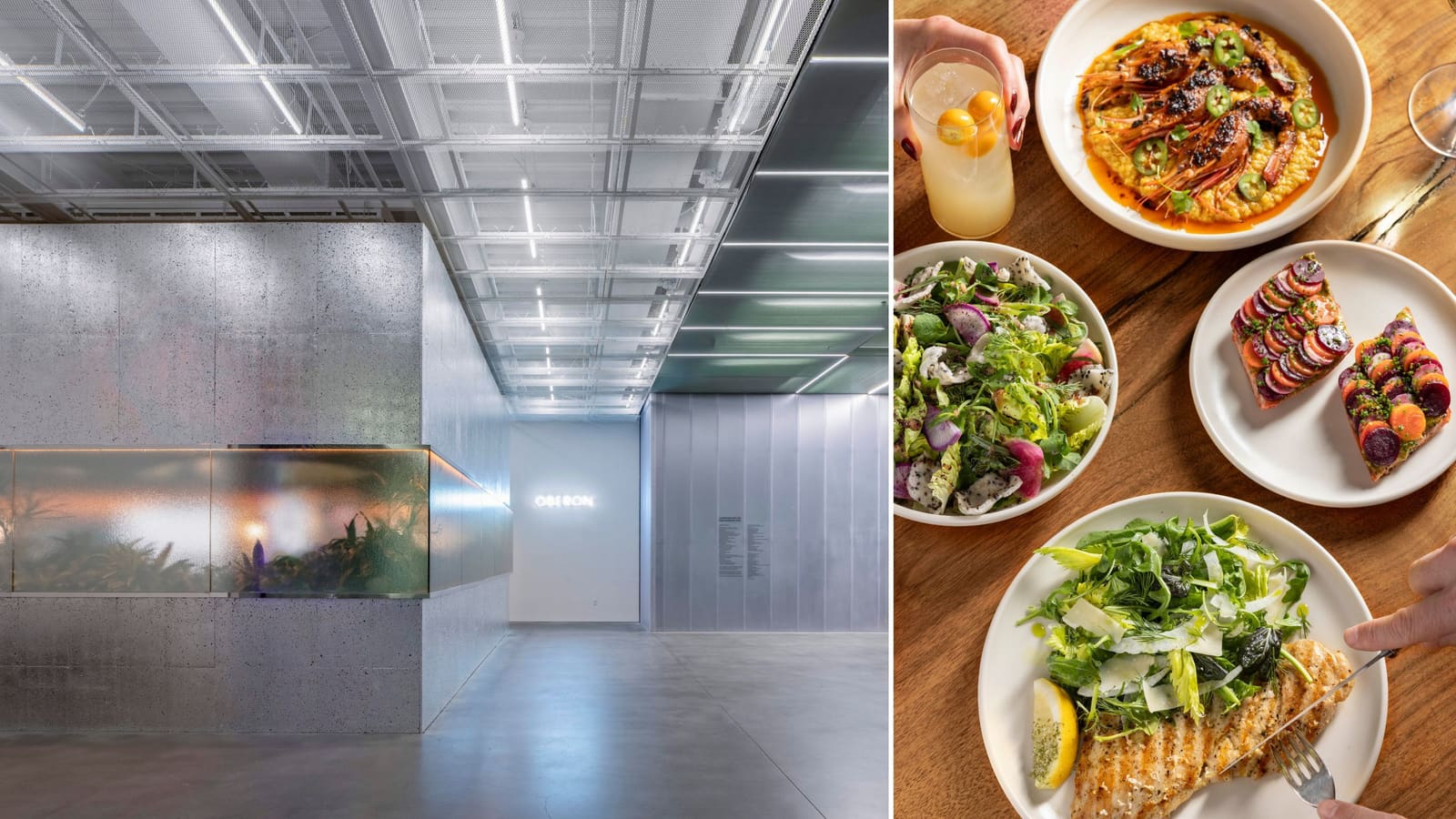
The silver-leafed box sits in the New Museum's ground-floor lobby like a monolith that wandered in from another century. From outside, the structure reads as brutalist, impenetrable. Step through the entrance, though, and the mood shifts entirely. The interior is warm, almost cave-like, every surface carved from offcuts of Portuguese cork that have been heated, compressed, and sculpted into something that feels both ancient and speculative. Overhead, CNC-milled cork conceals lighting and ventilation so seamlessly that the ceiling becomes a single, breathing surface. In the booths, three-dimensional domes carved from the same material create intimate alcoves. It is a space designed not to announce itself but to envelop.
This is Oberon, the latest addition to a growing roster of museum restaurants in New York that have begun to operate less as amenities and more as autonomous experiences. At Global Chic Voyage, we have watched this shift unfold over the past several years, as institutions realize that the social rituals of dining can be as carefully choreographed as the exhibitions upstairs. The difference here is architectural and operational. Oberon does not simply sit adjacent to the museum. It asserts itself as a distinct environment within it, accessible from the lobby during the day and, after hours, from Freeman Alley through an industrial metal walkway. Late-night service runs until one in the morning, long after the galleries have emptied.
A Two-Year Expansion, An Eighty-Two-Million-Dollar Bet
The restaurant is the final component of the New Museum's ambitious two-year expansion, an eighty-two-million-dollar project led by Shohei Shigematsu of Office for Metropolitan Architecture, working alongside Rem Koolhaas. The museum reopened earlier this year with nearly double its original footprint, adding sixty thousand square feet dedicated to exhibitions, artist residencies, and public programming. According to Shigematsu, the design philosophy guiding the new wing was one of tension rather than harmony. Rather than defer to the iconic stacked-box structure designed by Sejima and Nishizawa and Associates, the addition was conceived to both support and challenge the original building. Oberon was imagined in the same spirit: a restaurant that serves the institution best by offering something self-contained, something that does not merely complement but stands on its own.
The cork cladding, sourced from Portugal, reflects a broader commitment to regenerative materials and farm-to-table principles. The textured laminated glass that wraps the exterior creates a subtle two-way mirror effect, reflecting the flow of museum visitors while offering glimpses of the dining room within. The effect is one of permeability without transparency, a threshold that invites curiosity without demanding entry.
An Interdisciplinary Table
Chef Julia Sherman, whose 2017 book explored the intersection of food and contemporary art through interviews and recipes with figures like Laurie Anderson and Tauba Auerbach, brings a similar sensibility to Oberon. Raised downtown by an artist parent, Sherman grew up moving through museums as extensions of daily life. Her approach here is rooted in the belief that dining is a layered, collaborative experience. Fashion designer Mary Ping created the staff uniforms. April Johnson of Flowerpsycho designed the opening floral installations. Tableware was produced by The Noble Studio and Powerhouse Arts Ceramics Studio. Even the dark mint chocolates served with the check bear wrappers designed by Laurie Anderson.
The menu itself is approachable, vegetable-forward but not dogmatic. Sherman describes it as an exhale, a counterpoint to the intellectual and visual stimulation that museums demand. There are familiar anchors: crudo, shrimp, a burger. One dish that captures the restaurant's ethos pairs prawns with yellow lentils prepared as dal, finished with salsa negra made from toasted chiles. The result is silky, grounding, complex beneath a surface that reads as comfort. Another plate features roasted cabbage with brown butter, green ají, and chili crunch, a study in how a single vegetable can anchor a dish when treated with attention.
Sherman speaks of the restaurant as a space where visitors can pause and recalibrate. Museums offer so much stimulus, so many ideas layered on top of one another. Oberon was conceived as a place to process that, to sit with it, to let the body catch up with the mind.
An AI Shrinekeeper and Tables That Whisper
Art is woven into the dining room, but not as decoration. Los Angeles-based artist Ian Cheng created Shrine Oberon, a panoramic LED installation that illuminates the bar. The work uses artificial intelligence to respond to the flow of diners, generating a character Cheng calls the shrinekeeper, a curious alien who watches, learns, and interacts. The shrinekeeper greets guests, assigns them nicknames, plays chess, and accepts tips that manifest as permanent flora or small totems within the digital landscape. Over time, the piece becomes a cumulative portrait of everyone who has passed through.
Cheng was drawn to the enclosed, womb-like quality of the space, the absence of natural light, the sense of being inside something. The reference he cited was the cantina in Star Wars, a place where strangers gather and a certain character presides. Here, the shrinekeeper is that character, evolving with each encounter.
New York-based artist and designer Minjae Kim, whose practice blends sculptural forms with traditional Korean woodworking, designed the bar tops, booths, and two-top tables in tones that echo the cork interior. He also created a series of quilted fiberglass pendant lights, amorphous and soft, that add warmth without competing for attention. Kim describes his approach as one of negative space, a desire to let the architecture lead and the furniture follow quietly.
A Downtown Nexus, Not a Museum Annex
The Oberon Group, which operates the restaurant, has experience with cultural institutions. The team has opened cafés and dining rooms at BRIC House, the New-York Historical Society, and Metrograph. Managing partner Henry Rich describes the process as one of understanding community rather than imposing a formula. The aim was to create a gathering place for the downtown art world in its broadest sense: artists, gallerists, collectors, visitors passing through, regulars who live a few blocks away.
What distinguishes Oberon from earlier museum restaurants is the degree to which it operates independently. During museum hours, it functions as part of the visitor experience, a place to sit between galleries. After dark, it becomes something else entirely, a destination that happens to be housed within a cultural institution. The late-night hours, the alley entrance, the AI bartender, the cork-wrapped booth where you can sit and eat cabbage with chili crunch while a digital alien learns your face - all of it suggests a different kind of social space, one that borrows the museum's infrastructure but writes its own script.
The Exhale After the Exhibition
We have returned to Oberon twice since it opened, once in the afternoon and once well past ten. The experience shifts depending on the hour. In daylight, the restaurant hums with the quiet energy of museum-goers taking a break, flipping through exhibition brochures, checking phones. At night, the crowd skews younger, louder, more interested in the wine list than the galleries upstairs. The cork absorbs sound in a way that makes even a full dining room feel intimate, and the two-way glass creates the illusion that you are both inside the museum and apart from it.
What strikes us most is how little the space feels like an institutional amenity. There is no sense of obligation here, no feeling that you are eating in a museum because you happened to be visiting one. Oberon earns its place. The food is considered, the design is deliberate, and the art is not simply hung on the wall but integrated into the social fabric of the room. It is a restaurant that happens to be in a museum, not a museum restaurant. That distinction, small as it may seem, is what makes it worth the trip.
In a city where museum dining has long been an afterthought or, at best, a pleasant surprise, Oberon signals a different ambition. It suggests that the rituals of gathering, eating, and lingering can be as carefully curated as any exhibition. And it does so without fanfare, without declaring itself a destination. The cork box on the Bowery simply opens its doors, lights its bar, and waits for you to walk in.
Photo: Alex Fradkin
Spot something wrong? Email editors@globalchicvoyage.com. We log every correction publicly.
RELATED
SEE ALL →
15 Jul 2026 / 5 min
7 Aug 2026 / 5 min
30 Jul 2026 / 5 min
30 Jul 2026 / 5 min