
When the Rails Climb Higher Than the Clouds
A 560-mile rail corridor threading national parks, alpine hamlets, and ridgelines so steep the horizon tilts - this is train travel as pilgrimage.
SI
13 Jul 2026 · 5 MIN READ · UPDATED 17 AUG 2026
The Slow Ascent into Memory
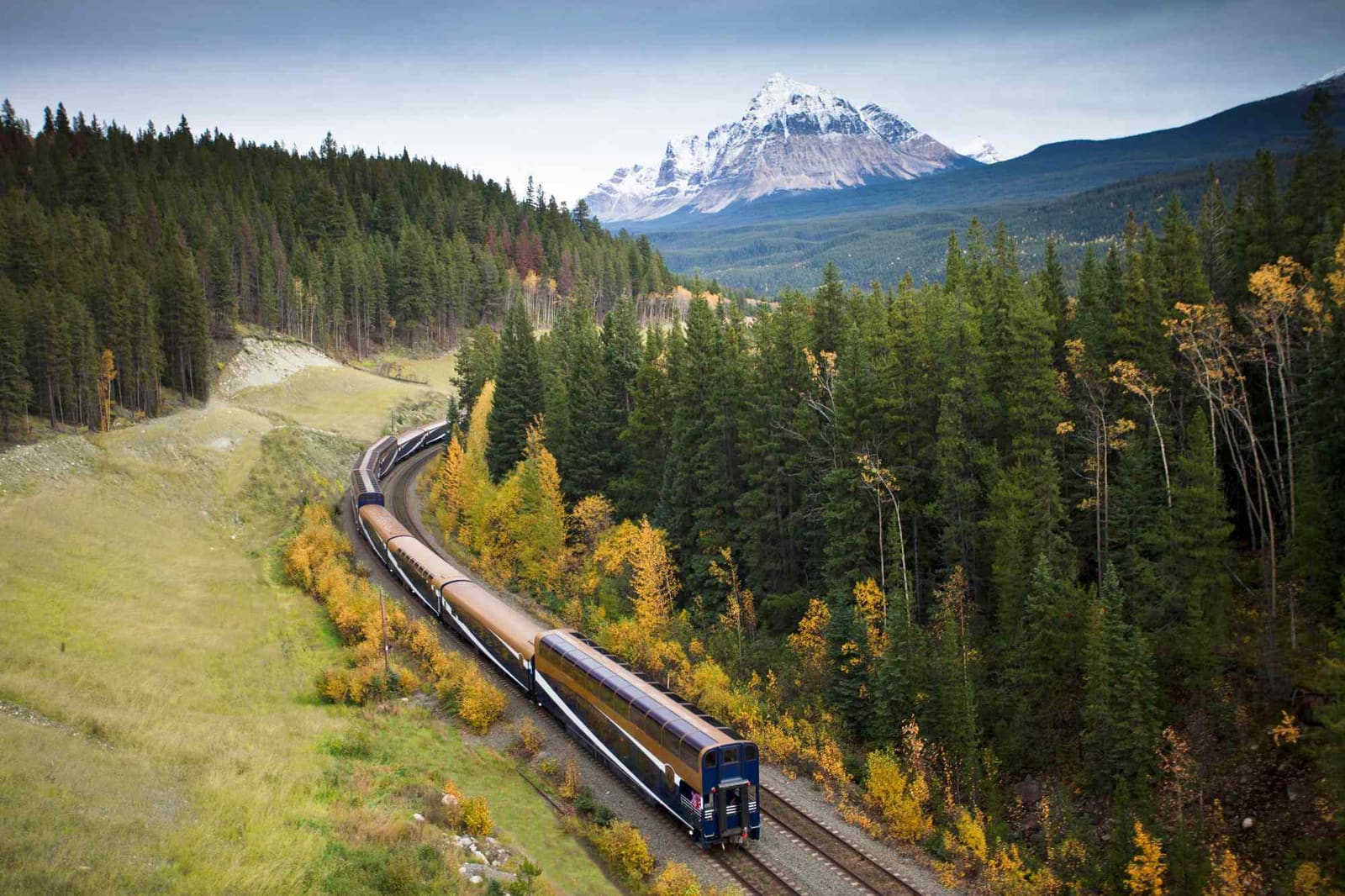
There is a particular quality to light at altitude - thin, unfiltered, the kind that makes every ridge look sharper than it should. We first noticed it an hour into the climb, when the train rounded a curve and the valley floor dropped away like a stage curtain. Below, a river threaded silver through pine. Above, the peaks held snow in their shadowed folds even though it was July. The conductor's voice crackled over the intercom, announcing the next stop in a town we'd never heard of, population eight hundred, elevation seven thousand feet.
This is the rhythm of a 560-mile rail corridor that refuses to hurry. It is not a shortcut. It is not efficient. It is, instead, a deliberate winding through terrain that resists roads, a route that treats distance as texture rather than obstacle. At Global Chic Voyage, we've returned to rail journeys like this one precisely because they ask travelers to surrender the dashboard, the itinerary, the compulsion to arrive. Here, arrival is beside the point.
A Corridor Stitched Between Wilderness and Settlement
The route threads a geography of contrasts: national parks where elk graze in meadows ringed by lodgepole pine, followed by whistle-stops where a single general store doubles as post office and café. One moment the train skirts a glacial lake so clear you can see boulders on the lakebed; the next, it slows through a railyard flanked by grain silos and a hand-painted sign advertising pie.
What makes the corridor singular is not any one landmark but the cumulative effect of passage - the way small towns announce themselves with a church steeple and a water tower, then recede just as quickly into forest. There are no billboards, no strip malls, no franchise architecture. The towns here are still legible as towns, shaped by topography and the accidents of nineteenth-century rail planning rather than highway interchanges.
At one stop, a woman boarded with a basket of huckleberry jam she'd made that morning. She sold six jars to passengers in our car before the train pulled out again. It was a transaction that felt less like commerce than exchange - proof that the route still functions as a lifeline, not just a tourist attraction.
The Architecture of Elevation
The engineering is quiet but audacious. The line climbs nearly four thousand feet over the first hundred miles, a gradient achieved through switchbacks and tunnels bored straight through granite. In places, the track clings to ledges so narrow that looking out the window feels like leaning over a balcony with no railing.
We watched the landscape shift in bands as we gained altitude: ponderosa giving way to Douglas fir, then subalpine fir, then nothing but rock and lichen and the occasional marmot sunning itself on a boulder. The air inside the car grew cooler. Passengers who'd been reading put down their books and moved to the observation car, where windows wrap around the ceiling and the view is unobstructed.
There is a particular pleasure in being carried through terrain you could never walk, at least not in a single day, and certainly not with a cup of coffee in hand. The train makes the inaccessible intimate. It democratizes the sublime.
National Parks as Waypoints, Not Destinations
Two national parks bracket the route, and both are accessible by rail - a rarity in an age when most park visitors arrive by car and circle the same crowded loops. Here, the train deposits you at trailheads where the only other people are those who've also chosen to travel slowly.
We disembarked at one such stop, a wooden platform at the edge of a valley where a ranger station sat among wildflowers. The train would return in three days. In the meantime, there were trails that led to alpine lakes, to overlooks, to meadows where the silence was so complete you could hear the rustle of a chipmunk in the underbrush.
The park felt less like a destination than a continuation of the journey - proof that the landscape the train moves through is not backdrop but subject. The rails don't cut through wilderness; they follow its contours, deferring to the mountains rather than conquering them.
Small-Town Stops and the Economies They Sustain
The corridor's survival depends on the towns it serves, and vice versa. At several stops, we watched freight cars being uncoupled - lumber heading east, feed heading west. The passenger service shares the line with commerce, a reminder that this is working infrastructure, not heritage theater.
In one town, the stationmaster doubled as the mayor. He waved as the train pulled in, then helped an elderly passenger with her luggage. Later, we learned he'd been advocating for years to keep the route funded, arguing that it was the only reliable link to the outside world when winter snows closed the highway.
There is something almost anachronistic about a train that still matters to the places it passes through - where arrival times are posted on chalkboards and the depot is the social hub. But anachronistic is the wrong word. This is continuity, not nostalgia. The towns have adapted. They run bed-and-breakfasts in old Victorians, guide services for hikers, farm-to-table dinners in renovated barns. They've learned to live with the train's pace, which is also the pace of the landscape itself.
The View from the Observation Car
We spent most of the second day in the observation car, a glass-walled capsule where strangers became a loose community bound by shared awe. A geologist pointed out fault lines. A retired schoolteacher recited Mary Oliver. A couple from Oslo sat in silence, holding hands, watching the light change on the ridges.
The mountains here are not the postcard kind - no Matterhorn spires, no Mont Blanc drama. They are older, rounder, softened by millennia of weather. But their beauty is cumulative, revealed in layers: a cliff face striped with mineral seams, a cirque filled with scree, a lone pine growing from a crack in the rock.
At one point, the train passed through a tunnel so long that the car fell into darkness. When we emerged, the view had changed entirely - we were on the opposite side of the range, looking down into a basin where a town glowed in the late afternoon sun. The shift felt almost cinematic, as if the tunnel had been a curtain and we'd entered a new act.
Why the Slow Route Endures
In an era when speed is the default, when flights compress continents into hours, a 560-mile train journey that takes two days feels like an act of resistance. But resistance implies opposition, and this route doesn't oppose anything. It simply offers an alternative - a way of moving through the world that privileges observation over efficiency.
We've noticed, in our years of chronicling travel, that the most memorable journeys are rarely the fastest. They are the ones that impose a rhythm, that force you to adjust your metabolism to the landscape's. The train does this. It will not speed up for you. It will not skip the small towns or the long stretches of pine forest where nothing happens except light and shadow and the occasional deer.
What you gain in return is a kind of attention that feels increasingly rare. You begin to notice things: the way a river changes color as it moves from snowmelt to lowland silt, the architecture of a town's main street, the exact moment when alpine gives way to desert scrub. The train becomes a frame, and the world outside becomes a film that unspools at exactly the pace it was meant to be seen.
The End of the Line, or the Beginning
The route terminates in a city we won't name - not because it's a secret, but because naming it would suggest the city is the point. It isn't. The point is the corridor itself, the 560 miles of track that stitch together wilderness and settlement, elevation and descent, solitude and company.
When we finally disembarked, the city felt almost jarring - traffic, noise, the hum of urgency. We stood on the platform for a long moment, reluctant to leave the train's orbit. A porter wheeled past with a cart of luggage. The conductor checked his watch. Somewhere behind us, the mountains we'd just crossed held their snow and their silence.
We will return. Not to the city, but to the rails - to the slow climb, the alpine light, the small towns where pie is still sold by the slice and the train is still the event of the day. At Global Chic Voyage, we've learned that the best routes are the ones you take twice. The second time, you notice what you missed. The third time, it feels like home.
Photo: Rocky Mountaineer
Spot something wrong? Email editors@globalchicvoyage.com. We log every correction publicly.
RELATED
SEE ALL →
1 Jul 2026 / 5 min
8 Jul 2026 / 5 min
27 Jul 2026 / 5 min
27 Jul 2026 / 5 min