
Crossing Three Climates by Rail: The Indian Pacific's Four-Day Journey
A transcontinental passage from the Indian Ocean to the Pacific reveals the continent's interior through glass and stillness.
CG
8 Jul 2026 · 5 MIN READ · UPDATED 17 AUG 2026
The Passage Begins Where Ocean Meets Rail
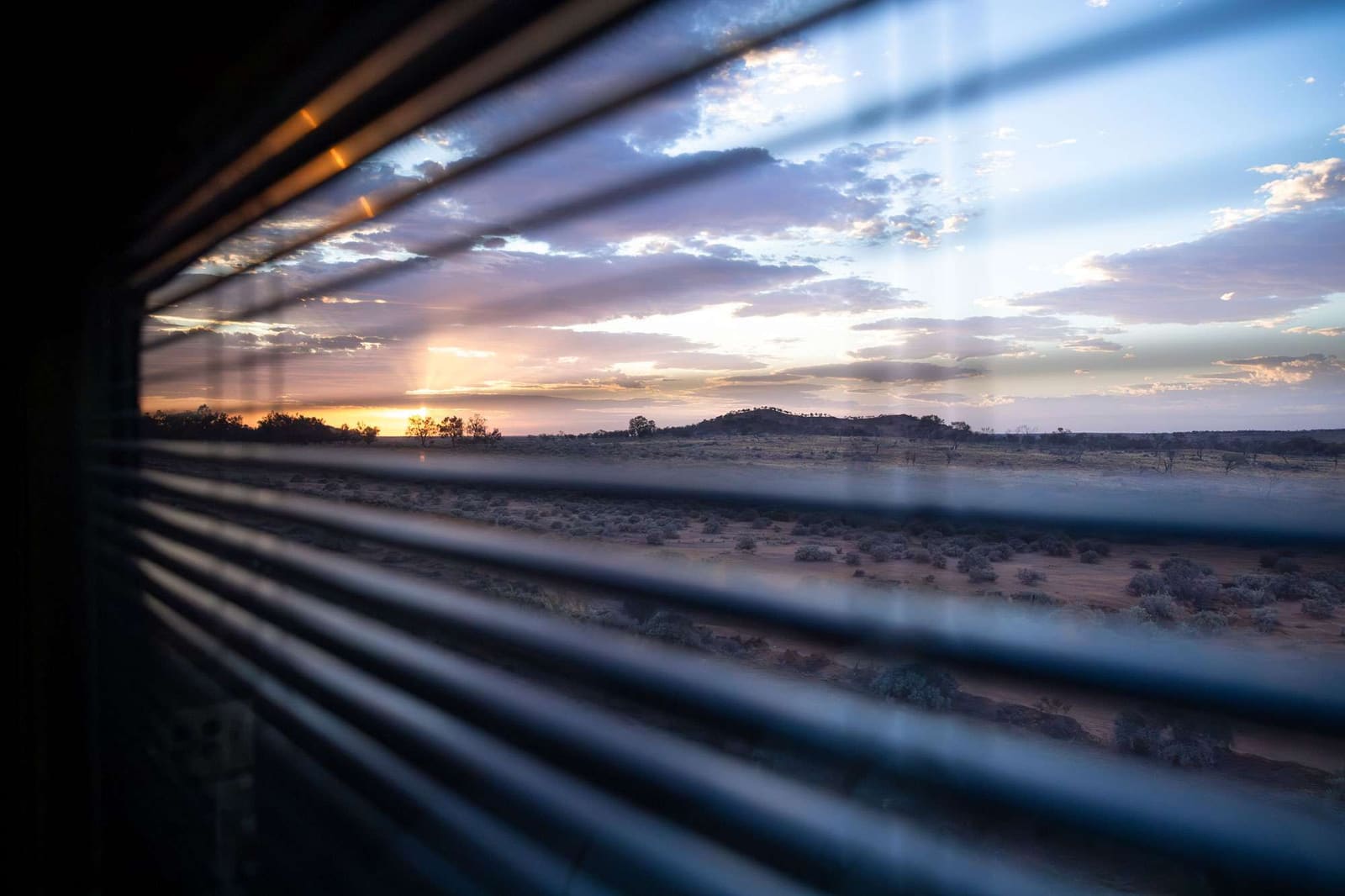
There is a particular quality to the morning light in Perth, a clarity that comes from facing an ocean with no landmass between here and Madagascar. The Indian Pacific departs from this edge, its carriages pointed east toward a horizon that will not yield the Pacific for another four days and 2,704 miles. At Global Chic Voyage, we've long held that the most revealing journeys are those that refuse to hurry, and this transcontinental passage stands among the slowest, most deliberate ways to understand a continent's breadth.
The train moves through climates as distinct as separate nations. Within hours of leaving the Western Australian coast, the jarrah forests give way to the Nullarbor Plain, a limestone plateau whose name, from the Latin, means "no trees." Here the track runs straight for 297 miles, the longest stretch of railway without a curve anywhere on Earth. Passengers watch the scrubland scroll past, unchanging yet somehow never monotonous, the way a Philip Glass composition holds attention through repetition and subtle variation.
Appetite and Arrival in the Red Centre
Food aboard becomes a ritual that structures the days. The dining carriages serve courses timed to the landscape, matching Western Australian marron with Chardonnay as the train crosses into South Australia, shifting to Barossa reds when the vines themselves appear outside the windows. The menus draw from regions the train actually traverses, a geographic honesty rare in travel dining.
At Rawlinna, a station that exists primarily to service the railway, the train pauses long enough for passengers to step onto red dirt and feel the Outback silence, a quiet so complete it seems to have texture. These brief stops punctuate the journey, offering not destinations but moments of calibration, a chance to register distance through the body rather than the eye.
By the second evening, the train reaches Cook, a former railway town now home to four permanent residents. The settlement offers no romantic vision of frontier life, only the honest arithmetic of isolation: what remains when economic purpose departs. Yet passengers linger on the platform, drawn by the strangeness of a place that persists beyond utility.
Historic Settlements and Shifting Terrain
The journey's midpoint brings a longer stop in Adelaide, where passengers can disembark for excursions into the wine country or remain aboard, watching the city's colonial grid from the stationary train. The choice itself feels luxurious, this permission to engage or observe as mood dictates.
Departing South Australia, the Indian Pacific begins its slow climb toward the Blue Mountains. The landscape gains texture, the flat vocabulary of the interior giving way to valleys and ridges. Eucalyptus forests thicken. The light changes, losing the hard glare of the centre, softening into the diffused green glow of coastal ranges.
Broken Hill appears briefly, its mine tailings and Victorian architecture a reminder that much of inland Australia was settled not for agricultural promise but for what lay beneath the surface. The town's art galleries and sculptor studios, unexpected in this red-dust context, suggest the ways communities reinvent themselves when the original reason for being exhausts itself.
The Arrival, Inevitable Yet Sudden
On the fourth morning, the train descends into the Cumberland Plain, and suddenly there are suburbs, the dense weave of a city that holds nearly a quarter of Australia's population. Sydney Harbour appears as if the continent has been holding this secret in reserve, waiting until the last possible moment to reveal water again.
The Indian Pacific terminates at Central Station, and passengers step onto the platform carrying the peculiar disorientation of those who have traveled slowly through vast distance. The journey has not been about speed or efficiency, those metrics that govern most contemporary movement. Instead, it has offered something increasingly scarce: a passage through landscape at a pace that allows the mind to absorb scale, to register the shifts in geology and climate that define a continent.
We return to trains like this not despite their slowness but because of it. In an era when air travel compresses distance into mere duration, the Indian Pacific insists on the reality of space, on the hours and miles that separate one coast from another. The luxury here is not in the fittings, though the carriages are comfortable, nor in the food, though it is thoughtfully prepared. The luxury is in time itself, in the permission to spend four days watching a continent unfold at the speed of steel wheels on steel rails.
The journey reminds us that Australia, despite its coastal cities and beach culture, is fundamentally an interior place, defined by the vast dry centre that most Australians never see. To cross it by train is to understand the nation differently, to grasp the scale of the inland and the courage, or perhaps stubborn optimism, required to lay tracks across it. The Indian Pacific does not conquer this distance so much as acknowledge it, moving through the landscape with a kind of mechanical patience that mirrors the continent's own indifference to haste.
Photo: Justin Meneguzzi
Spot something wrong? Email editors@globalchicvoyage.com. We log every correction publicly.
RELATED
SEE ALL →
1 Jul 2026 / 5 min
13 Jul 2026 / 5 min
27 Jul 2026 / 5 min
21 Jun 2026 / 5 min