
When Silver Shells Settle: Vintage Trailers Find Home in the Landscape
From canyon edges to riverbanks, the Airstream has shed its wheels and become something else entirely - a lens through which to see the American outdoors anew.
SI
21 Jun 2026 · 5 MIN READ · UPDATED 17 AUG 2026
A Pause in Motion
There is something quietly radical about a trailer that no longer moves. The Airstream, born in the 1930s as a symbol of restlessness and open-ended journeys, has in recent years found a second act as something far less transient: a room with a view that happens to be made of riveted aluminum. Parked on canyon floors, tucked beneath banana trees, or perched above mountain rivers, these vintage shells have become portals into landscape rather than vehicles through it.
At Global Chic Voyage, we have watched the resurgence of the trailer stay with interest. It is not simply nostalgia at work, though nostalgia certainly plays a role. It is also a shift in how travelers wish to occupy space. The appeal lies in the contrast: compact living that opens outward, midcentury design that refuses to compete with its surroundings, and the rare sensation of being somewhere without needing to be anywhere else.
What follows is a selection of vintage trailers that have been restored, anchored, and offered as stays across the United States. They share little beyond their aluminum skins and a commitment to simplicity. Each has found its own relationship with the land around it.
Desert Silence and Mountain Light
In the high desert north of Joshua Tree, a restored trailer sits on five private acres where the silence is broken only by the occasional roadrunner. The landscape here is wide and unforgiving in the way that deserts are, and the trailer does not attempt to soften it. Instead, it leans into the starkness: mountain views through every window, a wood-fired soaking tub positioned for sunset, a stock-tank pool that catches the afternoon heat.
The design is minimal, the amenities thoughtful. An outdoor projector allows for films under stars so bright they feel intrusive. There is no pretense of wilderness immersion - this is not camping - but there is a genuine invitation to slow down long enough to notice the way light moves across rock, the way temperature drops when the sun finally sets.
Joshua Tree National Park remains within reach for those inclined toward hiking and bouldering, but the real draw here is the permission to do very little. To sit. To soak. To watch the sky darken.
Urban Oases and Unlikely Hideaways
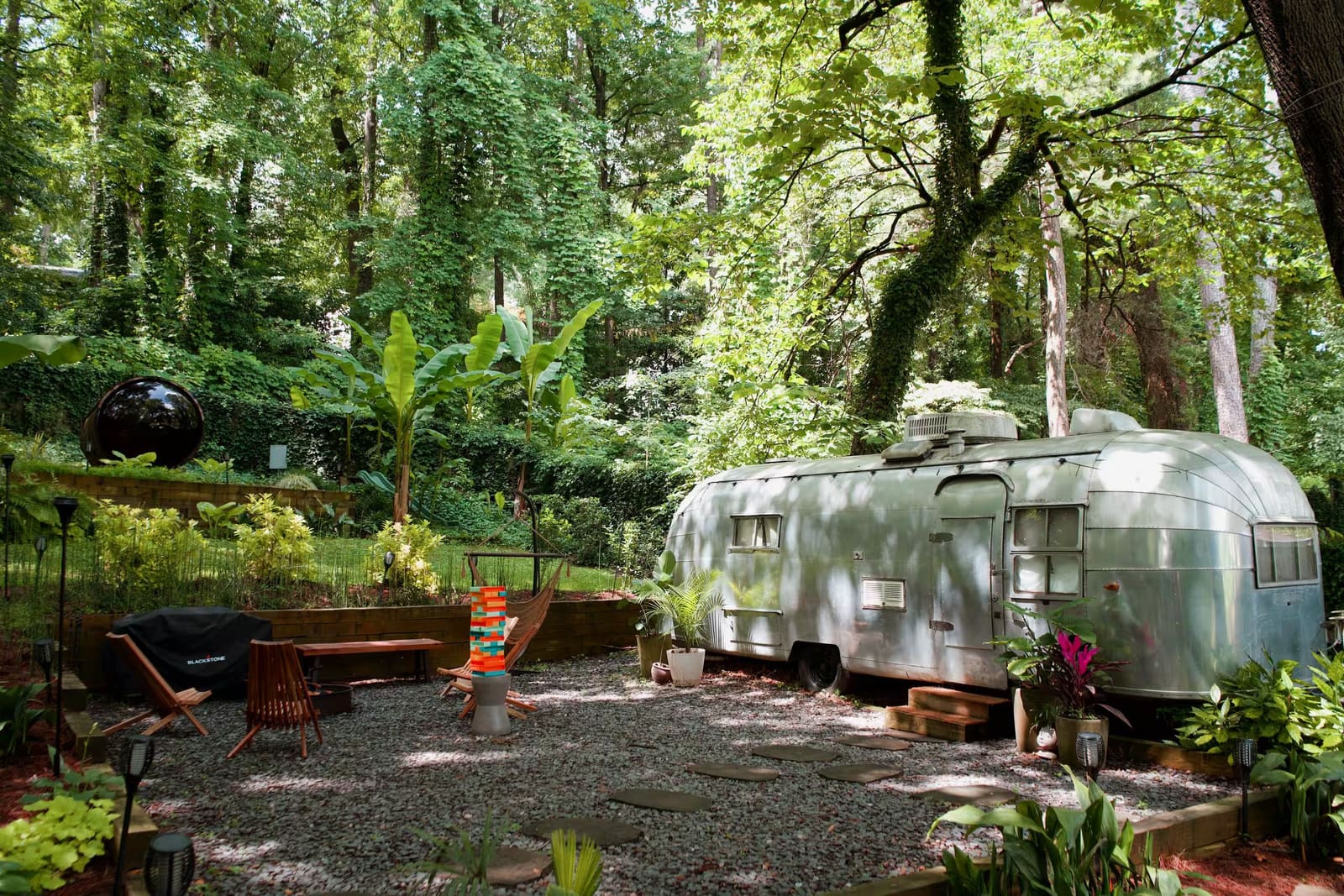
Not all vintage trailers have fled to remote corners. Some have settled into cities, carving out green pockets where none seemed possible. Just outside downtown Atlanta, a 1956 model sits among banana trees, a subtropical anomaly that feels both improbable and entirely right. The setting is lush to the point of excess: pool, hot tub, firepit, lounge spaces that spill into foliage. The city hums nearby, but it does not intrude.
Similarly, in Phoenix's Coronado neighborhood, a 1967 Overlander designed by local creative Joel Contreras has become something of a landmark. The trailer occupies a fenced yard within walking distance of the Roosevelt Row Arts District, yet it retains a sense of enclosure and privacy. Inside, the space is compact but never cramped, outfitted with modern appliances and a sleek kitchenette. Outside, desert landscaping and a shared deck invite lingering.
These urban stays work because they do not try to erase the city. Instead, they offer counterpoint: a place to retreat without fully withdrawing, to be near culture and dining and galleries while still inhabiting a space that feels separate, even sacred.
Farmland, Forest, and the Rhythm of Animals
In New York's Hudson Valley, an 1984 Airstream at June Farms sits tucked into woodland on a working farm where Highland cattle, horses, pigs, chickens, and ducks wander the grounds. The trailer itself is outfitted with radiant heat, air conditioning, a saltwater hot tub, and a modern bathroom - comforts that feel earned after a morning spent walking among the animals.
The rhythm here is dictated not by itinerary but by the farm itself. Mornings are for wandering. Afternoons for exploring the surrounding acreage. Evenings for soaking beneath the trees. Albany and Troy are close enough for a day trip, but the pull of the farm is strong. There is something grounding about proximity to animals, about the daily routines that shape a working landscape.
Further south, in North Carolina's Hot Springs, a 1973 Airstream sits on 30 acres of mountain terrain at Panther Branch Farm. Streams and waterfalls thread through the property, and hiking trails weave into the surrounding forest. The stay includes an outdoor sauna and access to natural spring water baths, both of which turn the forest into an extension of the accommodation itself. Goats, alpacas, chickens, and bees populate the farm, and their presence lends texture to the experience - a reminder that land is not simply scenery but a living system.
Riverside Anchors and Waterfront Perches
Water has a way of defining a stay. In Kernville, California, a restored Airstream sits directly on the Kern River, where the sound of moving water becomes the dominant sensory experience. The outdoor space here is terraced and layered: cedar hot tub, firepit, riverside seating, all oriented toward the water. The interior is updated but retains its vintage character, offering a simple base for two guests whose days will likely revolve around the river - rafting, swimming, floating.
In Louisville, Kentucky, a 1974 Sovereign Land Yacht occupies a waterfront position within Progress Park, a 12-acre adventure hub where guests have access to kayaks, paddleboards, fishing gear, and a sandy beach. The trailer itself sleeps up to six across four beds, though it is best suited to smaller groups. The appeal here is active rather than contemplative: a basecamp for families or friends who want to spend their days on the water and their evenings around a fire.
Both stays share a common logic. The water is not backdrop. It is the reason for being there.
Nostalgia Without Sentimentality
In Wassaic, New York, a 1970s Shasta camper - not an Airstream, but close kin - sits on a wooded hillside at the edge of nearly 400 acres of state land. The setup is stripped back: hammock, hot tub, firepit, small seating area. The camper sleeps two and is outfitted with modern appliances, including a television, Wi-Fi, and a Nespresso machine - gestures toward comfort that do not overwhelm the essential simplicity of the space.
What makes this stay work is its refusal to overstate. The nostalgia is present but not performative. The vintage aesthetic is real, not curated for Instagram. The location is quiet, green, and less than two hours from New York City, which makes it accessible without feeling convenient.
At Global Chic Voyage, we return often to the idea that luxury is not always about addition. Sometimes it is about subtraction. About removing layers until what remains is essential: shelter, landscape, silence.
The Architecture of Slowing Down
Vintage trailers, by their very design, force a reckoning with space. There is no room for excess. Every surface must serve a purpose. Every object must earn its place. This constraint, rather than feeling limiting, often becomes liberating. It clarifies what is needed and what is not.
But the real architecture of these stays is not interior. It is the relationship between the trailer and its surroundings. The way a hot tub is positioned to frame a mountain range. The way a deck extends into a grove of trees. The way an outdoor shower becomes a daily ritual rather than a necessity.
These are not accommodations designed to compete with the landscape. They are designed to reveal it.
The Invitation to Linger
What unites these vintage trailers is not their provenance or their aesthetic, though both matter. It is the invitation they extend: to stay awhile. To settle into a rhythm that is not dictated by sightseeing or itinerary. To spend an afternoon doing nothing more ambitious than watching light change, or listening to water, or walking among animals.
In a travel culture often defined by accumulation - more destinations, more experiences, more photos - the trailer stay offers a different value proposition. It asks travelers to choose depth over breadth, presence over motion.
It is, in many ways, the opposite of what the Airstream was originally designed for. And perhaps that is precisely why it works.
Spot something wrong? Email editors@globalchicvoyage.com. We log every correction publicly.
RELATED
SEE ALL →
29 Jul 2026 / 5 min
23 Jul 2026 / 5 min
21 Jul 2026 / 5 min
15 Jul 2026 / 5 min