
Villages That Still Know How to Whisper
In an age of overtourism and algorithmic itineraries, these small towns across five continents offer something rarer than beauty: the gift of unhurried time.
SI
21 Jul 2026 · 5 MIN READ · UPDATED 17 AUG 2026
The Cartography of Quiet
There is a particular quality of light in Praiano that the larger towns along the Amalfi Coast seem to have forgotten. It slants through the arches of San Gennaro Church in the late afternoon, pooling on centuries-old tile work, unhurried. The beaches - Gavitella, Marina di Praia - curve into the Tyrrhenian like parenthetical asides, intimate and unadorned. Twenty minutes from Positano by car, yet Praiano exists in a different temporal register altogether. We have returned here twice in the past three years, and each time the town has reminded us that proximity to fame need not mean capitulation to it.
This is the paradox at the heart of the world's most compelling small towns: they sit adjacent to the well-trodden circuits, yet maintain an almost stubborn fidelity to their own rhythms. At Global Chic Voyage, we have watched the geography of travel shift toward spectacle, toward the Instagram waypoint and the TikTok pilgrimage. And yet these villages - across Italy and Japan, Turkey and Greenland, Mexico and beyond - persist in their quieter registers, offering not photogenic moments but something closer to lived time.
Hokkaido's Chromatic Memory
In Biei, a town in Hokkaido's agricultural heartland, summer transforms the earth into a kind of horizontal tapestry. Lavender, poppies, marigolds - fields that stretch toward the Tokachi mountains in bands of saturated color, each row a deliberate stroke. The prefecture is better known for its winter skiing, its onsen tucked into snowy valleys, but the warm months here possess a different poetry. The flowers are not ornamental; they are rotational crops, part of the land's working vocabulary. To walk among them is to move through a landscape still dictated by season and soil, not by the demands of the tour bus schedule.
Biei asks you to recalibrate your sense of scale. The vistas are vast, the sky enormous, the human presence minimal. It is the antithesis of Tokyo's compressed energy, and perhaps that is why it feels so necessary - a reminder that Japan contains multitudes, that its beauty is not confined to the cherry blossom or the vermillion torii gate.
Gravity and Verticality
Some towns are defined by what looms above them. Baños, in the Andean foothills of Ecuador, sits in the long shadow of Tungurahua, an active volcano whose presence is both geological fact and daily companion. The town's name references its thermal springs, fed by the volcanic heat below, but it is the surrounding topography that truly defines the place: waterfalls cascading down forested cliffs, the Amazon basin spreading eastward, and that famous rope swing suspended over the Pastaza River gorge.
The swing has been photographed endlessly, turned into meme and metaphor, but standing at the edge of that precipice - Casa del Árbol, the treehouse from which it hangs - the sensation is less about spectacle than about the body's conversation with space. The arc of the swing, the void beneath, the volcano in the distance: it is vertigo as a form of awe.
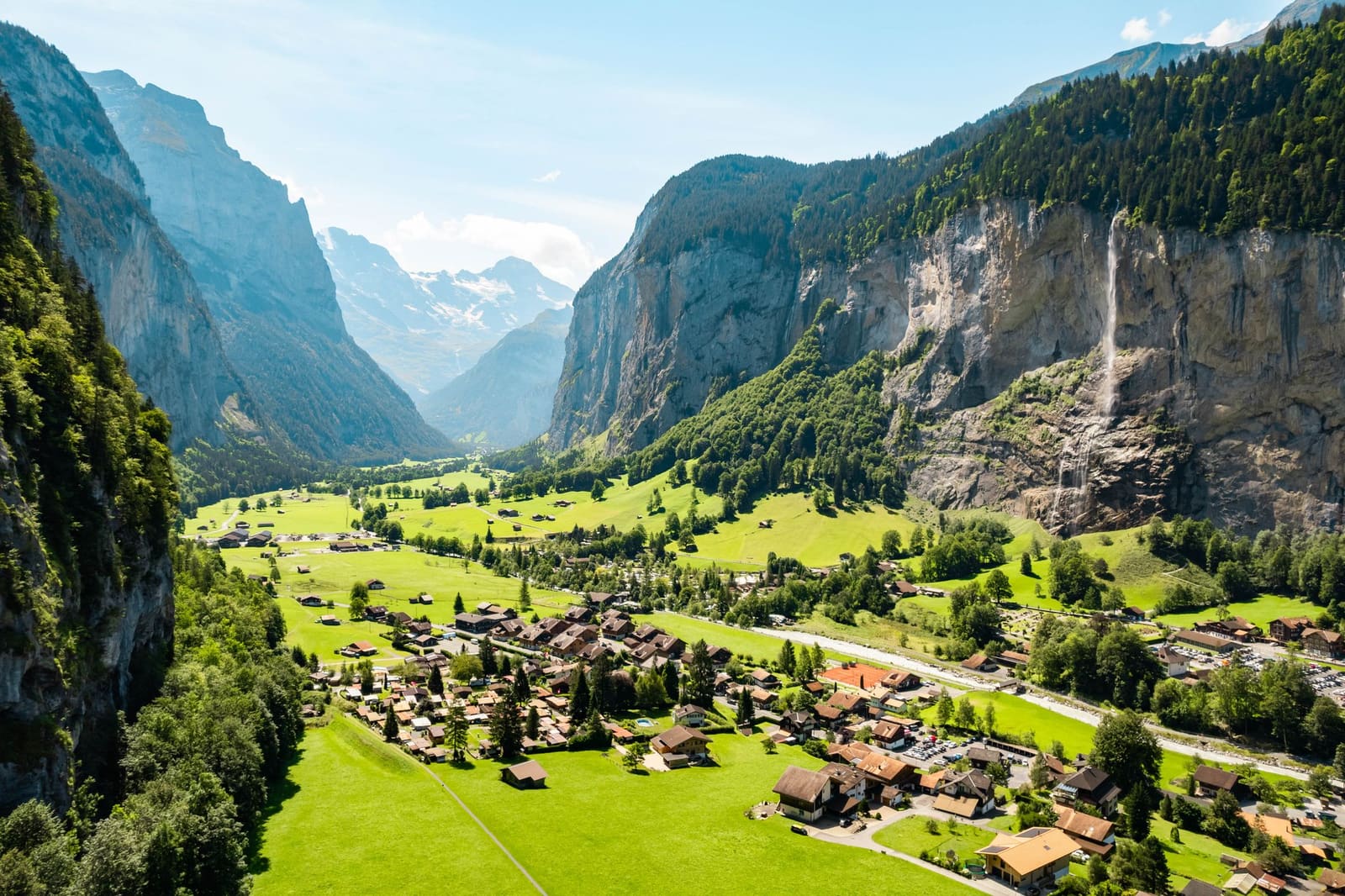
In a different hemisphere, Lauterbrunnen offers a Swiss counterpoint. The valley is a study in verticality, its sheer rock faces rising 300 meters on either side, seventy waterfalls threading down the cliffs. Tolkien reportedly drew inspiration from this landscape when imagining Rivendell, and the reference feels apt - not because the town is fantastical, but because it occupies a threshold space, where the cultivated meadows meet the sublime indifference of the Alps. The village itself is modest, a scattering of wooden chalets and hotels, but the geography around it renders human construction almost incidental.
The Architecture of Preservation
Certain towns function as living archives, places where the past is not reconstructed but continuously inhabited. Itchan Kala, the walled inner city of Khiva in Uzbekistan, is one such place. Its brick ramparts enclose a labyrinth of madrasas, minarets, and mosques, many dating to the city's tenure as a Silk Road waypoint. The entire enclosure is now a UNESCO site, yet around 300 families still live within its walls, their daily routines unfolding among structures that have stood for centuries.
To walk through Itchan Kala at dawn is to witness a kind of temporal layering: the call to prayer echoing off tilework installed by 19th-century artisans, morning light filtering through wooden lattices, the scent of bread baking in clay ovens. It is neither museum nor stage set, but a working town that happens to carry its history visibly.
Rothenburg ob der Tauber, in Bavaria, offers a Germanic variation on this theme. Its medieval Old Town remains remarkably intact - half-timbered houses, cobblestone lanes, the town wall still walkable in sections. December transforms it into a scene from a Grimm tale, snow dusting the multicolored facades, the Reiterlesmarkt Christmas market filling the squares with the scent of glühwein and roasted almonds. The preservation here is meticulous, almost theatrical, yet the town's appeal lies not in its perfection but in its willingness to inhabit its own aesthetic fully, without irony.
Chromatic Codes
Color becomes a kind of language in certain coastal villages. In Colonia del Sacramento, on Uruguay's eastern shore, the historic quarter is a study in earth tones and pastels - ochre walls, terracotta roofs, shutters painted in faded blues and greens. The town was founded by the Portuguese in the 17th century, contested by the Spanish, and now exists as a palimpsest of colonial architecture, its cobbled streets lined with vintage automobiles and bougainvillea.
A two-hour ferry from Buenos Aires, Colonia functions as a temporal escape hatch from the Argentine capital's intensity. The rhythm here is slower, the scale more human. Afternoons unfold along the riverfront, watching the light change over the Río de la Plata, the water turning from steel to amber as the sun descends.
Lunenburg, in Nova Scotia, offers a North Atlantic counterpoint. The fishing village's Old Town is a UNESCO site, recognized for maintaining its original 18th-century layout, and its waterfront is a riot of color - crimson, mustard, cobalt, each building painted in bold, unambiguous hues. The palette is practical, originally intended to help fishermen identify their properties from the water, but it has become the town's visual signature. Here, color is not decorative; it is legible, part of the maritime vernacular.
Desert Thresholds
Siwa Oasis rises from Egypt's Western Desert like a mirage made solid. The town is built around natural springs, surrounded by date palm groves and olive orchards, with the ruins of the Oracle Temple - where Alexander the Great reportedly sought counsel in 331 BCE - perched on a rocky outcrop. The architecture is predominantly kershef, a traditional method using sun-dried salt and clay bricks, structures that seem to emerge organically from the desert floor.
To arrive in Siwa after hours of driving through the Sahara is to experience oasis not as metaphor but as physical relief. The temperature drops beneath the palm canopy, the air smells of water and earth, and the town's pace adjusts to the desert's own logic: slow mornings, shuttered afternoons, evenings that extend late into the night when the heat finally relents.
Göreme, in Turkey's Cappadocia region, presents a different kind of desert threshold. The town is carved into the region's famous fairy chimneys - volcanic rock formations eroded into towers and cones - and its cave dwellings have been continuously inhabited for millennia. At dawn, hot air balloons rise by the dozens, drifting above the honeycombed landscape in near silence. From the ground, the spectacle is surreal; from the basket, the town below reveals its full extent: churches frescoed by Byzantine monks, underground cities, entire neighborhoods hewn from tuff.
The Balinese Exception
Penglipuran, in Bali's Bangli regency, is a traditional village that has become a kind of cultural exhibit, though not without cost. The main street is immaculate, lined with identical bamboo-gated compounds, each family home adhering to the same architectural template. The village's sacred bamboo forest is open to visitors, as are several temples, and during the biannual Galungan festival, the street is adorned with penjor - tall bamboo poles decorated with coconut leaves, flowers, and offerings.
The tension here is palpable: Penglipuran is undeniably beautiful, its preservation admirable, yet the volume of tourism threatens to flatten the very cultural specificity it purports to protect. We include it not as unqualified recommendation but as case study - a reminder that visibility and vitality are not always aligned, that a village can be loved to the point of erasure.
Antipodean Margins
Port Fairy, on Australia's southwestern Victoria coast, is a fishing village that has resisted the gentrification pressures that have transformed much of the Great Ocean Road. Its 19th-century cottages remain largely intact, their verandas and iron lacework weathered by salt air. The town's antique shops and cafes cater to a steady trickle of travelers, but the local economy still pivots around the fishing fleet and the annual folk festival.
To visit Port Fairy is to experience a version of Australia that exists outside the Sydney-Melbourne axis, a place where the pace is tidal, where the afternoon's primary decision is whether to walk the beach or explore the Moyne River estuary. It is unhurried in a way that feels increasingly rare, even defiant.
The Mountain Mystics
Tepoztlán, an hour south of Mexico City, occupies a narrow valley ringed by volcanic cliffs. The town has long attracted a particular breed of seeker - artists, healers, yogis - drawn by the area's reputation for spiritual energy. The Tepozteco pyramid, a pre-Columbian temple dedicated to the Aztec god of pulque, sits atop a nearly vertical cliff face, accessible only by a steep, rocky trail.
But Tepoztlán's appeal extends beyond the esoteric. The town's Sunday market is a sensory overload of mole negro, fresh tortillas, and handwoven textiles. Newer establishments - a sculpture garden called Dilao, a greenhouse cocktail bar named Margarita Concept - have layered contemporary design onto the colonial grid without erasing it. The result is a town that feels simultaneously ancient and evolving, rooted yet open to reinvention.
Coda: The Ethics of the List
We close not with prescription but with caution. To name a place, to publish its coordinates and virtues, is to alter it. The villages we have traced here - from Mandawa's frescoed havelis in Rajasthan to Sai Kung's geoparks in Hong Kong, from Burford's Tudor high street in the Cotswolds to Cadaqués' whitewashed alleys on the Catalan coast - are beautiful precisely because they have, until now, existed somewhat outside the circuits of mass tourism.
Our role, and yours, is not to extract but to engage. To move through these places with attention and respect, to support the local economies that sustain them, to resist the impulse to perform discovery. The towns that still know how to whisper do so because they have not yet been drowned out by our collective noise. May we learn to listen before we shout.
Photo: Getty Images
Spot something wrong? Email editors@globalchicvoyage.com. We log every correction publicly.
RELATED
SEE ALL →
29 Jul 2026 / 5 min
23 Jul 2026 / 5 min
15 Jul 2026 / 5 min

14 Jul 2026 / 5 min