
What a Decade of Charleston Summers Taught Me About Traveling Slowly
The Holy City reveals itself only to those willing to wander off the carriage-tour circuit - and stay long enough to notice.
SI
29 Jul 2026 · 5 MIN READ · UPDATED 17 AUG 2026
The Rhythm of Return
There is a particular quality to the light in Charleston at seven in the morning, just after the heat begins to gather but before the tour buses idle along East Bay Street. I learned this not from a guidebook but from repetition - summers spent arriving as a child, then as a restless adolescent, and finally as someone who understood that certain places demand you return in order to see them clearly. The Holy City, as locals have called it for generations, has always resisted the quick take, the weekend blitz, the checklist approach to travel. It asks for something closer to immersion.
At Global Chic Voyage, we've watched Charleston evolve from a quietly elegant Southern city into one of America's most visited destinations, and in that transformation lies a paradox. The more accessible it becomes, the more its essential character recedes behind a veil of popularity. The question for the discerning traveler is not whether to visit - Charleston's architecture, its culinary scene, its marshland beauty are undeniable - but how to visit in a way that honors the place rather than merely consuming it.
The Folly of the Three-Day Itinerary
Most visitors arrive with a mental map already drawn: Rainbow Row for photographs, a carriage ride through the historic district, dinner at one of the James Beard-nominated restaurants, perhaps a day trip to the plantations. These are not inherently wrong pursuits. But they represent Charleston as a series of attractions rather than as a living city with its own cadence and complications.
Helen Hill, president and CEO of Explore Charleston, has recently emphasized what longtime observers have known intuitively - that the city reveals itself most generously to those who slow down. This is not simply a matter of adding more days to your itinerary, though time certainly helps. It is about altering the fundamental approach, shifting from acquisition to observation, from doing to being.
The neighborhoods beyond the peninsula - James Island, Mount Pleasant, West Ashley - operate on different frequencies. They lack the concentrated historic charm of the French Quarter or South of Broad, but they contain the grocery stores where locals shop, the parks where families gather on Sunday afternoons, the seafood shacks where shrimp comes off the boat and onto your plate within hours. To ignore these areas is to mistake Charleston for a theme park version of itself.
What the Marsh Teaches
One summer, tired of the crowds at Waterfront Park, I began walking instead along Shem Creek in Mount Pleasant. The creek is a working waterway, lined with shrimp boats and seafood restaurants that cater as much to locals as to tourists. At low tide, the exposed mud releases a briny, fecund smell that some find unpleasant. But it is the smell of the Low Country itself - of oyster beds and spartina grass, of an ecosystem that has sustained human life here for thousands of years.
I sat on a dock one evening and watched egrets hunt in the shallows, their movements precise and unhurried. A pelican dove nearby, vanishing beneath the surface and emerging with a fish silvering in its pouch. The light turned amber, then rose, then a deep bruised purple. Tourists passed on the boardwalk behind me, headed to dinner reservations, and I understood then that there are two Charlestons - the one that appears in magazine spreads and the one that unfolds when you stop performing the role of visitor.
This is the paradox of travel writing itself: to describe a place is inevitably to package it, to suggest that experience can be replicated through the right combination of restaurants and viewpoints. But Charleston, like any place worth returning to, cannot be reduced to formula. It requires instead a kind of patient attention, a willingness to let the city set the terms of your encounter.
The Architecture of Time
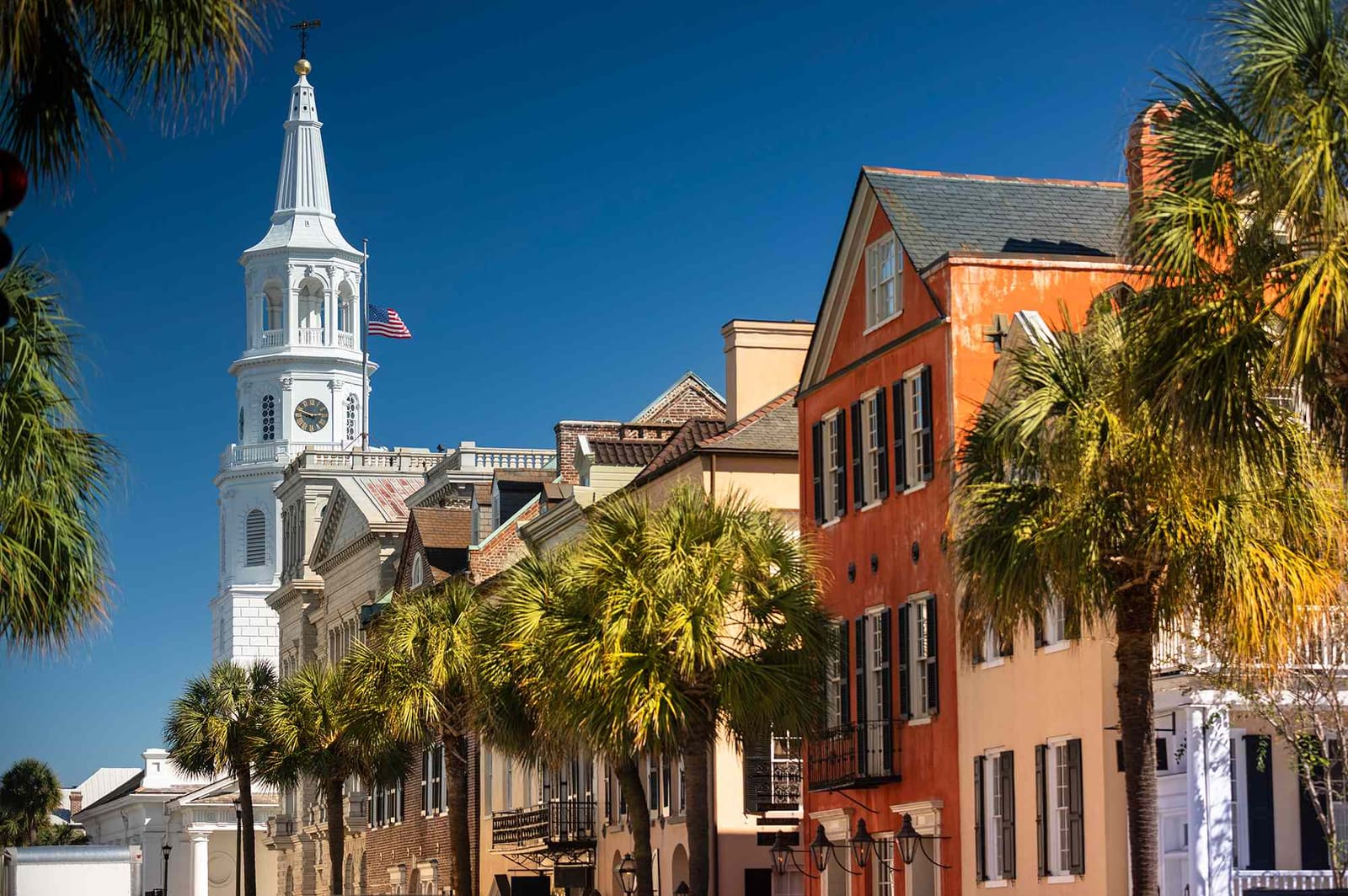
Charleston's historic architecture is justly celebrated, but the real revelation comes from understanding how these buildings exist in time. The pastel Georgian townhouses, the wrought-iron gates, the piazzas designed to catch the prevailing breeze - these are not museum pieces but living structures, adapted and re-adapted over centuries to accommodate new needs and tastes. Many have survived hurricanes, earthquakes, fires, and wars. They embody a particular relationship to impermanence and endurance.
Walking through the residential streets south of Broad Street on a weekday morning, you notice details that escape the carriage-tour narrative. A garden gate left ajar, revealing a courtyard thick with Confederate jasmine. The geometric shadows cast by palmetto fronds on a stucco wall. The faint sound of a piano being practiced, notes drifting through an open window. These are not attractions. They are simply the texture of a place where people live their lives, and they are available only to those who wander without agenda.
The same principle applies to the city's relationship with water. Charleston sits on a peninsula between two rivers, surrounded by tidal marshes and barrier islands. Its history is inseparable from maritime trade, naval warfare, and the brutal economics of the slave trade. To understand the city requires reckoning with these layers, not as abstract historical facts but as forces that continue to shape the landscape and culture.
Eating as Practice
Charleston's food scene has become a significant draw, and the acclaim is deserved. Chefs here have pioneered a contemporary approach to Low Country cooking that honors tradition while pushing boundaries. But the most instructive meals are often the simplest - a shrimp boil at a backyard gathering, oysters roasted over an open fire, okra soup made according to a family recipe passed down through generations.
I learned to eat she-crab soup not at a white-tablecloth restaurant but at a small café on Folly Beach, where the owner's grandmother's recipe had been in use for forty years. The soup was rich and slightly sweet, thickened with roe, finished with a splash of sherry. The owner explained the importance of using local blue crabs, the technique of extracting the roe without bitterness, the balance of cream and stock. It was a lesson in terroir as much as any wine tasting - a recognition that place expresses itself through flavor, and that paying attention to these expressions is a form of respect.
The farmers' market at Marion Square on Saturday mornings offers a similar education. Vendors sell Sea Island red peas, Carolina Gold rice, benne seeds, and other ingredients native to the region. Conversations at the market stalls reveal the connections between agriculture, ecology, and cuisine - how certain crops thrive in sandy coastal soil, how tidal patterns influence oyster harvests, how climate change is already altering growing seasons.
The Ethic of Slowness
What I have come to understand, after years of returning, is that Charleston rewards a particular ethic of travel - one that prioritizes depth over breadth, quality of attention over quantity of experience. This is not a matter of luxury, though time is always a privilege. It is a matter of intention.
The city's tourism infrastructure often encourages the opposite impulse - the desire to see everything, to maximize value, to return home with evidence of having been there. But the most resonant experiences resist documentation. They occur in the margins of the itinerary, in the unplanned conversation with a shopkeeper, in the decision to skip the museum and spend the afternoon reading in White Point Garden, watching container ships glide past Fort Sumter.
This approach runs counter to much contemporary travel culture, which treats destinations as backdrops for personal branding and measures experience in Instagram metrics. Charleston, to its credit, has resisted some of the worst excesses of overtourism, in part because its historic preservation laws limit development and in part because the city's identity is rooted in something older and more durable than trends.
Yet the pressure is real. As more visitors arrive, the balance becomes harder to maintain. The question facing Charleston - and places like it - is how to remain open and welcoming without becoming a caricature of itself, how to share its culture without commodifying it beyond recognition.
What Locals Know
The most valuable lesson from a decade of Charleston summers is this: locals know something visitors often miss. They know that the best beaches are not the most famous ones. They know which oyster roasts are worth attending and which are tourist traps. They know the rhythms of hurricane season, the patterns of afternoon thunderstorms, the subtle social codes that govern interactions in a city where families have lived for generations.
More than that, they know the cost of popularity. They see rents rising, traffic worsening, the gradual erosion of affordability that forces service workers to live farther from the city center. They watch their favorite restaurants become impossible to book, their quiet neighborhoods appear in travel guides. This is the uncomfortable underside of Charleston's success - a tension between economic vitality and livability, between sharing a place and preserving it.
As travelers, we are implicated in this tension. Our presence contributes to it, no matter how thoughtfully we move through the city. The least we can do is acknowledge the complexity, to travel with humility rather than entitlement, to recognize that we are guests in someone else's home.
The Long View
On my most recent visit, I walked the Battery at sunset, as I have done countless times before. The view is iconic - the harbor opening to the Atlantic, the pastel houses facing the water, the live oaks draped in Spanish moss. But familiarity had not diminished it. If anything, repetition had deepened my appreciation, allowing me to notice variations - the way the light changed with the season, the different ships at anchor, the gradual repair work on the seawall.
This, finally, is what Charleston has taught me: that true familiarity requires time, and that time reveals dimensions of place that speed obscures. The Holy City will accommodate the rushed visitor, will offer up its most photogenic facades and its acclaimed restaurants. But it reserves its deeper pleasures for those willing to return, to linger, to pay attention - not as tourists performing a role, but as travelers genuinely curious about what it means to be in this particular place, at this particular moment, with all its beauty and contradictions intact.
Credit: Pgiam / Getty Images
Spot something wrong? Email editors@globalchicvoyage.com. We log every correction publicly.
RELATED
SEE ALL →
2 Jul 2026 / 5 min
23 Jul 2026 / 5 min
21 Jul 2026 / 5 min

15 Jul 2026 / 5 min