
When a Writer Trades Cities for Quiet: One Novelist's Year in Venice
Andrew Sean Greer found that living in the lagoon - not just visiting - taught him to notice the pink-tinted street lamps, the fog that stalls the vaporetti, and the Venetian word for light bouncing off water.
SI
17 Jun 2026 · 5 MIN READ · UPDATED 17 AUG 2026
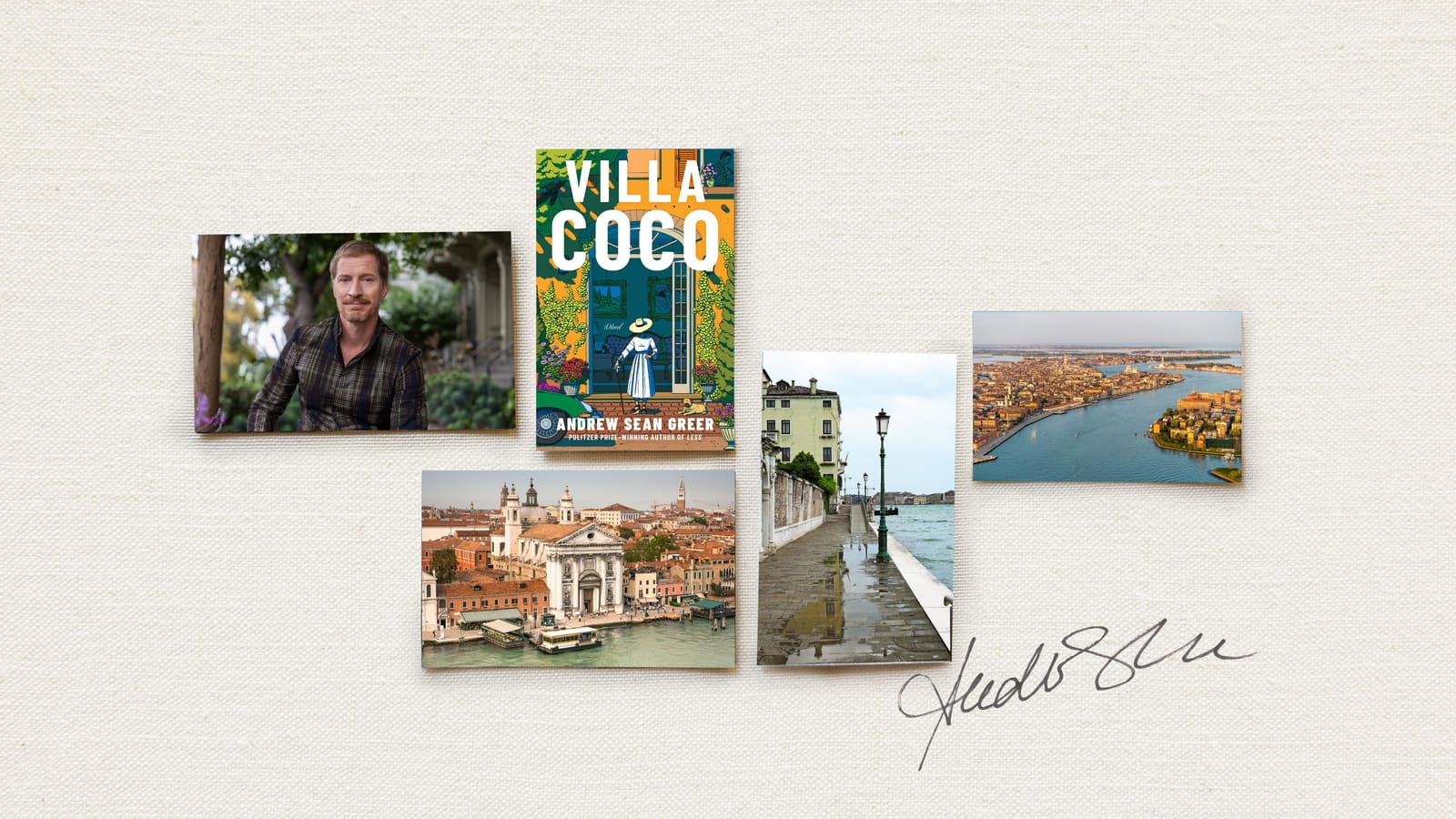
A Question of Where to Settle
There is a particular kind of restlessness that comes with being untethered from a place. In late 2024, Andrew Sean Greer found himself in that predicament, caught between Milan's rising rents and the bureaucratic reality that his Italian partner did not yet hold a U.S. green card. The solution, he thought, might be simple: find somewhere in Italy that could hold both of them, somewhere that would let him finish the novel he was deep inside. He pictured a medieval tower perched above the sea. His partner, more practical, vetoed the idea.
What Greer wanted, he came to realize, was not grandeur but conditions: quiet, a good restaurant, a beautiful square, a single masterpiece tucked inside a church. Enough to inspire without overwhelming. So they began a year and a half of searching, visiting lakeside towns outside Rome, coastal stretches south of Naples, testing each against an unspoken checklist. Finally, his partner suggested Venice. Greer's first reaction was incredulity. "It's almost like saying, 'I want to live in Sleeping Beauty's castle,'" he would later reflect. But they went anyway.
At Global Chic Voyage, we have long believed that the places we choose to live - even temporarily - shape not just our routines but our capacity to see. Greer's account of moving to Venice to complete his latest novel, Villa Coco, is a case study in that principle. The book itself is set largely in Tuscany, drawn from his time at a writers' retreat hosted by the Santa Maddalena Foundation. Yet it was Venice, with its winter fog and pink-tinted lamps, that allowed him to finish it.
The Texture of a Venetian Winter
Greer arrived in November, as the city emptied of tourists and settled into its quieter self. He was already deep into Villa Coco - a story about a young post-graduate who answers a help-wanted advertisement to catalog the contents of what turns out to be an aging Italian villa owned by an equally aging, charismatic Baronessa. The work demanded concentration, and Venice, in winter, offered exactly that.
Friends directed him to the library at the Fondazione Querini Stampalia, a palazzo in the Castello district where desks face a garden and other people sit working in companionable silence. To reach it from his apartment, Greer would take the long route by vaporetto, the water bus that threads along the Giudecca Canal and stops at the docks near San Marco and San Zaccaria. The daily journey became a kind of ritual, a way to settle his mind before sitting down to write.
What struck him most was the quality of attention the city demanded. Living in a country not his own, working in a language not his own, he found himself alert in a way he had not been in years. Early morning walks along the Zattere - a waterfront promenade in Dorsoduro - revealed layers he had missed on previous visits: runners in the dawn light, elderly women walking dogs, workers readying the trash boats. These were not tourist sights. They were the texture of a place when you stay long enough to see it breathe.
What San Francisco and Milan Could Not Give
Greer had spent three decades living and writing in San Francisco. Perhaps it was simply the accumulation of years, but he noticed that he had stopped paying attention. Familiarity had dulled his gaze. Milan, where he had lived before Venice, proved equally unhelpful. It was too much like other business-oriented cities, he felt, and offered too little to take in visually during walks. The fact that he spent much of his time there during the Covid-19 pandemic, restricted to a narrow radius around his apartment, did not help. He emerged from Milan with nothing - not material, he clarified, but the subtler thing that happens when your thoughts are allowed to wander and imagine.
Venice offered the opposite. A carved face on the side of a building might become a metaphor. A peculiar angle of light might lodge in his mind and reappear, later, as something a character notices. The city became a kind of collaborator, feeding him details he had not known he needed.
The final scene of Villa Coco takes place in Venice. Greer had drafted part of it before moving, but once he was living there, he realized the writing had been superficial, a tourist's take. The whole point of literary fiction, he has said, is to make readers recognize something they had not paid attention to before. Staying put allowed him to gather the details a visitor would miss.
He learned, for instance, that the street lamps in Venice are tinted pink. He discovered gibigiana, a Milanese word for the way light bounces off the water in the canals. He experienced the winter fog so thick that the vaporetti must halt mid-canal and wait for it to lift, churches emerging suddenly from the mist as the boat nears shore. These observations, he decided, were far more romantic than the gondola ride down a postcard canal.
The Case for Lingering
Greer's experience in Venice underscores a principle we have watched play out across the cities and regions we cover: that depth of place reveals itself only to those who linger. The Art Biennale was underway during his time there, adding another layer of visual stimulus, but it was the everyday rhythms - the pink lamps, the fog, the early risers along the Zattere - that seeped into his work.
This is not an argument for everyone to abandon their lives and relocate to Venice, nor is it a romanticization of the expatriate writer. It is, rather, an acknowledgment of what slow travel and sustained presence can yield. When you move through a place quickly, you collect impressions. When you stay, you begin to notice the light.
For writers, this distinction matters in practical terms. Greer's productivity in Venice was not simply a function of having a beautiful desk in a palazzo library, though that certainly helped. It was the accumulated effect of walking the same routes, seeing the same faces, learning the vocabulary of a place until it became second nature. The novel he was finishing was set elsewhere, but Venice gave him the mental space to complete it.
What a Place Teaches When You Stay
Living in Venice also reminded Greer of the value of disorientation. Being in a country not his own, working in a language not his own, kept him alert. This is the paradox of displacement: it can sharpen your attention even as it unsettles you. The unfamiliar becomes a lens through which you see more clearly, not less.
At Global Chic Voyage, we have long advocated for travel that prioritizes depth over breadth, that values the month-long rental over the three-day whirlwind. Greer's account offers a writer's version of that philosophy. The city he chose - Venice, with all its storied beauty and its risk of cliché - became newly legible to him because he committed to it. He did not simply visit; he lived. He did not simply observe; he participated in the daily choreography of a place.
The details he gathered - gibigiana, the pink lamps, the fog-stalled boats - are the kind that emerge only when you are no longer performing the role of traveler. They are what you notice when you have stopped trying to notice and have simply begun to inhabit.
The Discipline of Attention
Greer's time in Venice also speaks to a broader question about creativity and place. Can a city make you more attentive? Can it teach you to see again? The answer, based on his experience, seems to be yes - but only if you allow it to. Milan, for all its design pedigree and cultural infrastructure, did not offer him what Venice did. San Francisco, after three decades, had become too familiar to surprise him.
Venice worked because it was new enough to demand his attention but structured enough to support a daily rhythm. The vaporetto ride to the library, the morning walks along the Zattere, the quiet winter streets - these became the scaffolding around which his days, and his work, could organize themselves.
This is not a prescription. Another writer might find Milan electrifying and Venice suffocating. But it is a reminder that the relationship between a writer and a place is specific, almost chemical. What matters is finding the environment that lets your mind wander in the direction it needs to go.
The Novel, Finished
Villa Coco tells the story of a young person who answers an advertisement and finds themselves in a Tuscan villa, cataloging the belongings of a charismatic Baronessa. The novel draws on Greer's own time at a Tuscan writers' retreat, but it was completed in Venice, a city that appears only in the final scene. That scene, rewritten after Greer had lived in Venice long enough to see it clearly, became something different from what he had originally imagined. It became, he felt, more honest.
The lesson, if there is one, is not about Venice specifically. It is about what happens when you stop moving and start noticing. When you trade the gondola for the vaporetto, the postcard view for the pink-tinted lamp. When you learn the word for the way light bounces off water and watch the fog roll in thick enough to stop the boats.
Greer's year in Venice was not a pilgrimage or a retreat in the traditional sense. It was simply a decision to stay in one place long enough to let it teach him something. The result was a finished novel and a renewed sense of what it means to pay attention.
For those of us who spend our lives moving between cities, chasing the next story or the next experience, his account is a useful corrective. Sometimes the deepest travel is the kind that keeps you in one place, watching the light change, learning the rhythms, waiting for the fog to clear.
Spot something wrong? Email editors@globalchicvoyage.com. We log every correction publicly.
RELATED
SEE ALL →
29 Jul 2026 / 5 min

23 Jul 2026 / 5 min
21 Jul 2026 / 5 min

15 Jul 2026 / 5 min