
The Quiet Luxury of Closed Doors: Singapore's Most Considered Private Dining Rooms
From Cantonese duck carved tableside to outdoor terraces under the stars, the city's new wave of secluded dining spaces blends intimacy with ambition—and offers something far more valuable than privacy: the chance to linger.
SI
13 Jun 2026 · 5 MIN READ · UPDATED 17 AUG 2026
A Table for Two, a Door That Closes
There's a particular kind of silence that descends when the door to a private dining room clicks shut. Not the hush of a library, but something warmer—the feeling of a space held just for you, insulated from the hum of a dining room in full swing. In Singapore, where real estate is precious and restaurants are often designed to turn tables efficiently, the private dining room has become a quiet luxury: a place where time moves differently, where menus can unfold at their own pace, and where the architecture of the evening is as considered as the food itself.
At Global Chic Voyage, we've watched this category mature. What was once the domain of corporate lunches and milestone birthdays has evolved into something more textured—spaces that blend intimacy with ambition, where the design language is as articulate as the wine list. From Cantonese fine dining enclaves tucked beneath Marina Bay Sands to garden-wrapped pavilions in Dempsey Hill, Singapore's private dining rooms now reflect a city that has learned to value the unhurried meal, the long conversation, the kind of evening that doesn't check its watch.
The New Geography of Intimacy
The city's private dining landscape divides along lines of scale and sensibility. At one end: the small, jewel-box rooms designed for two to ten guests, where marble tables are inlaid with wildflowers and hand-painted murals frame the meal. At the other: entire venues that can be bought out for 90 or more, where terrace bars and live stations turn dinner into theatre.
Yantra, located within Tanglin Mall, offers three distinct rooms—each with its own character. The Wild Flower room seats six around a marble-topped table embedded with botanicals, a space so intimate it feels like dining inside a still life. The Polo Room, by contrast, opens onto an outdoor patio and connects directly to the bar—useful for pre-dinner aperitifs or the kind of evening that stretches past dessert. The menu spans vegetarian and non-vegetarian Indian cuisine: slow-cooked goat with spice, grilled seabass seasoned with ajwain, sautéed spinach finished with garlic. An eight-course experience menu is available for groups who prefer not to choose.
Siri House, nestled in the greenery of Dempsey Hill, takes a different approach entirely. Its outdoor private dining packages—Bubbles & BBQ, Brunch in the Sun, Garden Dining at Dusk—are built around the landscape as much as the food. The BBQ option includes a live station, tropical tablescape, and the possibility of a champagne trolley; the five-course Garden Dining menu features salmon tartare and harissa chicken plated with precision. Minimum spend starts from SGD 500, rising to SGD 1,500 depending on the format. For couples, the two-person Garden Dining at Dusk offers one of the city's more romantic private room experiences—proof that intimacy doesn't always require four walls.
Cantonese Craft and Industrial Glamour
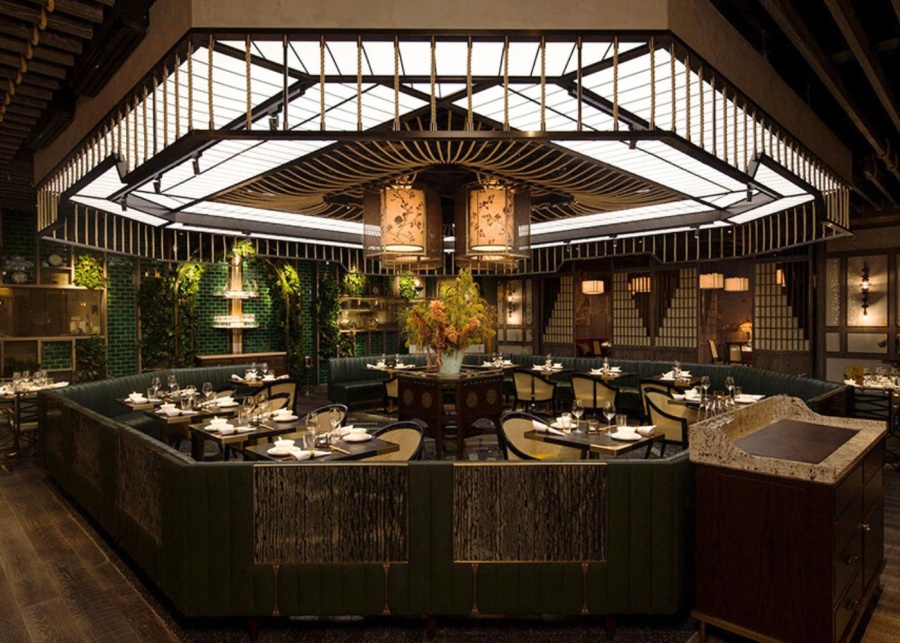
If there's a single room that encapsulates Singapore's current appetite for elevated Chinese dining, it may be Mott 32's private enclave. Located beneath The Shoppes at Marina Bay Sands, the restaurant blends industrial New York references with oriental luxury—exposed brick, pendant lighting, lacquered screens. The private and semi-private rooms accommodate six to twelve guests, and the menu centers on the kind of Cantonese techniques that reward patience: applewood-roasted Peking duck, widely regarded as one of the best iterations outside Hong Kong, served tableside with house-made hoisin, raw cane sugar, cucumber, scallions, and steamed pancakes. The kitchen also offers seafood, dim sum, and vegetarian options, all prepared with the same attention to ingredient sourcing and method. Mott 32 Singapore received a recommendation in the Forbes Travel Guide 2025, a nod to both execution and atmosphere.
Further east, Jia Wei Chinese Restaurant—inside Grand Mercure Singapore Roxy, near Marine Parade MRT—presents a more accessible model. Three private rooms accommodate thirteen to twenty guests, with a six-course menu that can be customized to budget. The Nanyang-inflected cuisine includes Hokkaido scallops glazed with orange and spice, A4 wagyu cubes with a smoky char, and coconut pudding topped with bird's nest. Minimum spend is set at SGD 1,000 per room, with corkage fees capped at SGD 40 per bottle for up to three bottles—a structure that appeals to groups seeking flexibility without sacrificing quality.
Altitude, Microbrewery, and the Terrace Advantage
Singapore's vertical geography has always lent itself to dining with a view, and the city's private rooms have learned to capitalize on elevation. LeVel33, perched on the 33rd floor of Marina Bay Financial Centre Tower 1, holds the Guinness World Record for the world's highest urban microbrewery. Its rooftop private spaces can be configured for standing receptions, seated dinners, or terrace events, with capacity for 24 to 30 guests in seated arrangements. The menu integrates brewing elements into modern preparations: seared Hokkaido scallops with Brut beer beurre blanc, salads dressed with Blond lager and verjuice. A plant-based menu is available for vegan diners. The terrace offers unobstructed views of the Marina Bay waterfront—an asset for evenings when the architecture of the city becomes part of the occasion.
Artemis Grill, on the 40th floor of CapitaGreen, takes a Mediterranean approach to the same premise. Floor-to-ceiling windows frame the skyline, and the private dining setup accommodates groups from ten upward, with a minimum spend of SGD 1,400. The menu leans on vibrant, produce-forward flavors—olive oil, citrus, grilled seafood, herb-heavy preparations—executed with the kind of restraint that lets ingredients speak clearly.
Why Intimacy Matters Now
The appeal of the private dining room is not merely functional—though privacy and dedicated service remain central to the proposition. What these spaces offer, increasingly, is the chance to shape the rhythm of an evening. In a city where dining out often means navigating wait times, ambient noise, and the subtle pressure to vacate a table, the private room becomes a kind of temporal luxury: a place where the meal can unfold at its own pace, where conversation need not compete with surrounding tables, where the architecture—whether floral wallpaper, hand-laid marble, or a view of the harbor—can be absorbed without distraction.
This shift reflects a broader recalibration in how Singapore approaches hospitality. The city has long excelled at efficiency and spectacle; what it is learning now is the value of the unhurried gesture, the meal that resists commodification, the evening that feels less like a transaction and more like an experience held in trust. The private dining room, in this context, is not an indulgence so much as an acknowledgment: that some occasions deserve their own architecture, their own silence, their own sense of time.
From the cinematic interiors of Firangi Superstar—where modern Indian plates reinterpret classic flavors beneath arches inspired by Kashmir and Rajasthan—to the halal-friendly dim sum spreads at Loong Dim Sum, capable of seating eight to eighty depending on configuration, the city's private dining options now span a wide spectrum of ambition and approach. What unites them is a commitment to creating environments where the meal is not merely served but staged, where the room itself becomes part of the narrative.
The Long View
As Singapore continues to refine its position as a global dining capital, the private room may prove to be one of its most revealing innovations. Not because it represents cutting-edge technique or avant-garde presentation, but because it speaks to a more fundamental shift: the recognition that luxury, in its most resonant form, is often about control—control over time, over atmosphere, over the terms of engagement. In a city that moves fast, the private dining room offers something increasingly rare: the chance to slow down, to linger, to let the evening unfold on its own terms.
The door closes. The city hums beyond the glass. And for a few hours, at least, the world shrinks to the size of a single table, a single conversation, a single meal prepared with care and served without rush. That, more than any view or any dish, may be the real luxury on offer.
Spot something wrong? Email editors@globalchicvoyage.com. We log every correction publicly.
RELATED
SEE ALL →
30 Jun 2026 / 5 min
30 Jul 2026 / 5 min
28 Jul 2026 / 5 min
24 Jul 2026 / 5 min