
The Moon-Touched Island Where Aegean Light Meets Volcanic Stone
Milos rises from the Cyclades with landscapes that feel borrowed from another planet - sea caves carved by millennia, water so blue it rewrites your understanding of colour, and a quietness that luxury cannot buy.
SI
13 Jul 2026 · 5 MIN READ · UPDATED 17 AUG 2026
A Geography Written in Fire and Water
The first time you round the northeastern coast of Milos by boat, the landscape refuses to behave like the rest of the Cyclades. Where Santorini offers drama and Mykonos polished white geometry, this island presents something stranger - cliffs that ripple in bands of ochre and chalk, coves where the seabed glows phosphorescent green through gin-clear water, and rock formations so lunar in character that you half-expect to see Neil Armstrong's footprints pressed into the pumice.
At Global Chic Voyage, we've watched this island move from the margins of Greek tourism into a quieter kind of spotlight, one that rewards the traveller willing to trade convenience for geological wonder. Milos earned recognition in recent global travel surveys not because it chases trends, but because it remains profoundly itself - a working island of fishing villages and mineral quarries that happens to possess some of the most arresting coastal scenery in the Mediterranean.
The volcanic origins are everywhere. The island's seventy-plus beaches each tell a different chapter of its fiery past: Sarakiniko's bleached white moonscape, sculpted by wind into smooth alien forms; Kleftiko's sea arches rising from cobalt depths like the ruins of a giant's cathedral; Firiplaka's rust-red cliffs striped with sulphur yellow. This is not an island that asks to be Instagrammed so much as contemplated, its beauty less about postcard perfection than about deep time made visible.
The Caves That Hold the Light
If Milos has a signature experience, it lives in the sea caves that puncture its southwestern coastline. These are not tourist grottos with handrails and ticket booths, but wild geological accidents accessible only by small boat, their interiors cathedral-vast and filled with light that refracts through seawater into impossible shades of turquoise and lapis.
Kleftiko remains the most celebrated, and for good reason. The name translates roughly to "the place of thieves," a reference to the pirates who once used these towering rock stacks and hidden chambers as shelter. Approaching by water at mid-morning, when the sun climbs high enough to illuminate the submerged caves, you understand why travellers return year after year. The water here achieves a transparency that feels almost synthetic, as though someone has backlit an aquarium. You can swim through arches, duck beneath stone bridges, float in chambers where the only sound is the lap of wavelets against volcanic tuff.
But the caves extend far beyond Kleftiko. Sykia Cave opens to the sky through a collapsed roof, creating a natural amphitheatre where swimmers gather in a pool of light. Papafranga's narrow channel leads to a hidden lagoon enclosed by white cliffs. These are places that resist commodification - too remote for tour buses, too dependent on sea conditions for guaranteed access, too raw to ever feel fully tamed.
Villages That Still Fish
For all its geological theatrics, Milos remains a working island, and that quality permeates the experience in ways that matter. Adamas, the main port, arranges itself around a deep natural harbour where fishing boats still outnumber yachts. Tavernas here serve fish bought that morning from boats you can see moored twenty metres away. The rhythm is unhurried, the tourism infrastructure competent but not overdeveloped.
Plaka, the medieval capital perched on a hilltop, offers the obligatory sunset views - and they are legitimately spectacular, the caldera spreading below in shades of rose and violet - but it also retains the feel of a place where people actually live. Narrow lanes wind between whitewashed houses, cats sleep in doorways, and the small archaeological museum holds Cycladic figurines and Roman statuary with a quiet professionalism that larger islands have long since abandoned for gift shops.
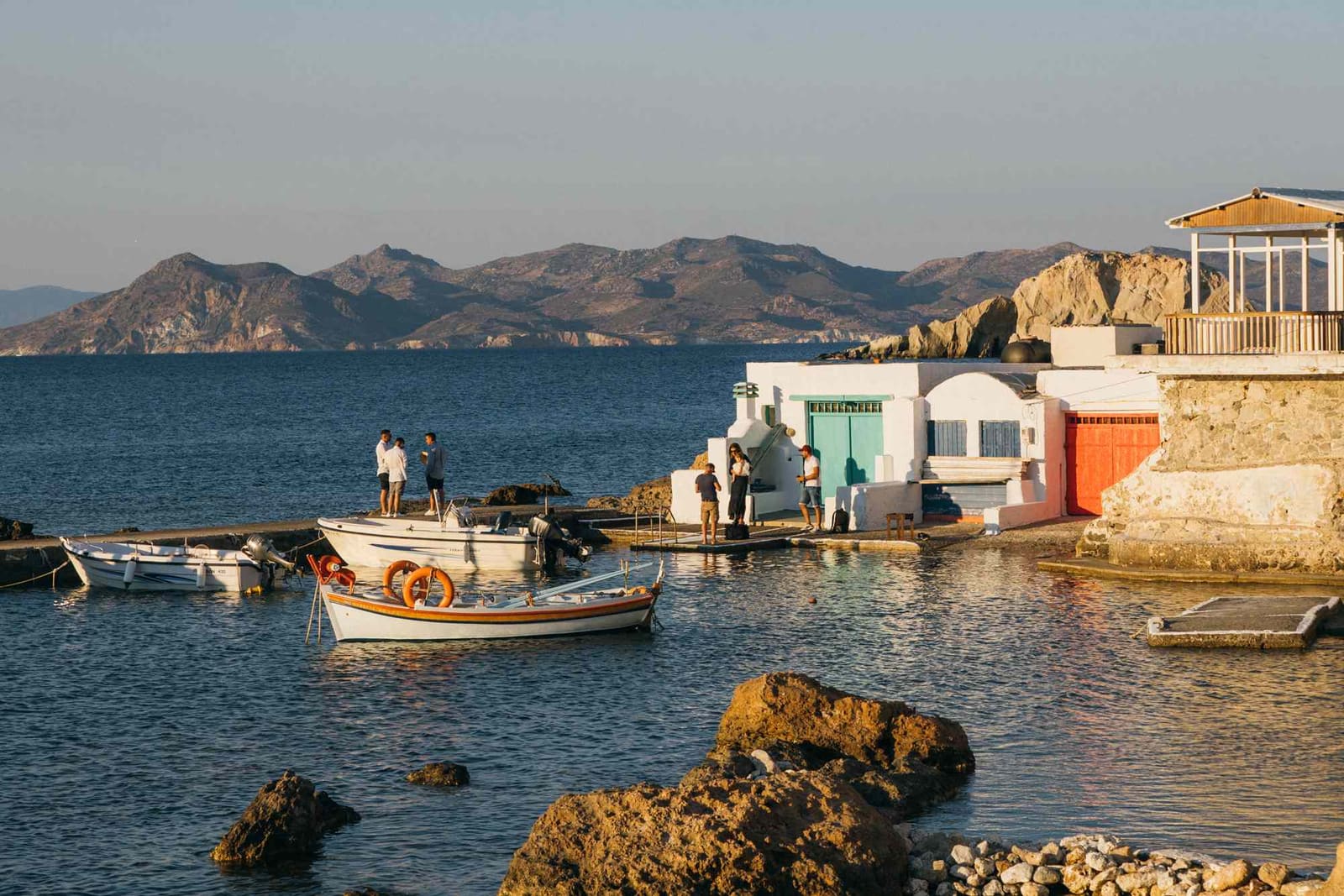
The fishing village of Klima, with its syrmata - brightly painted boat garages built into the cliff face, their wooden doors opening directly onto the sea - has become iconic in recent years, and yes, it photographs beautifully. But walk there in early morning or late afternoon, outside the brief window when day-trippers arrive, and you'll still see fishermen mending nets, still smell octopus drying in the sun. The island has learned to accommodate visitors without entirely performing for them.
Water in Every Shade of Possible
The beaches of Milos defy easy categorization, each shaped by the island's volcanic complexity into something distinct. Sarakiniko draws the most attention, its wind-sculpted white rock flowing into the sea like frozen cream, but it offers almost no sand and limited shade - this is a beach for exploration and photography rather than languid afternoons.
For actual swimming, the island reveals its generosity elsewhere. Tsigrado requires a descent down a wooden ladder wedged between cliffs, opening onto a small cove of golden sand and water so clear you can count pebbles at three metres' depth. Paleochori stretches long and dark-sanded beneath multicoloured cliffs, with thermal springs warming patches of the shallows. Firiplaka's red and white striations provide natural sun umbrellas in the form of overhanging rock, while Provatas offers the rare luxury of organized amenities without sacrificing beauty.
The water itself - this becomes the obsession. The volcanic seabed and mineral-rich geology conspire to produce colours that seem chemically enhanced: electric turquoise in the shallows, deepening to cobalt where the shelf drops away, shot through with veins of emerald where underwater caves channel the light. Snorkelling here requires no particular destination; you simply enter the water and bear witness.
The Practicalities of Remoteness
Milos asks for a certain flexibility. The island lies far enough from Athens - roughly three hours by ferry, or a short flight to a small airport - that it discourages casual day-tripping. Beaches are scattered, road signage occasionally cryptic, and the best coves require either a boat or a willingness to navigate dirt tracks in a rental car. This is not an island for travellers who require concierge-level hand-holding.
But for those comfortable with a degree of self-sufficiency, that remoteness becomes part of the appeal. You wake to plan your day around wind direction and sea conditions, not reservations. You discover beaches by asking locals or simply following promising dirt roads. You eat where fishermen eat, because there are no Michelin-starred alternatives orchestrating your palate.
Accommodation ranges from simple rooms in villages to a handful of boutique properties that understand luxury as space, view, and quietness rather than thread count. The island has thus far resisted the mega-resort model, its tourism infrastructure scaled to preserve rather than overwhelm. Whether this balance holds as recognition grows remains the central question for Milos, as it is for every beautiful place that finds itself suddenly visible.
Why This Island, Now
At Global Chic Voyage, we track not just where travellers go, but why certain places resonate in particular moments. Milos answers a contemporary hunger for landscapes that feel untranslated, for beauty that requires a little effort, for islands that have not yet fully committed to being products. It offers the Cycladic light and Aegean swimming that define Greek island fantasy, but wraps them in geology so strange and specific that the experience cannot be replicated elsewhere.
The moon-like quality of Sarakiniko, the cathedral hush inside Kleftiko's sea caves, the improbable colours of the water - these are not amenities that can be installed or experiences that can be designed. They are accidents of volcanism and erosion, available to anyone willing to make the journey and meet the island on its own terms.
In an era when so much of luxury travel involves elaborate curation and Instagram-optimized backdrops, Milos offers something increasingly rare: the possibility of genuine discovery, of rounding a headland and finding a cove that makes you stop and stare, of swimming in water so clear and strange it rewrites your internal catalogue of blue. The island's growing recognition feels earned rather than manufactured, a slow acknowledgment that some places simply possess a quality worth the detour.
The question, as always, is how long that quality can survive its own success. For now, Milos remains balanced on the edge - known enough to support travellers, remote enough to preserve its character. The caves still echo only with water and wind. The villages still smell of fish and salt. The volcanic rock still glows at sunset like something from another world. Get there while the balance holds.
Photo: Marco Argüello / Travel + Leisure
Spot something wrong? Email editors@globalchicvoyage.com. We log every correction publicly.
RELATED
SEE ALL →
23 Jul 2026 / 5 min
27 Jul 2026 / 5 min
8 Jul 2026 / 5 min
8 Jul 2026 / 5 min