
Dominica Rises to the Top of the Caribbean
The Nature Island has been recognized as the region's finest destination, drawing travelers to its volcanic peaks, emerald rainforests, and cascading waters.
SI
8 Jul 2026 · 5 MIN READ · UPDATED 17 AUG 2026
A Landscape That Chose Drama Over Ease
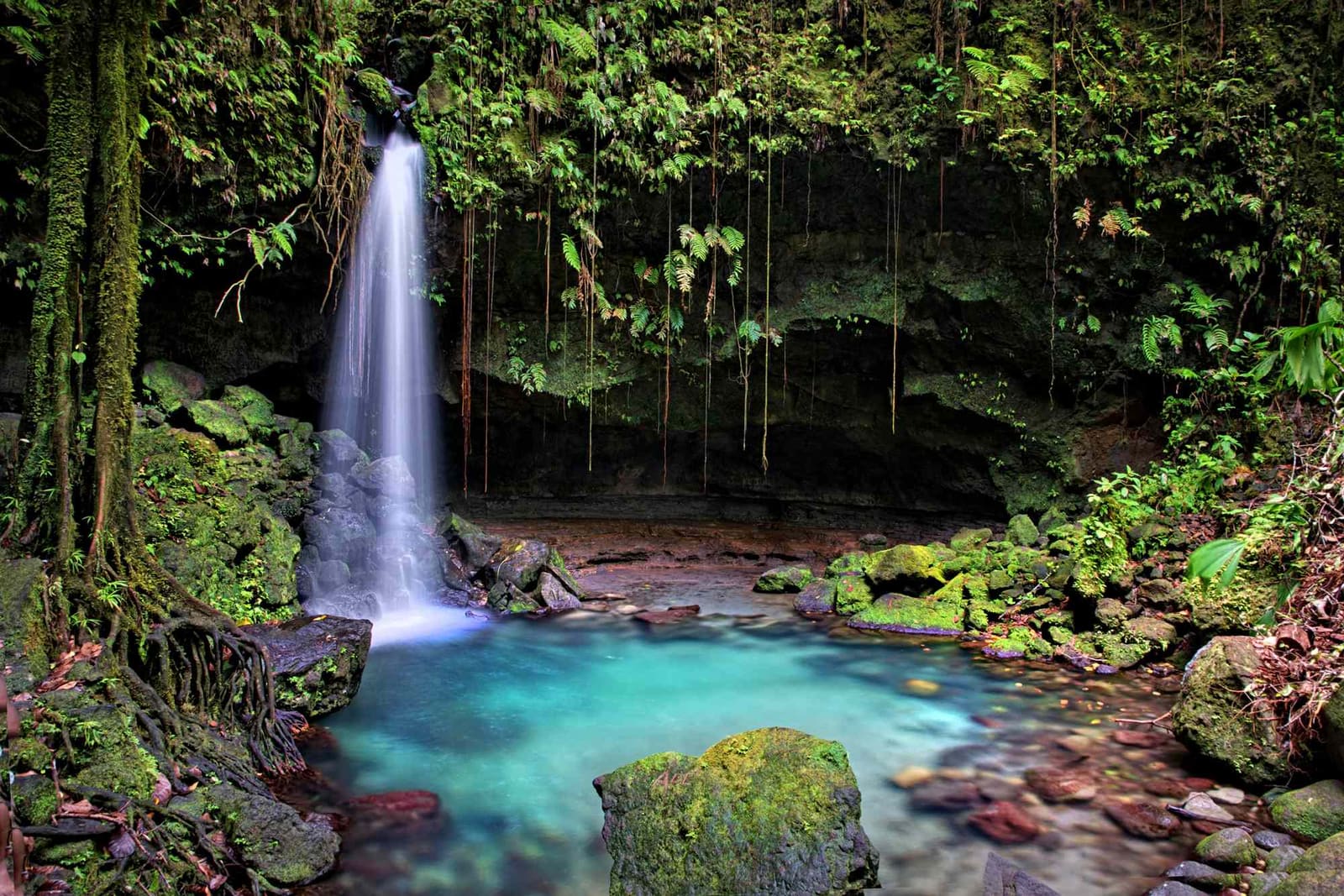
There are Caribbean islands that unfurl themselves gently, all white sand and turquoise shallows, and then there is Dominica. Here, the landscape rises abruptly from the sea in folds of green so dense they appear almost black in certain light. Waterfalls tumble from cliffsides hidden beneath canopies older than the colonial architecture found on neighboring islands. Volcanic peaks pierce the clouds, their slopes scarred by fumaroles that hiss and steam as though the earth itself is breathing.
At Global Chic Voyage, we've watched this island quietly distinguish itself from the resort-lined shores that dominate Caribbean tourism. Dominica has never aspired to be a beach destination in the conventional sense. Instead, it has leaned into what makes it geologically and ecologically singular: the raw, unmanicured wilderness that earned it the moniker "Nature Island." And now, in the 2026 World's Best Awards, that distinction has been formally recognized. Dominica has been named the finest island in the Caribbean.
The Volcanic Architecture Beneath the Green
The island's topography is a direct consequence of its volcanic origins. Nine active volcanoes shape the interior, their presence felt not only in the steaming vents and hot springs scattered across the terrain but in the mineral-rich soils that sustain one of the most biodiverse rainforests in the region. The Morne Trois Pitons National Park, a UNESCO World Heritage Site, encompasses much of this volcanic heartland. Within its boundaries lie the Boiling Lake, the second-largest thermally active lake on the planet, and the Valley of Desolation, where sulfuric gases vent from the ground in clouds that drift across bare, ochre rock.
Walking through these landscapes requires a different kind of engagement than the passive luxury often associated with Caribbean travel. The trails are steep, frequently muddy, and demand both physical stamina and a willingness to be uncomfortable. But the rewards are proportional. The view from the rim of Boiling Lake, reached after hours of trekking through cloud forest, is less a scenic vista than a confrontation with geothermal force. The water below churns in shades of gray and blue, its temperature fluctuating with subterranean activity that remains only partially understood.
Water in Constant Motion
Dominica claims more rivers per square mile than any other island in the Caribbean. Three hundred and sixty-five, by local count, one for each day of the year. These waterways carve through the island's interior, fed by rainfall that exceeds two hundred inches annually in the highlands. The result is a network of waterfalls that range from the easily accessible to the nearly mythic.
Trafalgar Falls, a twin cascade located a short drive from the capital of Roseau, offers a relatively gentle introduction. The path is paved, the viewing platform sturdy. But venture further inland, toward Middleham Falls or Victoria Falls, and the experience shifts. These require hours of hiking through dense forest, fording streams, navigating roots and rocks slick with moisture. The waterfalls themselves, when finally reached, feel less like destinations than like secrets temporarily revealed.
The island's relationship with water extends beneath the surface as well. The reefs along the western coast, particularly near Scotts Head and Soufrière Bay, are among the healthiest in the region. Coral formations thrive in the nutrient-rich waters stirred by volcanic activity. Divers encounter not only the expected parrotfish and angelfish but also seahorses, frogfish, and the occasional nurse shark. The underwater topography mirrors the terrestrial: steep drop-offs, canyons, and submerged hot springs where warm water rises through cracks in the volcanic rock.
A Cultural Landscape Shaped by Resistance
Dominica's human history is inseparable from its difficult terrain. The Kalinago people, indigenous to the island, resisted European colonization longer here than on most neighboring islands, aided by the mountainous interior that made large-scale plantation agriculture impractical. Today, the Kalinago Territory occupies thirty-seven hundred acres along the island's eastern coast, one of the last remaining indigenous communities in the Caribbean.
Visitors to the territory can engage with cultural practices that have persisted for centuries: cassava bread-making, canoe carving, basket weaving using techniques passed down through generations. But this is not a static or performative culture. The Kalinago have adapted, incorporating contemporary materials and methods while maintaining traditional knowledge systems. The architecture of the Kalinago Barana Autê, a cultural center built in the traditional style using modern engineering, reflects this synthesis.
The island's Creole culture, shaped by African, French, and British influences, expresses itself most vividly in music and cuisine. The rhythms of bouyon, a genre that originated here in the 1980s, blend Caribbean percussion with electronic elements. The food leans heavily on root vegetables, plantains, and freshwater fish, seasoned with herbs that grow wild across the island. Callaloo soup, crab backs, and mountain chicken (actually a large frog native to Dominica) appear on menus alongside more familiar Caribbean dishes.
The Infrastructure of Restraint
Dominica's tourism industry has developed slowly, constrained by both geography and deliberate policy. There are no international hotel chains, no all-inclusive resorts of the type found on Aruba or Jamaica. The largest properties hold fewer than one hundred rooms. Many accommodations are small guesthouses, eco-lodges tucked into the hillsides, or villas managed by local families.
This limited infrastructure is often framed as a drawback, a sign that the island has "failed" to develop in the manner of its neighbors. But at Global Chic Voyage, we've come to see it as a form of strategic positioning. The absence of mass tourism has preserved both the ecological integrity of the island and the authenticity of its cultural life. The travelers who come here tend to be those for whom hiking, diving, and cultural immersion hold more appeal than poolside lounging. They are, in other words, the kind of travelers the island has chosen to attract.
The recognition from the 2026 World's Best Awards suggests that this approach is resonating. As more destinations grapple with overtourism and the homogenization of place, Dominica offers a counter-model: tourism scaled to the capacity of the environment and the community, focused on depth of experience rather than volume of visitors.
The Practical Considerations
Getting to Dominica requires patience. There are no direct flights from major North American or European hubs. Most travelers connect through San Juan, Antigua, or Barbados, then take a short regional flight to Douglas-Charles Airport on the island's northeastern coast. The runway is short, limiting the size of aircraft that can land. Alternatively, ferries run between Dominica and Guadeloupe or Martinique, a slower but more scenic option.
Once on the island, transportation is best arranged through local drivers who know the roads, which twist sharply through the mountains and can be treacherous after rain. Rental cars are available, but navigating requires confidence and caution. Many visitors opt for guided tours, particularly for hikes into the national park or dives along the coast.
Accommodations range from budget guesthouses in Roseau to mid-range eco-lodges in the interior to higher-end properties along the western coast. Prices are moderate by Caribbean standards, though the island's remoteness means that imported goods, including many food items, are more expensive than on larger islands with more developed supply chains.
The best time to visit is between November and May, when rainfall is lighter and trails are more manageable. The summer and fall months bring higher precipitation and the risk of hurricanes, though Dominica's mountainous terrain often disrupts storm systems, sparing the island the worst impacts.
What the Recognition Signals
The 2026 World's Best Awards ranking is not an isolated phenomenon. It reflects a broader shift in how travelers are evaluating destinations. The criteria that once dominated, ease of access, predictable luxury, sanitized cultural experiences, are giving way to new priorities: ecological health, cultural authenticity, the opportunity to encounter a place on its own terms rather than through the lens of resort marketing.
Dominica's ascent to the top of the Caribbean rankings suggests that the island's long-standing commitment to environmental protection and small-scale tourism is being vindicated. But it also raises questions about how the island will manage increased attention. Tourism growth, even when well-intentioned, exerts pressure. Trails erode, reefs suffer from increased diver traffic, local culture becomes performative under the gaze of too many cameras.
The challenge for Dominica will be to maintain the qualities that earned it this recognition while accommodating the inevitable increase in visitor numbers. That will require continued investment in infrastructure that supports sustainable tourism: better waste management systems, enforcement of environmental regulations, training programs for guides and hospitality workers, and policies that ensure tourism revenue benefits local communities rather than external investors.
At Global Chic Voyage, we remain cautiously optimistic. Dominica has, so far, resisted the temptations that have undermined other Caribbean destinations. Its leadership has articulated a vision of tourism that aligns with ecological and cultural preservation. Whether that vision can withstand the pressures of success remains to be seen. But for now, the island offers something increasingly rare: a Caribbean destination that has not yet been flattened by its own popularity, where the landscape still feels wild and the culture retains its particularity. That, perhaps more than any ranking, is reason enough to go.
Photo: Getty Images
Spot something wrong? Email editors@globalchicvoyage.com. We log every correction publicly.
RELATED
SEE ALL →
29 Jul 2026 / 5 min
27 Jul 2026 / 5 min
27 Jul 2026 / 5 min
24 Jul 2026 / 5 min