
The Lime-Green Chairs and Hot-Pink Doors of Cape Town's Queer Heart
For thirty years, one corner of de Waterkant has been a refuge, a stage, and a homecoming - the story of a bar that helped a city learn how to be itself.
SI
21 Jun 2026 · 5 MIN READ · UPDATED 17 AUG 2026
A Corner That Holds a Continent
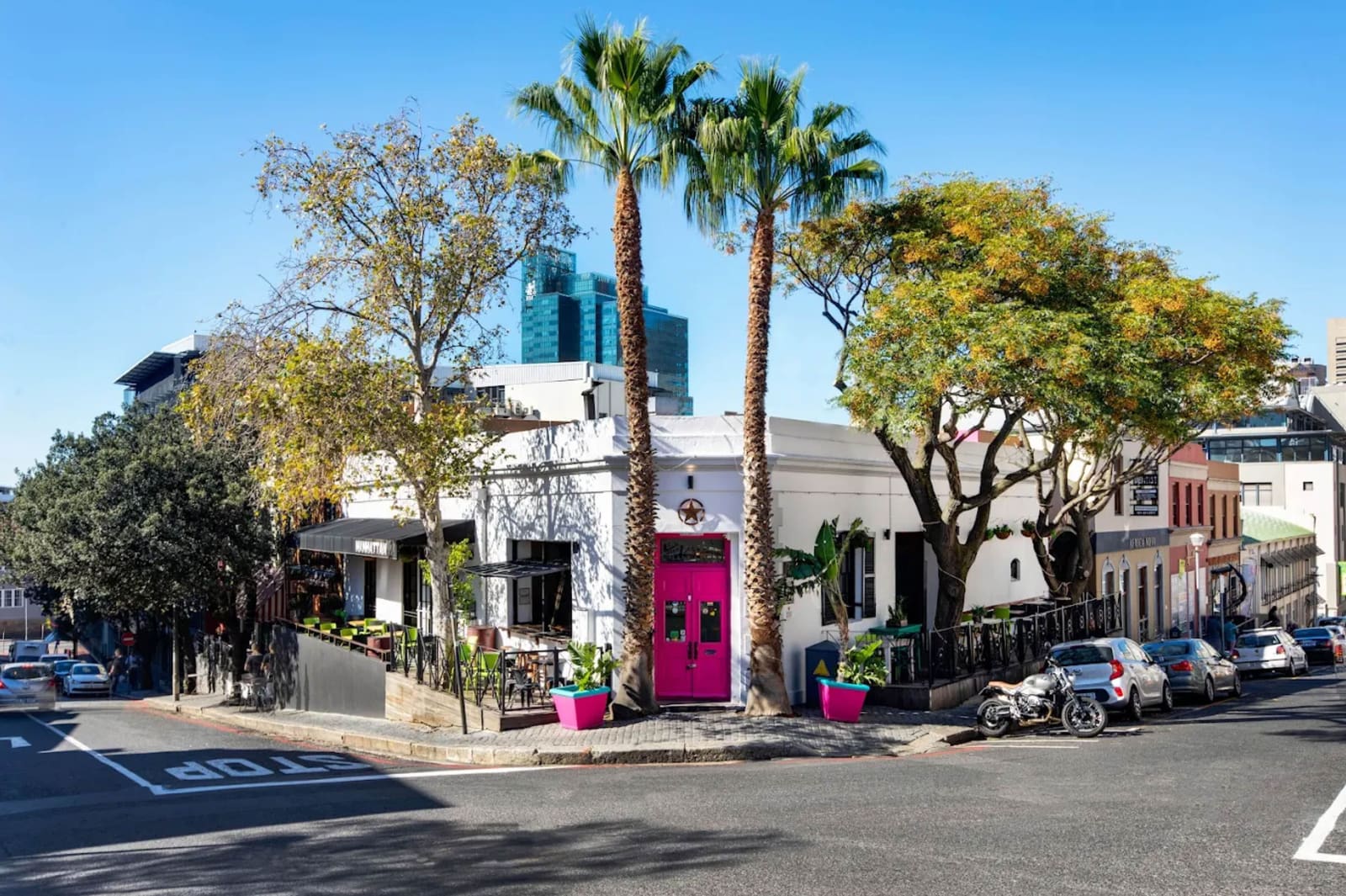
There is a corner in Cape Town where the chairs are lime-green and the doors are painted hot-pink, and if you arrive on the right evening you might hear laughter spilling onto the pavement before you see the building itself. The structure is angular, white-walled, modernist in the way that suggests confidence rather than showiness. It occupies an entire intersection in de Waterkant village, and it has been there - in one form or another - since 1994, which makes it older than the constitution that reshaped the nation around it.
At Global Chic Voyage, we've long believed that the most important spaces in a city are rarely the loudest. They are the ones people return to, the ones that become shorthand for an entire chapter of a life. In Cape Town, that place is Cafe Manhattan, and its story is not just about a bar. It is about what happens when a community is given a corner of its own, and what that corner becomes over thirty years.
Before the Rooftops and the Boutiques
Cafe Manhattan was established by Russell Shapiro, a local entrepreneur, in a year that carried extraordinary weight. South Africa was two years away from adopting a constitution that would make it the first nation to explicitly prohibit discrimination based on sexual orientation. The end of apartheid was still unfolding. The neighborhood of de Waterkant, now thick with sleek rooftop restaurants and luxury boutiques, was a quieter, less polished enclave. The cafe became a catalyst, a gathering point that helped define the character of the area long before the developers arrived.
What Shapiro built was not merely a venue. It was a stage. In 1997, he opened On Broadway, a sister venue funded by proceeds from the cafe, dedicated to cabaret, comedy, theatre, and performance. The acts that graced its stage were flamboyant, unapologetic, and wildly popular. Celebrity impersonators took on Marilyn Monroe and Lady Gaga. An all-female vocal trio delivered Motown classics that packed the room. A drag performer named Lilly Slaptsilli ran a show for nearly eighteen years, becoming a fixture in the collective memory of the city's queer nightlife.
These were not quiet performances. They were declarations. In a country still finding its footing after decades of institutionalized oppression, visibility was both a risk and a radical act. Cafe Manhattan offered a rare thing: a public space where queer artists could claim the spotlight, where audiences could cheer without looking over their shoulders.
The Architecture of Welcome
Walk past the threshold and the minimalism of the exterior gives way to color and texture. The decor is eclectic, leaning toward a kind of wild-west-adjacent aesthetic that feels both playful and deliberate. The space is open-air, breezy, designed to let the Cape Town climate do half the work of hospitality. But the real architecture here is social. It is the way the room arranges itself around the idea of refuge.
Lindiwe Nuolandi, who has managed the bar for eight years, was recruited in part because she is a member of the local queer community. She describes the environment as less judgmental, more relaxed than other workplaces she has known. For her, the cafe is not just a job; it is a reprieve. The clientele - locals, seasonal visitors, travelers from across the continent - share a certain ease. They get along, she says simply, and that ease is the product of intentional design as much as any physical layout.
Melanie Habel, the head chef, speaks of the "swallows," the affectionate local term for visitors who migrate from colder climates during South Africa's summer months. They return year after year, drawn by the burgers but also by something harder to quantify. The bar has evolved its programming over the decades: quiz nights hosted by drag artists, date-night specials, Eurovision watch parties, and a monthly market called First Thursdays that fills the street with food trucks and vendors from the queer community. These are not merely events. They are rituals, small acts of economic and social solidarity woven into the fabric of the neighborhood.
A Geography of Safety
Jorge Baron, who co-organizes a monthly queer networking series called Village Drinks, often meets travelers from Nigeria, Uganda, and Zimbabwe at the cafe. They are, he says, blown away by the simple fact of being able to exist openly. In much of the continent, such visibility remains dangerous. Cape Town, for all its complexities, offers a rare pocket of relative safety, and Cafe Manhattan has become a symbol of that possibility.
The bar's history is inseparable from the broader legal and cultural shifts that have unfolded in South Africa since the mid-1990s. The constitution adopted in 1996 under Nelson Mandela did not erase prejudice overnight, but it created a legal framework that made visibility less perilous in certain urban centers. Cafe Manhattan emerged in that narrow window, a space that both reflected and accelerated the cultural changes taking shape around it.
Yet the story is not one of seamless progress. South Africa remains a country of profound contradictions, where legal protections coexist with violence and inequality. The bar's significance lies precisely in its specificity: it is a corner, not a country. It is a place where people can breathe, even if the rest of the world remains complicated.
Found Family and the Geometry of Belonging
Arthur Van Wyk, a comedy producer from Durban, began visiting the cafe in the late 1990s, when he was in his twenties. He had left his township after experiencing gun violence and was offered a place to stay by a man who happened to be gay. The two became close friends, and Van Wyk, who does not identify as LGBTQ+ himself, found himself absorbed into a wider social circle that revolved around the cafe.
He describes the experience as transformative. As a young colored man navigating Cape Town in the aftermath of apartheid, he found in the bar a sense of belonging he had not anticipated. People treated him as one of their own. He shared meals - chicken and shrimp curry, plates passed between friends - and he strolled through the onsite markets where queer vendors sold trinkets and T-shirts. The bar became, for him, a model of what community could look like when it was built on welcome rather than exclusion.
This is the geometry of found family: not bloodlines but chosen kinship, not inheritance but deliberate construction. Cafe Manhattan has always operated on this principle. It is a place where people who have been told they do not belong can walk through hot-pink doors and find a table waiting.
The Legacy of a Lime-Green Chair
Habel notes that former patrons who have moved away from Cape Town make a point of returning whenever they are in the city. They arrive with a kind of reverence, she says, because the bar reminds them of their old days. It is a living archive, a place where personal histories are stored in the arrangement of tables, the tilt of a picture frame, the memory of a particular night when the drag queen hit every note and the crowd roared.
The building's facade was once electric blue, decked with rainbows. Now it is white, punctuated by those lime-green chairs and hot-pink doors. The evolution of the exterior mirrors the evolution of the community it serves: more confident, perhaps, but still unmistakably itself.
At Global Chic Voyage, we return again and again to the idea that luxury is not always about opulence. Sometimes it is about time - the luxury of a space that has endured long enough to become part of the landscape, long enough to hold the memories of multiple generations. Cafe Manhattan has been many things over three decades: a catalyst, a stage, a refuge, a homebase. But perhaps most importantly, it has been consistent. In a world that often demands queer people justify their existence, the bar simply opens its doors.
What a Corner Can Teach a City
There is a lesson in the longevity of this place, and it has little to do with business strategy or market positioning. It is about what happens when a space commits, over decades, to a single proposition: that people deserve a place where they can be themselves without translation or apology.
Cape Town has changed around Cafe Manhattan. The neighborhood has gentrified, the skyline has filled with new construction, the demographics have shifted. But the corner remains, lime-green chairs and all, a fixed point in a city that is still learning how to hold all its citizens with equal care.
The bar's story is not a fairy tale. It does not erase the violence and exclusion that persist elsewhere in the country and the continent. But it offers something equally important: proof that alternative geographies are possible, that a single corner can become a world unto itself, that thirty years of welcome can accumulate into something like home.
When travelers from across Africa walk through those hot-pink doors and find themselves, for a moment, able to simply be, they are not just visiting a bar. They are stepping into a history, a legacy built one lime-green chair at a time. And when they leave, they carry that possibility with them - the knowledge that such places exist, that they endure, and that they will be there, on that corner in de Waterkant, when they are ready to come back.
Spot something wrong? Email editors@globalchicvoyage.com. We log every correction publicly.
RELATED
SEE ALL →
31 Jul 2026 / 5 min

29 Jul 2026 / 5 min
13 Jul 2026 / 5 min
8 Aug 2026 / 5 min