
The Italian Hospitality Brand Weaving Palazzi, Peaks, and Private Clubs into One World
Le Graal arrives with a portfolio, not a property - three destinations across Italy that share a vision of hospitality as belonging, not booking.
SI
22 Jun 2026 · 5 MIN READ · UPDATED 17 AUG 2026
A Vision Rooted in Connection, Not Convention
There is a particular kind of arrival that certain hotels engineer - the moment the heavy door closes behind you and the city outside becomes an echo. But Le Graal, the new Italian luxury brand set to unfold across three wildly different landscapes, is not interested in that kind of isolation. Its founder, Fabrizio Di Amato, speaks of hospitality not as a series of stays but as an ecosystem, a world you enter once and inhabit across multiple geographies. It is an ambitious proposition, one that asks guests to think of their relationship with a brand the way they might with a friend's country house - fluid, recurring, layered with memory.
At Global Chic Voyage, we have watched the luxury hospitality sector fracture into two camps: the sprawling international chains that promise consistency across continents, and the fiercely independent properties that stake their identity on singularity. Le Graal appears to occupy a third space entirely. It is small enough to retain intimacy - just three addresses planned so far - but conceived with enough breadth to allow guests to move between them as though crossing rooms in a palazzo, not borders on a map.
Di Amato, a Rome-born entrepreneur whose engineering group Maire has operated far from the world of suites and sommelier lists, describes Le Graal as a personal venture rooted in a broader ambition to elevate the Made in Italy narrative. According to Di Amato, the brand represents a departure from traditional hospitality definitions, seeking instead to create environments where culture, aesthetics, and human connection converge organically. His family office has begun assembling the pieces: a luxury helicopter company, a Brunello winery in Montalcino, and now this trio of destinations that will open in sequence over the next two years.
The Cortina Debut: Alpine Heritage Reimagined
Le Graal Cortina will arrive first, opening this autumn in a 1920s Austrian heritage building a short walk from the town center and ski lifts. The architect is Achille Salvagni, for whom this marks a first hotel commission. His interiors for the thirty-room property - thirteen of them suites - sidestep the familiar alpine vocabulary of dark timber and stag heads. Instead, Salvagni has worked with brushed-oak Versailles flooring, white dolomitic stone, and a palette of red, green, and gray marbles, layered with tone-on-tone stuccoes that soften the mountain light.
Claudio Ceccherelli, Le Graal's director of operations and a veteran of Park Hyatt Paris-Vendôme, Hôtel Martinez Cannes, Park Hyatt Milan, and Villa d'Este, describes the result as a new visual and experiential narrative within the Dolomites. Every room frames a view of the peaks, but the interiors resist the rustic clichés that have calcified around ski-resort design. The hotel will remain open year-round, an acknowledgment that Cortina's hiking trails and summer festivals deserve the same reverence as its winter slopes.
We have seen this shift before - the desire to unbind mountain destinations from their seasonal straitjackets - but few properties have matched the architecture to the ambition. Salvagni's approach, rooted in restraint and materiality rather than motif, suggests a different kind of alpine luxury: one that privileges calm over coziness, light over lodge.
Rome's First Contemporary Members' Club
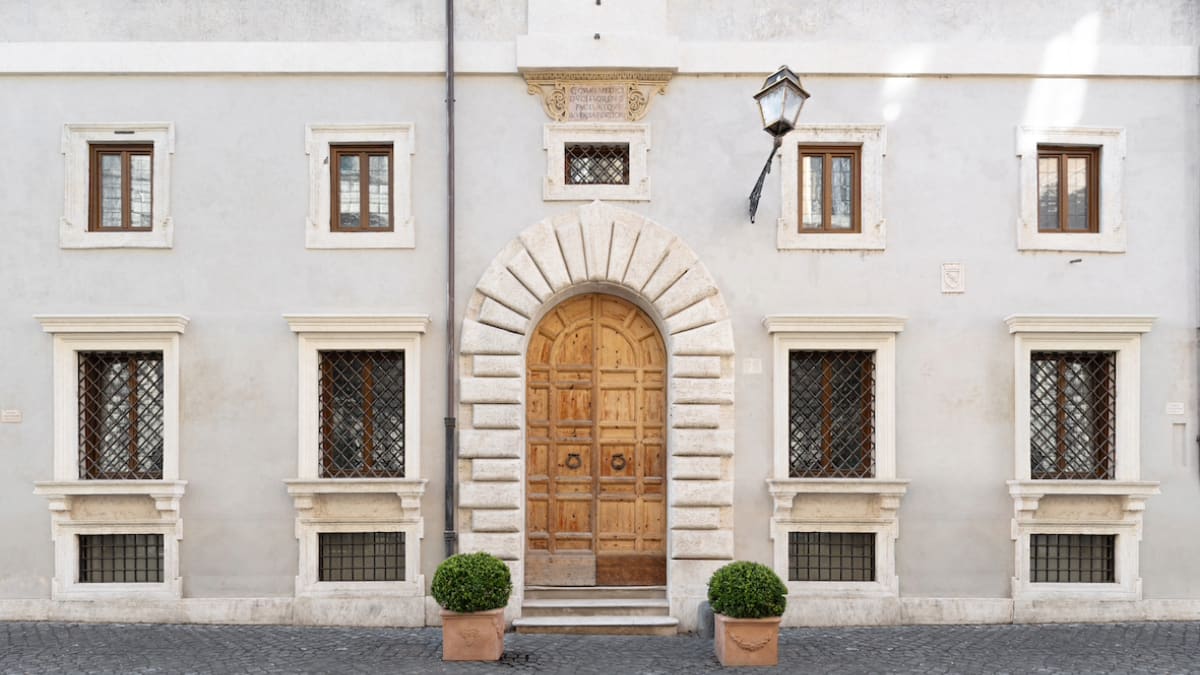
By winter, Le Graal will open a private members' club inside Palazzo Medici Clarelli on Via Giulia, one of Rome's most storied streets. The palazzo will house eleven rooms and suites, two restaurants, a cloister lounge, an American bar, a speakeasy, a cigar room, a wine cellar, a gym, and treatment rooms. It is a dense program for a single building, but the layering feels deliberate - each space a different register of privacy, sociability, ritual.
Di Amato, a member of 5 Hertford Street and Oswald's in London, credits the British club model with shaping his vision. He found in those spaces a particular kind of sophistication - rooted in community and cultural exchange, yet quiet, discerning. But he wanted to reinterpret that model for Rome, stripping away the hierarchies that can define London's storied clubs. According to Di Amato, membership will be shaped not by title or industry but by curiosity and shared sensibility, creating an environment where relationships feel natural and conversations unfold without effort.
Rome has long had its social institutions - literary salons, diplomatic circles, the overlapping worlds of film and fashion - but it has lacked a contemporary members' club of this scale and ambition. Le Graal's version arrives at a moment when the city's creative and entrepreneurial communities are expanding, yet the infrastructure for connection has remained curiously static. The club is designed to fill that gap, offering not just a beautiful setting but a forum for exchange that feels as essential as it does elegant.
Lake Garda and the Architecture of Well-Being
The third address, slated for 2028, will transform a Palladian villa on Lake Garda into a retreat centered on well-being. The programming is built around three pillars - energetic renewal, conscious longevity, and stress management - each integrated with the landscape, the architecture, and the regional cuisine. It is a model we have seen gain traction across Europe, particularly as wellness moves away from the spa-as-amenity approach and toward something more holistic, more central to the guest experience.
Ceccherelli emphasizes that the foundation of Le Graal's approach is deeply Italian: respect for craftsmanship, cultural context, and the enhancement of historic buildings. The Lake Garda property will not be a wellness resort in the generic sense - sterile, interchangeable, clinically detached from place. Instead, it will root its treatments in the region's agricultural traditions, its thermal history, its relationship to water and light. The villa itself becomes part of the therapy, its proportions and materials shaping the rhythm of the day.
We have returned often to the question of what makes a wellness retreat feel authentic rather than performative. The answer, increasingly, lies in specificity - not just in the treatments offered but in the way those treatments are woven into the fabric of a place. Le Graal's Lake Garda project, at least in ambition, suggests that kind of integration.
An Ecosystem, Not an Empire
What distinguishes Le Graal from other emerging luxury brands is its refusal to scale in the conventional sense. There are no plans for a dozen properties, no franchising agreements, no march across continents. Instead, the brand is building a closed loop: three properties, each distinct in character and purpose, yet connected by a shared sensibility and, crucially, by the ability to move between them. A guest at Cortina might receive an invitation to an event at the Rome club. A member in the capital could travel to Lake Garda for a retreat. The helicopter company and the winery are not add-ons but part of the same constellation, tools for crafting bespoke journeys that feel less like itineraries and more like narratives.
This model - boutique in scale, expansive in imagination - recalls the European grand tour, when travel was measured not in nights booked but in relationships cultivated, landscapes absorbed, experiences layered over time. It asks guests to invest not just financially but emotionally, to see Le Graal not as a provider of services but as a portal into a particular way of moving through Italy.
Ceccherelli speaks of this as creating a feeling not of being hosted but of being part of something. It is a subtle distinction, but an important one. Hosting implies a transaction, a beginning and an end. Belonging implies continuity, return, the slow accumulation of memory that transforms a place from destination to home.
The Quiet Ambition of Rediscovery
Italy has never lacked for luxury hospitality. Its grand hotels are institutions, its family-run properties the stuff of legend, its design heritage unmatched. What it has lacked, perhaps, is a contemporary framework for connecting those elements - one that honors the past without being trapped by it, that embraces innovation without discarding identity.
Le Graal's arrival suggests that such a framework is possible. It is not about reinvention, as Ceccherelli notes, but rediscovery - taking what has always been there and arranging it in a way that feels newly urgent, newly relevant. The craftsmanship, the cultural context, the respect for historic architecture: these are constants. What changes is the lens through which they are viewed, the narrative that binds them together.
As the brand prepares to open its first property in Cortina this autumn, the question is not whether Le Graal can deliver on its vision of interconnected luxury - the team, the properties, and the ambition are all in place. The question is whether travelers are ready to engage with hospitality as something more than a series of bookings, to see it instead as a world they can inhabit, return to, and ultimately belong to. If they are, Le Graal may well define a new chapter in Italian luxury, one where the journey is not from place to place but from guest to member, from visitor to kin.
Spot something wrong? Email editors@globalchicvoyage.com. We log every correction publicly.
RELATED
SEE ALL →
30 Jul 2026 / 5 min
7 Jul 2026 / 5 min
17 Jun 2026 / 5 min
12 Jun 2026 / 5 min