Proximity Is the New Luxury: Midtown's Quiet Hotel Renaissance
The heart of New York has finally learned to breathe — and the new generation of hotels rising between 34th and 59th streets proves the city's center can be both essential and escapist.
SI
12 Jun 2026 · 5 MIN READ · UPDATED 17 AUG 2026
The View From the 47th Floor
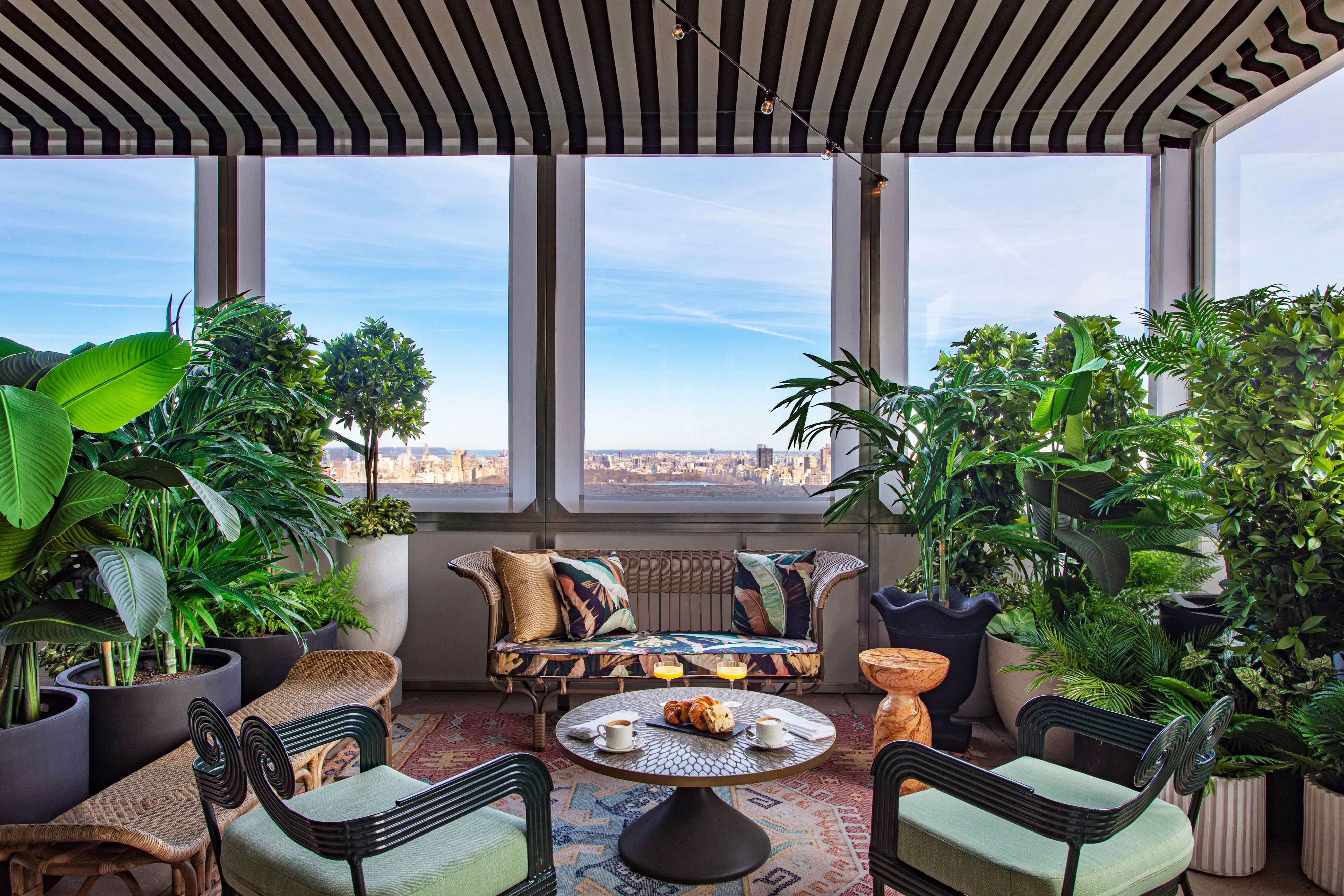
There's a particular quality of light that arrives just before dusk in Midtown Manhattan, when the geometry of the grid softens and Central Park becomes a dark lung breathing against the glass towers. We've watched it from enough hotel windows over the years to recognize the shift — that brief interlude when the neighborhood's relentless commercial pulse slows just enough to reveal something more textured beneath. At Global Chic Voyage, we've long argued that a city's center tells you more about its aspirations than its edges ever could, and nowhere is this truer than in the stretch of Manhattan between 34th and 59th streets, where the question of how to sleep in the middle of everything has finally produced answers worth discussing.
For decades, Midtown meant transit: a place to pass through en route to somewhere more interesting, a corridor of corporate beige punctuated by tourist landmarks. But the hotels that have emerged and re-emerged here in recent years suggest a different understanding — one that recognizes proximity not as compromise but as possibility. To stay in Midtown now is to position yourself at the intersection of uptown refinement and downtown grit, with Broadway's marquees in one direction and the Met's limestone façade in the other. The neighborhood has learned, finally, to offer refuge within reach.
The Gilded Return: Heritage Reimagined
The Waldorf Astoria's reopening after an eight-year restoration represents more than architectural preservation — it's a statement about what permanence means in a city addicted to reinvention. The Grand Ballroom, site of the first Met Gala and inaugural Tony Awards, now welcomes a generation for whom those events exist only in archival photographs. Cole Porter's Steinway still stands in Peacock Alley, the lobby lounge where marble columns rise toward silver-leafed ceilings restored to their 1893 splendor. The Waldorf Astoria clock, crafted for the Chicago World's Fair, keeps time as it has for more than a century.
We've noticed that grand dame hotels often struggle with the tension between reverence and relevance — the impulse to preserve can calcify into museum-like stasis. What distinguishes the Waldorf's return is the way common spaces assert their continued social function. The ballrooms aren't relics; they're active stages for the city's ongoing performance of itself. Even the updated Waldorf salad, invented here in the 1890s and now fine-tuned for contemporary palates, acknowledges that tradition requires translation, not mere repetition.
A few blocks west, The Plaza continues its own century-long negotiation between icon and institution. Perched on Central Park South, it remains as embedded in New York's social fabric as the park itself — a place where Upper East Side women arrive with shopping bags for drinks in the Palm Court, where tourists make pilgrimage because of Home Alone 2, where afternoon tea services range from classic sets to the Eloise-themed version crowned with dramatic puffs of cotton candy. The Plaza's longevity stems not from resistance to change but from its ability to absorb successive generations into its mythology. F. Scott Fitzgerald and Marilyn Monroe walked these halls; so did fictional characters who shaped how millions imagine New York. The hotel understands that its value lies partly in providing continuity in a city that demolishes its past with alarming regularity.
The New Vertical Village
Kimpton Era Midtown, which opened in March 2026, occupies 33 floors near Rockefeller Center and offers a different proposition entirely. The rooms are compact but designed with the understanding that travelers increasingly value common spaces over private square footage. Three on-site restaurants — Amasa, a Latin American steakhouse; Bar Amasa, the taqueria upstairs; and Bar Rocco, an Italian restaurant helmed by celebrity chef Rocco DiSpirito — suggest that the hotel sees itself less as accommodation and more as neighborhood anchor. An upscale rooftop bar and spacious fitness center complete the amenities.
What interests us about properties like the Kimpton Era is their implicit argument about urban density: that concentration can produce richness rather than claustrophobia, that being in the middle of everything is itself a kind of luxury. Some rooms look directly at the Empire State Building, framing one of the city's most recognizable silhouettes as borrowed scenery. The location enables walking access to MoMA, Times Square, and dozens of other landmarks — a radius that would require transit or taxis from neighborhoods farther afield.
Park Lane New York, a 610-room property next to The Plaza, operates as what we might call a strategic alternative: less famous than its neighbor, but offering comparable Central Park views from its 47-floor post-war tower. The open-air rooftop bar, Darling, draws both Manhattanites and informed travelers for evening drinks with what the hotel describes as a "very Old New York feel" — a phrase that captures the city's ongoing nostalgia for versions of itself that may never have existed quite as remembered. The interiors blend Parisian Art Nouveau details with modern touches: plush pink-velvet seating and a mural of Central Park's duck pond alongside minimalist bed frames and black-and-white photography. It's maximalism held in check by restraint, decoration that stops short of excess.
The Urban Aman: Adapting a Formula
Aman New York's arrival in 2023 marked the brand's first urban American outpost, a significant departure for a hospitality group built on remote sanctuaries and seamless integration with natural landscapes. Taking residence in Midtown's Crown Building, a carefully renovated Beaux-Arts landmark, Aman faced the challenge of translating its signature qualities — discretion, expansiveness, intimacy, full-bodied wellness — to the density and velocity of Manhattan.
The solution involved vertical rather than horizontal sprawl: a spa and wellness center spread over three floors, a 7,000-square-foot outdoor terrace, high-ceilinged suites each with its own fireplace. Belgian designer Jean-Michel Gathy of Denniston Architects handled the interiors, maintaining Aman's minimalist aesthetic while acknowledging the building's architectural heritage. The kitchen sources ingredients locally — seafood from the Bronx Fish Market, produce through a network of regional purveyors — an approach to sustainability that grounds the hotel in its immediate geography even as the brand's global footprint suggests placelessness.
We've observed that urban Amans (Tokyo being the first) function less as escapes than as filters: they don't remove you from the city so much as recalibrate your relationship to it, providing enough sensory calm that re-entering the streets feels like a choice rather than an assault. Whether this constitutes genuine urbanism or merely luxury insulation remains an open question, but the model has clearly found its audience.
Design as Disruption
The Whitby Hotel, Firmdale Hotels' second New York property, makes its argument through color and pattern rather than scale or heritage. Designer Kit Kemp's interiors read as deliberate provocation in a neighborhood long dominated by neutral-heavy luxury: rooms individually decorated with brightly patterned headboards, walls in shades of yellow, crimson, or gray, furniture mixing new and vintage pieces, sometimes-quirky art lending residential warmth. The Orangery, where afternoon tea is served, fills with light and comfy chairs covered in gorgeous patterned fabrics — a space that competes with the finger sandwiches and scones for attention.
What Kemp achieves, and what makes The Whitby particularly valuable in the Midtown context, is the creation of an environment that feels both family-friendly and sophisticated — a rare balance that most hotels sacrifice in pursuit of one demographic or the other. It's like an English summer garden translated to hotel form, two blocks from Central Park, offering the antithesis of corporate restraint without tipping into childish whimsy.
Baccarat Hotel on West 53rd took a different approach when it opened as the 260-year-old French luxury brand's first hospitality property: interiors that function as three-dimensional brand statement, spaces where crystal becomes architectural element rather than decorative accent. The hotel has consistently appeared on reader-choice lists, suggesting that maximalist luxury — when executed with enough conviction — still finds its audience even in a market increasingly attracted to minimalist restraint.
Why Midtown Now Matters
The hotels clustering in Midtown's current iteration tell us something about how urban centers are being reimagined in an era when remote work has theoretically decentralized the office district. Rather than emptying out, the neighborhood has doubled down on its role as convergence point — not just for commerce but for culture, dining, design. The fact that properties like Lotte New York Palace position themselves as gateways to Gilded Age history (with Palace rooms and premium Tower rooms occupying different vertical zones of the same building) suggests that heritage increasingly functions as amenity, that proximity to MoMA or Rockefeller Center or the original Saks Fifth Avenue carries weight beyond mere convenience.
At Global Chic Voyage, we've watched other global cities struggle with their centers — London's Square Mile emptying after dark, Singapore's CBD feeling increasingly corporate — and we recognize in Midtown's current hotel landscape an alternative model. These properties aren't serving a transient business class passing through on expense accounts; they're creating reasons to choose the center over the periphery, to stay where the energy concentrates rather than where it dissipates.
The question isn't whether Midtown has shed its corporate reputation entirely — walk these blocks on a weekday morning and the answer is clearly no. But the hotels rising and returning here prove that a neighborhood can hold multiple identities simultaneously: essential and escapist, historical and contemporary, dense and surprisingly serene. The view from the 47th floor includes both the park and the grid, and increasingly, that double perspective feels like the point.
The Cartography of Sleep
What we're mapping, ultimately, is a shift in how travelers conceptualize urban centers. The old binary — exciting but exhausting versus peaceful but peripheral — no longer quite holds. Midtown's new and renewed hotels suggest a third option: proximity as luxury, centrality as refuge, the middle of everything as exactly where you want to be.
The light has gone full dark now outside those 47th-floor windows, and the grid has lit up in its nightly performance of controlled energy. Somewhere below, a rooftop bar is filling with people who chose to stay rather than leave, who recognized that the beating heart of Manhattan beats strongest when you're close enough to feel it. The city's center, it turns out, can hold — and sleep quite well, thank you.
Spot something wrong? Email editors@globalchicvoyage.com. We log every correction publicly.
RELATED
SEE ALL →
30 Jul 2026 / 5 min
12 Jun 2026 / 5 min
27 Jul 2026 / 5 min
8 Aug 2026 / 5 min