
The Baroque Heart of Mexico That Travelers Are Still Overlooking
Puebla has long lived in the shadow of its more famous neighbors, but its culinary depth, architectural grandeur, and quieter rhythms offer something Oaxaca lost years ago: room to breathe.
SI
22 Jun 2026 · 5 MIN READ · UPDATED 17 AUG 2026
A City That Refuses to Shout
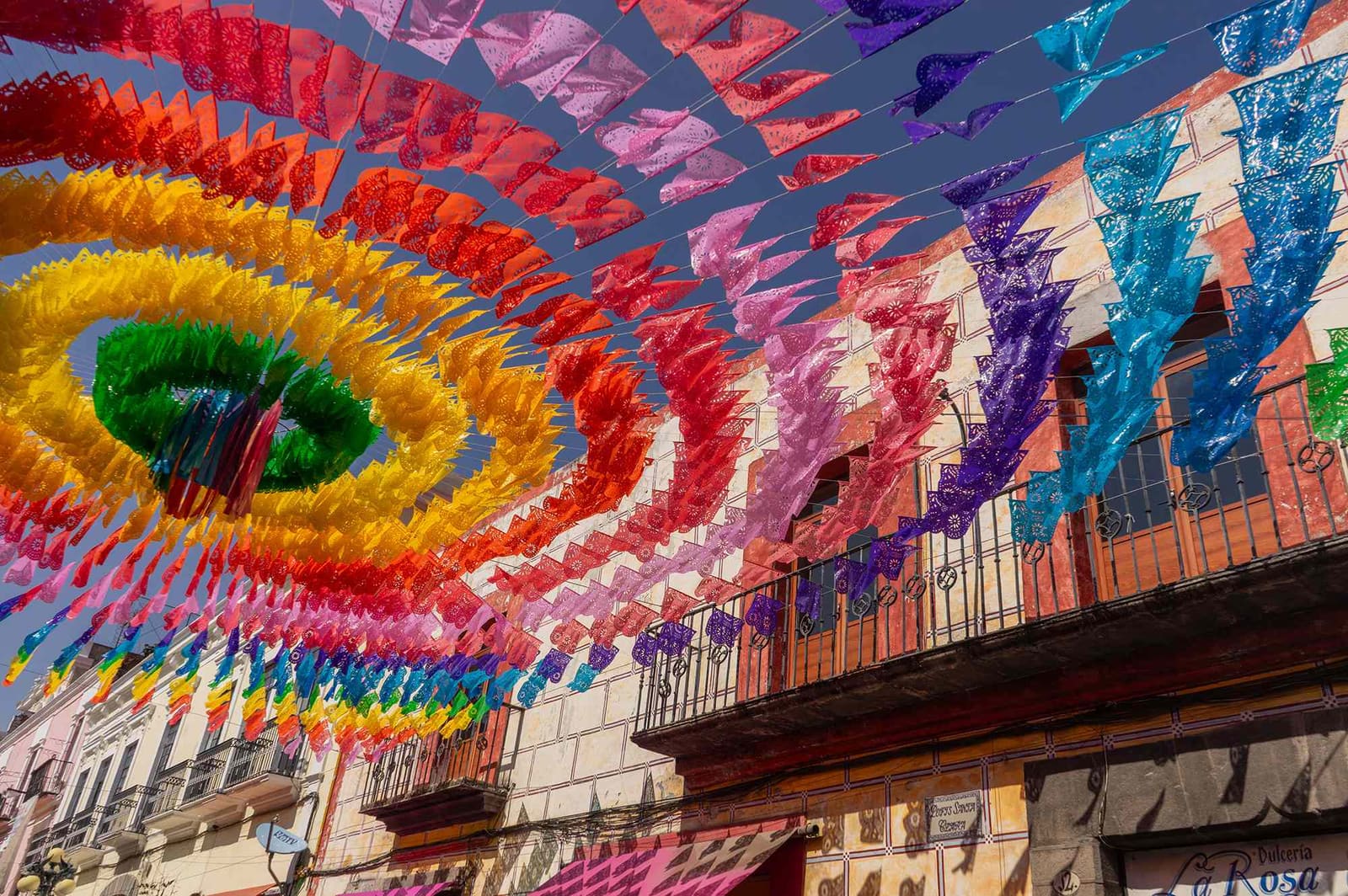
There is a particular kind of morning light in Puebla that feels borrowed from another century. It slants across the Talavera-tiled domes of churches, catches the edges of wrought-iron balconies, and pools in the courtyards of colonial mansions where bougainvillea spills over stone walls. The city wakes slowly, without fanfare - market vendors arranging pyramids of chiles poblanos, church bells marking the hour, the scent of mole simmering in kitchens that have been perfecting the recipe for generations.
At Global Chic Voyage, we've watched Oaxaca transform over the past decade from a traveler's secret into a destination that now strains under its own popularity. The mezcalerias are packed, the boutique hotels booked months ahead, the streets thick with visitors seeking the very authenticity that mass attention inevitably dilutes. And while that evolution has brought welcome recognition to Oaxacan culture, it has also prompted a quieter question among travelers who value discovery over destination checklists: where can we find that same depth of tradition, that layered sense of place, without the crowds?
The answer, it turns, out, sits just two hours southeast of Mexico City - a city of nearly three million that has somehow managed to remain outside the well-worn circuits of international tourism.
The Architecture of Devotion and Power
Puebla was founded in 1531 as a planned Spanish colonial city, and that intentionality still reads in its grid of streets, its grand plazas, its extravagant display of baroque architecture. The historic center, a UNESCO World Heritage site, contains more than 2,600 registered monuments - churches encrusted with gold leaf and carved stone, convents with hidden courtyards, mansions faced entirely in hand-painted Talavera tiles that shimmer like jewel boxes in the afternoon sun.
Walk along Calle 4 Norte and you will pass the Casa de los Muñecos, its facade covered in satirical ceramic figures that mock the city's colonial elite. Turn a corner and you'll find yourself facing the Capilla del Rosario, a chapel so ornate, so drenched in gilt and polychrome plaster, that it has been called the eighth wonder of the New World. These are not reconstructions or museum pieces; they are living spaces, still used, still woven into the daily rhythms of a city that has never stopped being a regional capital, a commercial hub, a place where history is not performed but inhabited.
The Cathedral of Puebla, with its twin bell towers rising more than sixty meters, anchors the Zócalo - the main square where families gather on Sunday evenings, where street musicians play, where the municipal palace glows amber under floodlights. Unlike the tourist-centric plazas of more famous colonial cities, Puebla's Zócalo still belongs primarily to locals, a fact that changes the entire texture of being there.
The Cuisine That Shaped a Nation
If Oaxaca is known for its seven moles, Puebla can claim the invention of mole poblano itself - the dark, complex sauce that marries chocolate with chiles, spices, nuts, and sometimes more than thirty ingredients, simmered for hours until it achieves a depth that defies easy description. The dish, according to legend, was created by nuns at the Convent of Santa Rosa in the seventeenth century, a story that may or may not be entirely true but speaks to the city's deep entanglement of faith, creativity, and gastronomy.
Puebla's culinary influence extends far beyond mole. Chiles en nogada, the patriotic dish of stuffed poblano chiles draped in walnut cream sauce and scattered with pomegranate seeds, was invented here. So was cemita, the sesame-seed sandwich layered with avocado, Oaxacan cheese, papalo leaves, and your choice of protein - a street food so beloved that it has inspired fierce loyalty among vendors and eaters alike. The city's markets - Mercado El Parián, Mercado La Victoria - overflow with ingredients that have anchored regional cooking for centuries: huitlacoche, chapulines, fresh cheeses, chiles in every stage of ripeness and preservation.
We've eaten in Puebla's fondas and high-end restaurants, in family kitchens and market stalls, and what strikes us most is the absence of performance. The food here is not designed to impress tourists or win Instagram fame; it is cooked for people who know the difference, who have been eating these dishes their entire lives and will notice if the seasoning is off or the technique rushed. That accountability produces a kind of culinary rigor that is increasingly rare in destinations where the audience is transient and forgiving.
Talavera and the Language of Craft
Puebla is one of the few places in the world where traditional Talavera pottery is still made according to the strict techniques introduced by Spanish artisans in the sixteenth century and refined over generations. The process is laborious: only certain clays from specific deposits can be used, the pottery must be shaped by hand, fired twice, painted with mineral-based pigments, and glazed with a tin-lead formula that produces the characteristic milky white background.
True Talavera carries a certification mark, a guarantee that it was made in Puebla or the neighboring town of Atlixco and adheres to the Denominación de Origen standards established to protect the craft from industrial imitations. Walking through the workshops - some of which have been operated by the same families for generations - you see artisans painting intricate floral patterns, geometric designs, and religious iconography with brushes so fine they seem barely capable of holding pigment. The work is slow, meticulous, and entirely at odds with the speed of contemporary manufacturing.
The city itself is a gallery of Talavera: facades covered in tiles, fountains decorated with blue-and-white patterns, kitchen walls in private homes that have been tiled for centuries. It is a visual language that binds the city together, a reminder that beauty, in Puebla, is not an exception but an expectation.
The Proximity Paradox
Puebla sits less than 130 kilometers from Mexico City, connected by a modern highway that makes the journey quick and straightforward. That proximity has been both a gift and a curse. On one hand, it has allowed Puebla to thrive economically, to remain a vital industrial and commercial center rather than a city dependent on tourism. On the other, it has meant that many travelers treat it as a day trip - a quick loop through the historic center, a meal, perhaps a visit to the nearby pyramids of Cholula, and then back to the capital before dark.
But Puebla rewards those who stay. The city reveals itself in layers: in the early morning quiet of the Biblioteca Palafoxiana, the oldest public library in the Americas, its shelves lined with volumes bound in vellum and leather; in the late afternoon crowds at the Paseo de San Francisco, a former convent turned shopping and dining complex where families stroll and teenagers gather; in the evening hum of cantinas where mezcal and pulque are served without ceremony or explanation.
The rhythm of Puebla is not the rhythm of a tourist destination. It is slower, more grounded, less concerned with curating an experience for outsiders. That can feel disorienting at first, especially for travelers accustomed to cities that have learned to anticipate and cater to foreign visitors. But it is also what makes Puebla compelling - a chance to observe a Mexican city that is still, fundamentally, itself.
The Road Not (Yet) Taken
We hesitate, always, to frame any place as the "next" anything. Such comparisons flatten the particular identity of a city, reduce it to a placeholder in someone else's narrative. Puebla is not Oaxaca, nor is it trying to be. It lacks Oaxaca's indigenous craft markets and mezcal folklore, its thriving artist community and politically charged murals. What it offers instead is a different kind of richness: the grandeur of colonial power translated into architecture, a culinary tradition that shaped the national palate, and a scale that allows for both urban energy and moments of genuine stillness.
Whether Puebla will follow Oaxaca's trajectory - toward greater visibility, more international flights, boutique hotels in restored mansions, the inevitable recalibration that comes when a place becomes a brand - remains uncertain. For now, it exists in a rare state of equilibrium: culturally significant enough to sustain itself, overlooked enough to remain largely unchanged by the forces that reshape destinations into digestible experiences.
The travelers we know who return to Puebla year after year do so not because it offers novelty, but because it offers constancy. The same mole recipes, the same tile workshops, the same Sunday evenings in the Zócalo. In an era when so many places are racing to reinvent themselves for the global tourism market, there is something profoundly luxurious about a city that simply continues - beautiful, complex, and entirely unconcerned with whether the rest of the world is paying attention.
What It Means to Arrive Early
There is a calculus that thoughtful travelers understand: arriving at a destination before the crowds means witnessing it in a state that will not last, but it also means being part of the change, however gently. Puebla does not need saving, nor does it need discovery. It has been here, thriving in its own right, for nearly five centuries.
But for those who value culinary depth over trend-chasing, architectural grandeur over Instagram backdrops, and the quiet satisfaction of a city that does not perform its identity - Puebla offers something increasingly scarce. Not the next Oaxaca, but perhaps the antidote to what Oaxaca has become: a place where the morning light still slants across Talavera domes, where mole simmers in kitchens that have been perfecting the recipe for generations, and where the only performance is the daily, unhurried act of being a city that knows exactly what it is.
Spot something wrong? Email editors@globalchicvoyage.com. We log every correction publicly.
RELATED
SEE ALL →
10 Jul 2026 / 5 min
8 Jul 2026 / 5 min
21 Jul 2026 / 5 min
20 Jul 2026 / 5 min