
Into The Canopy: Singapore's Rainforest Wild Completes Its Vision Of Immersive Conservation
Rainforest Wild Adventure
CO
9 May 2026 · 5 MIN READ · UPDATED 17 AUG 2026
A Clearing in the Canopy
There is a moment, somewhere between the forest floor and the first swaying branches overhead, when the air shifts. The hum of the city fades. Leaves filter the light into coins of gold. It is here, suspended between earth and sky, that Singapore's newest wildlife park asks you to pause—not as a spectator behind glass, but as a participant in something older, wilder, more fragile.
On May 20, Rainforest Wild Adventure at Mandai Wildlife Reserve will open its long-anticipated eastern zone, completing a twenty-hectare mosaic inspired by the rainforests of Asia and Africa. This is not simply an expansion; it is the fulfilment of a premise first introduced when the park debuted its western half: that the future of wildlife experience lies not in passive observation, but in layered immersion—physical, emotional, ecological.
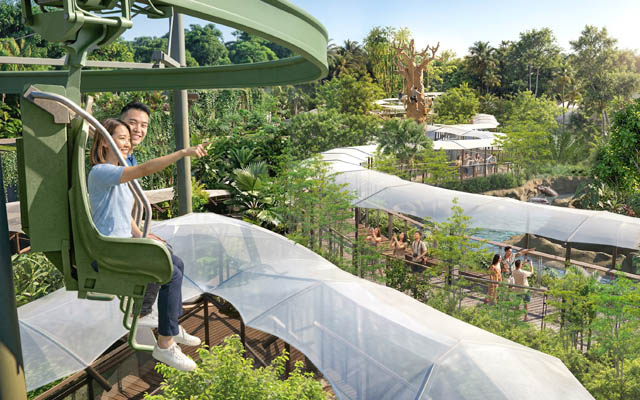
The east and west zones now flow into one another, a single ticket granting passage through interconnected habitats where boundaries dissolve and visitors choose their own depth of engagement. Some will walk the accessible trails. Others will harness up for treetop courses, canopy gliders, and simulated cave descents. All will encounter animals living, as much as captivity allows, on their own terms.
The Architecture of Encounter
Rainforest Wild Adventure operates on a deceptively simple principle: vary the plane of engagement, and you vary the quality of attention. The park offers nine Adventure+ experiences across its two zones, each calibrated to different thresholds of effort and adrenaline. In the eastern zone—spanning seven hectares of Afro-tropical and Madagascan-inspired terrain—visitors can glide across canopies, scale elevated viewpoints, or navigate treetop courses that hover above animal habitats. The western zone leans into guided high-element challenges: climbing walls, harnessed traverses, fabricated cave systems.
This is not adventure for adventure's sake. The physical acts—reaching, balancing, ascending—are designed to mirror the verticality of rainforest life itself, where ecosystems stack in layers and most biodiversity exists above eye level. To climb is to see as a primate sees. To glide is to inhabit, briefly, the perspective of a hornbill.
The eastern zone introduces species rarely seen in this part of the world. Chief among them: the okapi, a creature so elusive it was unknown to Western science until 1901, and which now makes its debut in Southeast Asia. Mandai houses four okapis, participants in an international breeding programme aimed at shoring up genetic diversity for a species listed as endangered. They share the park with pygmy hippos, eastern bongos, red river hogs, and Nile lechwe—species whose wild ranges are shrinking, whose futures hinge on coordinated global effort.
Madagascar, that island ark of evolutionary singularity, is represented through multi-species habitats. The design philosophy here is one of agency: animals move freely, exhibit natural behaviours, and are visible or invisible depending on their own rhythms. Some days you will see everything. Some days, almost nothing. This is by design. It is a quiet assertion that the animal's experience matters as much as yours.
Why Asia's Approach to Wildlife Tourism Is Shifting
For decades, the dominant model of the zoo was didactic—animals as living textbooks, enclosures as classrooms. That model is eroding. Across Asia, a new generation of wildlife parks is emerging, one that privileges experience over explanation, immersion over instruction. China's panda reserves have pioneered volunteer programmes where visitors muck stalls and prepare bamboo. Thailand's elephant sanctuaries have largely abolished riding in favour of observation and bathing rituals. Singapore, with Rainforest Wild, is betting that physical engagement—climbing, gliding, navigating—can deepen ecological empathy in ways that signage cannot.
This shift mirrors broader changes in luxury travel, where the passive consumption of beauty is giving way to something more demanding: participation, responsibility, discomfort. The modern traveller, especially the younger cohort, seeks not just to witness but to feel implicated—in the landscape, in the story, in the consequences.
Rainforest Wild's structure reflects this. The park does not shepherd you along a single path. It offers thresholds. You decide how far in you go. The metaphor is apt: conservation, too, is a matter of thresholds—how much effort we are willing to expend, how much convenience we are willing to surrender, how deeply we are willing to engage with systems we did not break but have inherited.
The Okapi and the Archive
The arrival of the okapi in Southeast Asia is more than a zoological footnote. It is a reminder that the work of conservation is also a work of translation—moving genes, knowledge, and care across borders in the hope that no single catastrophe can erase a species. The okapi, native to the dense Ituri Forest of the Democratic Republic of Congo, is threatened by habitat loss, poaching, and political instability. Its presence in Singapore is both a hedge against extinction and a provocation: What does it mean to care for a creature most of us will never see in the wild?
Coinciding with the opening, Mandai Wildlife Group will host National Geographic-themed retail pop-ups across the park, featuring apparel and visual displays drawn from the magazine's century-long archive. It is an unexpected pairing—commerce and conservation, nostalgia and urgency—but perhaps a fitting one. National Geographic has long traded in the aesthetics of the wild, those iconic yellow-bordered images that made distant ecosystems feel intimate, knowable, worth saving. The pop-ups, in their way, acknowledge that storytelling and spectacle have always been part of the conservation toolkit. The question is whether they can still move us to action, or whether we have become too fluent in the language of loss.
What Mandai Signals for Singapore's Eco-ambitions
Singapore has never been content to be merely efficient. It wants to be exemplary. Mandai Wildlife Reserve—encompassing not just Rainforest Wild but also the Singapore Zoo, Night Safari, River Wonders, and Bird Paradise—is a statement of intent: that a small, dense, hyper-urbanized nation can also be a global leader in conservation and wildlife education. That green space is not a luxury but a necessity. That biodiversity can coexist with density, if you are willing to design for it.
The reserve is accessible by shuttle services linking the park to Khatib MRT station, a nod to Singapore's car-lite ambitions. Rainforest Wild Adventure East will operate daily from 9 a.m. to 6 p.m., with last admission at 5 p.m. As part of the soft opening, ticket holders will have access to selected Adventure+ activities, with additional experiences available for separate booking.
But Mandai is also a test case. Can a park designed for immersion and agency succeed in a culture that often prizes control and predictability? Can visitors trained to expect seamless, air-conditioned comfort embrace the sweat, the waiting, the possibility of seeing nothing? Can a city-state with limited hinterlands become a credible voice in global conservation conversations?
The answers will unfold slowly, like a canopy revealing itself leaf by leaf.
Why It Matters
Rainforest Wild Adventure is not simply a new attraction. It is a proposition about what we owe the nonhuman world, and how we might begin to pay it. In an era of accelerating habitat loss and climate instability, zoos and wildlife parks are becoming something they were never designed to be: arks, gene banks, last redoubts. The question is whether they can also become sites of transformation—places where visitors leave not just entertained, but changed.
Singapore's approach—blending physical challenge, ecological design, and species conservation—suggests one possible path forward. It is not without contradictions. The park is, after all, a constructed environment, a simulation. But perhaps that is the point. We live in a world where the wild is increasingly mediated, managed, contingent. If we are to care for it, we must first learn to see it—and sometimes, that means climbing toward it, one branch at a time.
Spot something wrong? Email editors@globalchicvoyage.com. We log every correction publicly.
RELATED
SEE ALL →
31 Jul 2026 / 5 min
22 Jul 2026 / 5 min
9 Jun 2026 / 5 min
4 May 2026 / 5 min