
After Dark in the Lion City: A Festival of Folklore and Light
Singapore's annual nocturnal gathering returns this August with stories of dragons, sisters, and monsoon spirits told through projection, shadow, and bamboo.
SI
22 Jul 2026 · 5 MIN READ · UPDATED 17 AUG 2026
The City Remembers After Sunset
There is something about the tropics at night that invites stories. The air thickens, the modern city softens, and suddenly the space between colonial façades and glass towers feels porous enough for older narratives to slip through. In Singapore, where land has been reclaimed and rivers buried beneath asphalt, the act of remembering becomes a form of archaeology. This year, from late August through early September, the city-state's annual nocturnal arts gathering will attempt exactly that: to excavate the myths, maritime folklore, and half-forgotten legends that once shaped the region, and render them visible again through projection, installation, and performance.
The theme is deliberate. Myths and Legends anchors this year's programme, a curatorial choice that sidesteps the usual celebration of innovation in favour of something older and less certain. At Global Chic Voyage, we have long argued that the most compelling cultural festivals are those willing to look backward as well as forward, to acknowledge that even the most vertical of cities rests on layers of story. Singapore's iteration does this with particular grace, weaving together indigenous folklore, colonial-era mystery, and the seafaring traditions of the Bugis and Malay Archipelago into a cohesive, walkable experience across the Bras Basah precinct.
Projection as Palimpsest
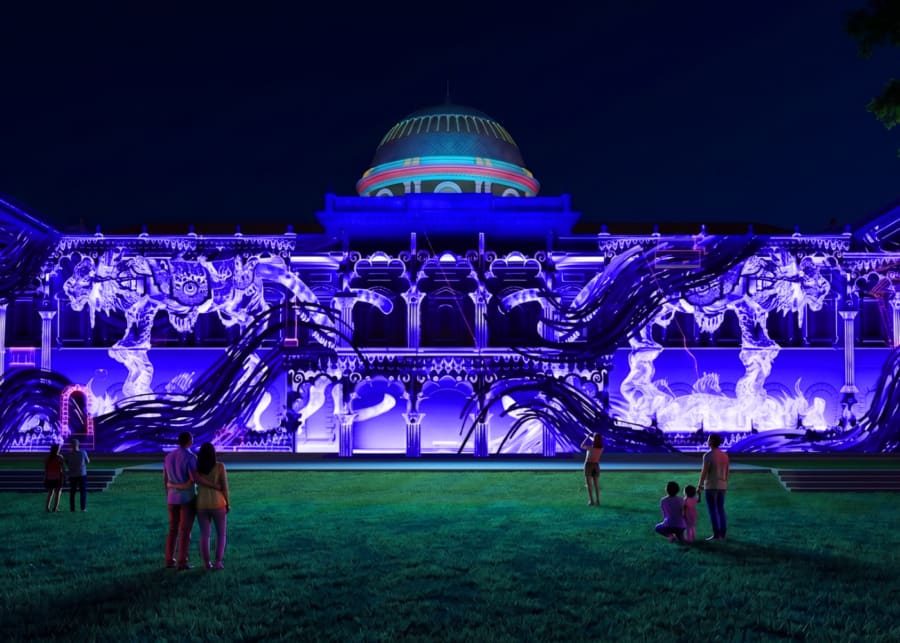
The centrepiece, as in years past, unfolds on the neoclassical face of the National Museum. This year's projection mapping draws on local folklore, both terrestrial and maritime, accompanied by a soundtrack produced collaboratively between Singapore's Artusik and Malaysia's UiTM. The choice to involve regional partners is not incidental. Southeast Asian mythology has never respected national borders; the same dragon appears in different skins from Luzon to Java, the same flood myth ripples across coastlines. By commissioning a cross-border score, the festival acknowledges that these stories belong to a shared imaginative geography, one that predates the modern state.
Elsewhere, the historic Cathay building becomes the stage for an inaugural projection mapping competition, showcasing work from artists across the region. The façade, Art Deco in bone and cream, will cycle through twenty submissions before narrowing to a final five. It is a canny move, turning heritage architecture into both canvas and collaborator, and it speaks to a broader ambition: to make the festival not merely a showcase but a platform for emerging practitioners.
Walking Through Water That Is No Longer There
Two guided nocturnal trails offer a slower, more intimate encounter with the district's layered past. The first charts Fort Canning Hill, that curious green knoll at the city's heart, once the seat of an ancient kingdom and later a British stronghold. The seventy-minute walk promises buried gold, a sacred shrine of uncertain identity, and the spring that sustained early settlement. It is the sort of programme that rewards the curious, those willing to trade spectacle for narrative depth.
The second trail, presented by The Artist Village, traces the path of Sungai Bras Basah, a river now entirely concealed beneath roads and civic buildings. Participants will move through four stations, each marked by live performance, site-specific mythology, and a custom non-alcoholic ritual drink. There is something quietly radical about this approach: to walk the ghost of a river, to insist that what has been paved over still matters. In a city where land is precious and memory often expendable, such gestures carry weight.
Relics, Real and Invented
Among the installations, a few stand out for their conceptual ambition. The Dragon's Tooth, sited on the SMU Campus Green, constructs an entire mythology around a guardian artefact, a luminous bamboo sanctuary housing what is described as "elemental memories of early seafaring protectors." The piece is interactive, inviting visitors to navigate fields of light and shadow while contemplating themes of courage, memory, and belonging. It is unabashedly theatrical, and all the better for it.
Nearby, another work takes the Singapore Stone as its point of departure. That enigmatic fragment, inscribed with undeciphered script and now residing in the National Museum, has long haunted local imagination. The installation, titled simply Traces, translates the stone's mystery into an exploration of cultural movement and emotional memory. It is the sort of work that resists easy interpretation, which is precisely its strength.
At Funan, a speech-activated installation retells the legend of the Sisters' Islands, the story of Minah and Linah, two siblings who drowned fleeing pirates and were transformed into the twin islets that bear their name. The choice to make the piece voice-responsive is clever, turning passive viewing into a kind of incantation. You speak, the legend unfolds. It is a small gesture toward participation, a way of making folklore feel less like heritage and more like a living, mutable thing.
The Aesthetics of Sustainability
One installation merges national iconography with environmental consciousness: a 2.8-metre interactive Merlion sculpture crafted from fibreglass composite, its arm and head animated, its surface blooming with hearts. The work is described as a tribute to Singapore's evolution into a "Garden City," that aspirational brand of tropical urbanism that has become one of the nation's most recognizable exports. It is earnest, perhaps overly so, but there is something endearing about the attempt to reconcile mythic symbol with ecological ambition.
Elsewhere, Art-Zoo, a local creative lifestyle brand, presents an inflatable world of mythical plants and creatures at the National Library Building Plaza. The adjacent book kiosk, stocked with selections from the National Library Board's collections, extends the experience into the literary. It is a small touch, but one that underscores a broader curatorial intelligence: the understanding that festivals can be more than spectacle, that they can also be invitations to sustained inquiry.
Horror as Archive
For those inclined toward the darker end of the folkloric spectrum, the Asian Film Archive presents a series of horror film screenings and panel discussions at the Oldham Theatre. The programme focuses on local and regional horror cinema, genres that have long served as repositories for cultural anxiety and suppressed history. Attendees are encouraged to arrive in costume, a detail that transforms the screenings into something closer to ritual than passive consumption. At Global Chic Voyage, we have always believed that the best travel experiences are those that allow for transformation, however temporary. A good horror film in a heritage theatre, surrounded by others in fantastical dress, can do exactly that.
What Remains After the Lights Go Out
Festivals of this kind are inherently ephemeral, and perhaps that is part of their power. They ask us to show up at a specific time, to move through the city differently, to see familiar landmarks rendered strange by projection and shadow. When the installations are dismantled and the lights switched off, what remains is not the work itself but the memory of having moved through it, of having paused in front of a luminous dragon's tooth or walked the ghost of a buried river.
In Singapore, a city often accused of privileging the future at the expense of the past, such festivals perform quiet but essential work. They insist that myth still matters, that folklore is not merely nostalgia but a way of understanding who we are and where we have come from. They remind us that even the most rational of cities is built on stories, and that sometimes, after dark, those stories rise to the surface again.
Credit: The Fox, The Folks
Spot something wrong? Email editors@globalchicvoyage.com. We log every correction publicly.
RELATED
SEE ALL →
31 Jul 2026 / 5 min
9 Jun 2026 / 5 min
9 May 2026 / 5 min

28 Jul 2026 / 5 min