
How a Madrid Designer Revived Mallorca's Historic Yacht Club with Vintage Riva Glamour
Inside the five-year transformation of Club de Mar, where 1970s sensuality meets nautical precision through high-gloss surfaces and signal-flag colour
SI
14 Jul 2026 · 5 MIN READ · UPDATED 17 AUG 2026
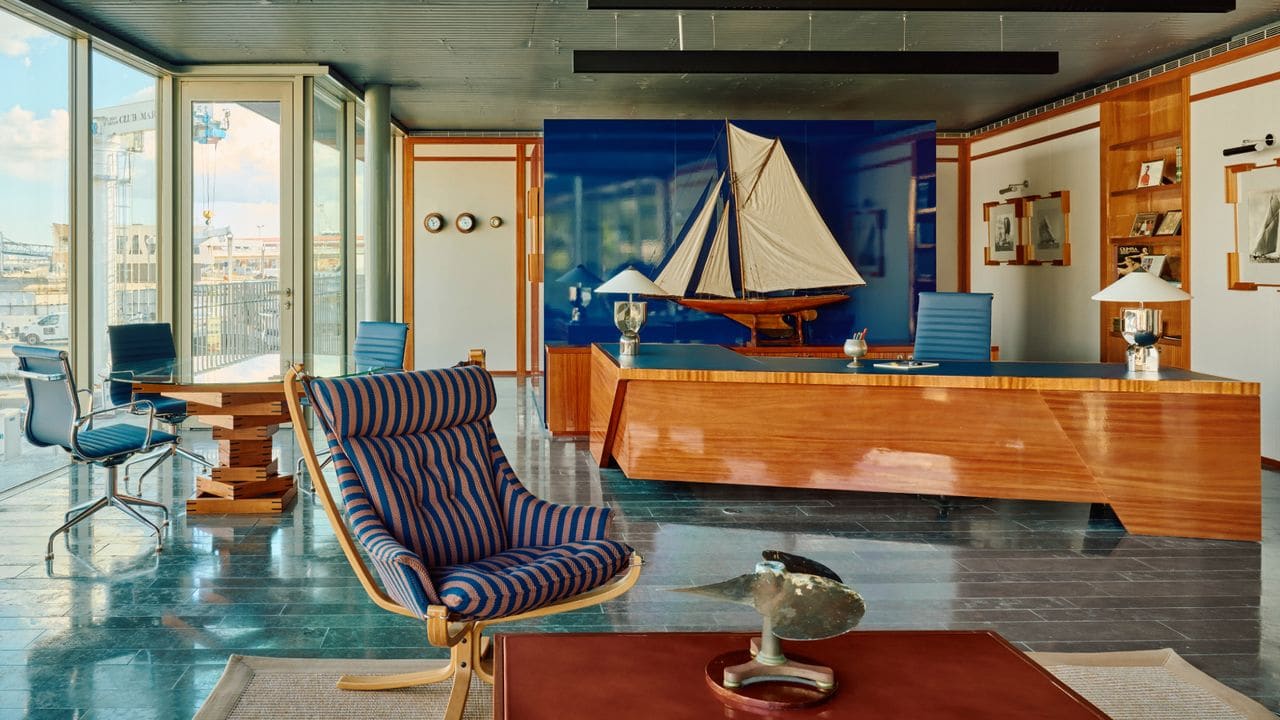
The Marina That Shaped a City
There is a particular slant of light that happens on Palma's waterfront in late afternoon, when the sun catches varnished wood and chrome just so, turning a room golden. At Club de Mar, that alchemy feels intentional. The yacht club, perched on Muelle Pelaires with views toward the cathedral and old town, has always occupied a singular place in Mallorca's maritime culture. When it opened in 1972, Palma was cementing its reputation as a serious sailing destination, luring the kind of vessels that once lingered exclusively along the French Riviera. The club became a landmark, a social anchor, a place where the nautical world and the island's emerging cosmopolitan identity converged.
After more than five years of careful redevelopment, it has reopened with interiors by Marta de la Rica, the Madrid-based designer whose work tends toward the sculptural and the sensorial. Her challenge was to honour half a century of history without embalming it in nautical cliché. At Global Chic Voyage, we've watched too many yacht clubs lean into anchor motifs and rope-wrapped columns, mistaking literalism for atmosphere. De la Rica took a different route.
A Language Borrowed from Boats
Her starting point was not the sea itself, but the objects that move across it. Vintage Riva runabouts, with their high-gloss hulls and lacquered dashboards, became a kind of material muse. The 1970s, the decade of the club's founding, offered a philosophy: luxury expressed through tactility, warmth, a certain unhurried confidence. "I wanted to create a unity of purpose through colour, material and shape," de la Rica explains, and that unity is evident the moment you step inside.
High-gloss lacquered wood wraps bars, counters, wall panels. Slats run horizontally, edges are softened, corners rounded. There is a nautical grammar here, but it speaks in proportions and finishes rather than symbols. Light moves through the space and catches varnish, chrome, glass, activating surfaces as it shifts. The effect is less museum, more vessel: you feel the presence of the sea not through thematic decoration, but through the way materials respond to Mediterranean sun.
Signal Flags as Palette
Colour, in de la Rica's hands, becomes narrative. She drew from the International Code of Signals, the system of maritime flags used for ship-to-ship communication. Red, blue, yellow, each hue pulled from that lexicon and deployed across upholstery, textiles, sculptural furniture. Stripes appear throughout, a visual rhythm that nods to regatta pennants without imitating them outright.
Burgundy conical lamps hang like buoys. Oval bars anchor social zones. Rounded geometries soften the interiors, echoing the curves of boat hulls and porthole windows. Much of the furniture was custom-designed for the space, a deliberate choice that allowed de la Rica to control not just aesthetics but also scale and proportion. The result is a strong, cohesive visual identity that feels specific to this club, this city, this stretch of coast.
Antiques That Anchor Memory
Scattered throughout the interiors are objects from the club's own archive: boat models, barometers, diving helmets, anchors that have been repurposed not as wall decor but as sculptural counterpoints to the custom pieces. "Antiques bring soul and history to a space," de la Rica notes, and here they function as material witnesses to decades of sailing culture. They are not staged or spotlit; instead, they inhabit the rooms quietly, grounding the glossy newness in continuity.
This layering of old and new is where the project finds its emotional centre. The club's history is not erased or sanitized but woven into the present, allowed to coexist with contemporary design without either overshadowing the other. It is a delicate balance, one that requires restraint and a clear sense of what belongs.
A Terrace That Floats
Step onto the terrace and the city unfolds: Palma's old town, the cathedral rising above terracotta rooftops, the harbour dotted with masts. De la Rica describes the sensation as being "on a boat," and the comparison holds. The terrace hovers at the water's edge, open to sky and breeze, framed by the lacquered interiors behind and the Mediterranean ahead. It is a threshold space, neither fully land nor sea, and that ambiguity is part of its appeal.
From here, the design choices inside make even more sense. The high-gloss surfaces, the nautical proportions, the way light and material interact, all of it calibrated to extend the feeling of being afloat. The sea is present not as decoration but as context, shaping every decision about finish, colour, form.
Why Nostalgia Without Pastiche Matters
What de la Rica has achieved at Club de Mar is increasingly rare in hospitality and private club design: a project that honours its origins without becoming a costume drama. The 1970s are evoked not through kitsch or retro styling, but through an approach to luxury that prioritizes sensory experience over ostentation. The nautical references are embedded in the architecture of the interiors, in the way spaces are proportioned and surfaces treated, rather than applied as thematic veneer.
This matters because so much of contemporary design, especially in heritage projects, defaults to one of two extremes: aggressive modernization that erases history, or overly reverent preservation that stifles vitality. De la Rica finds a third way, where past and present inform each other, where the designer's hand is visible but not domineering. It is a model worth studying, particularly for projects tied to place and tradition.
The reopening of Club de Mar also signals a broader shift in how Mediterranean destinations are thinking about their nautical infrastructure. As yacht culture becomes more global, more diverse, clubs like this one have an opportunity to define themselves not just as service providers but as cultural institutions, places that reflect and shape local identity. De la Rica's interiors do exactly that: they are unmistakably Mallorcan, unmistakably nautical, and unmistakably of this moment, all at once.
Photo: Daniel Schaefer
Spot something wrong? Email editors@globalchicvoyage.com. We log every correction publicly.
RELATED
SEE ALL →
8 Aug 2026 / 5 min
30 Jul 2026 / 5 min
8 Aug 2026 / 5 min
8 Aug 2026 / 5 min