
The Comedian Who Learned to Travel by Failing Beautifully
Conan O'Brien's latest odyssey through Mumbai, Manila, and Casablanca reveals what happens when spontaneity, discomfort, and a willingness to look ridiculous become the best travel philosophy.
ML
17 Aug 2026 · 7 MIN READ · UPDATED 18 AUG 2026
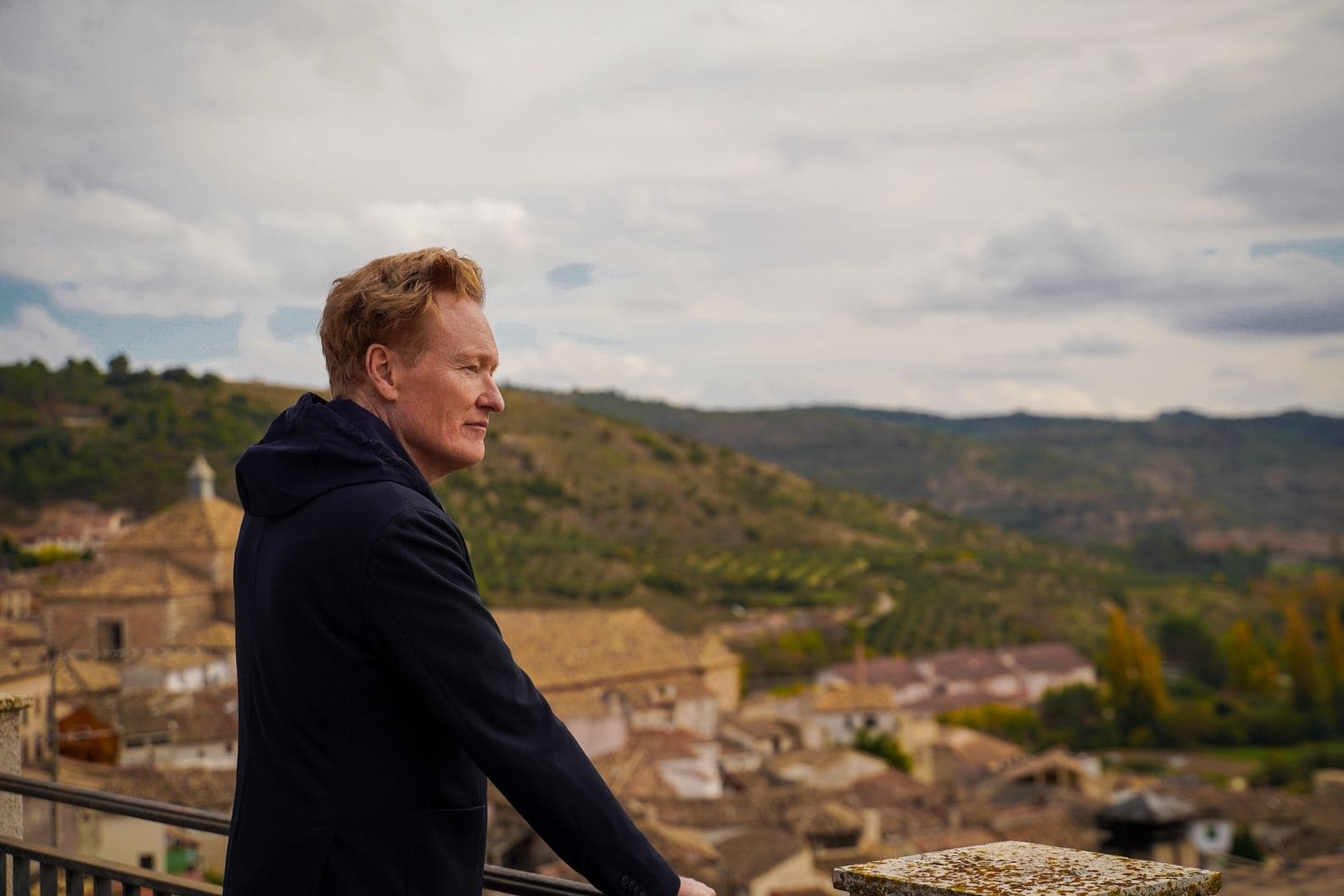
A Clown in the Sahara
There is a particular kind of traveler who arrives at a destination armed with meticulously curated itineraries, restaurant reservations made months in advance, and a camera roll destined for algorithmic perfection. And then there is the traveler who dresses as Vincent van Gogh, sprints across an Amsterdam park in full costume, and gets turned away from a museum by security guards scribbling in a notebook. At Global Chic Voyage, we've long believed that the latter approach, however chaotic, often yields the richer story.
Conan O'Brien belongs firmly to the second camp. The Emmy-winning comedian has spent three seasons of his travel series traversing continents with a philosophy that inverts the usual celebrity travelogue: instead of showcasing his sophistication, he weaponizes his awkwardness. The third season takes him to Morocco, India, the Netherlands, and the Philippines, where he continues a peculiar form of cultural diplomacy rooted in self-mockery, improvisation, and an appetite for the unpredictable.
"My goal is that you might not really learn anything about the country, but you do get a sense of the people," O'Brien explains. "I am basically there to be mocked." It is an oddly honest mission statement for a travel show, and one that reflects a deeper truth about how we connect across borders.
The Geography of Discomfort
O'Brien's destination choices follow a logic that has little to do with UNESCO listings or bucket-list prestige. Cleveland, he notes, would not make the cut, regardless of how compelling the local fan. What he seeks instead is visual drama and cultural friction, places where his physicality and American informality will clash spectacularly with local norms.
India emerged as an ideal canvas. The density, the chromatic intensity, the sheer sensory overload of Mumbai streets offered everything he was looking for. He had visited Jaipur once before, years earlier, for a commercial shoot, and the memory lingered. "It just felt like the most different place I could go and still be on Earth," he recalls, describing the visual tapestries, the chaos, the colors that seem to operate at a different saturation level than the rest of the world.
But spectacle alone does not sustain a travel narrative. O'Brien also hunts for places where his preferred mode of interaction, tactile and boundary-pushing, will generate friction. Norway, he mentions hypothetically, with its cultural reserve and personal-space norms, would provide excellent comedic tension. The discomfort is not incidental to the experience; it is the experience.
This is where O'Brien's approach diverges from the typical luxury travel narrative. He is not chasing the transformative spa treatment or the farm-to-table tasting menu. He is chasing the moment when a 16-year-old cricket player in Mumbai yells at him for wearing the wrong outfit and breaking every rule of the game. He is chasing the security guard at the Van Gogh Museum who will not let him in, no matter how committed he is to the bit.
Improvisation as Infrastructure
O'Brien's background in improvisational comedy, rather than stand-up, shapes the architecture of his travels. He arrives with a rough outline, a sense of possibility, but no script. The Mumbai commuter train sequence, for instance, was not pre-negotiated with transit authorities or choreographed for optimal camera angles. He simply jumped onto a crowded train, and the crew scrambled to follow.
This guerrilla approach yields moments that no amount of planning could manufacture. In Amsterdam, the Van Gogh Museum misadventure became his favorite segment of the Netherlands episode precisely because nothing went as intended. They arrived at the wrong museum. They ran across a park in full costume. They were turned away at the door. And in the midst of that cascade of minor failures, something spontaneous and human emerged.
"I am at my happiest when things are a little off-kilter," O'Brien admits. It is a counterintuitive confession for someone whose career has been built on precision timing and scripted wit. Yet there is a logic to it. Improvisation requires presence, attention, and a willingness to abandon the plan in favor of what is actually happening. These are also the skills that separate competent travelers from memorable ones.
The show's format allows O'Brien to embrace accidents as narrative fuel. A cracked coffee mug during a celebrity interview, a security guard's unexplained diary entry, a teenager's impatience with a bumbling foreigner, all of these become material. "When you travel, things don't go to plan," he observes. "If you are ready to find the humor in it, and improvise, and figure out another way, you're going to have a great trip."
The Comedy of Translation
Not every joke lands. In Casablanca, at a fan's family home, cultural and linguistic gaps swallow punchlines whole. O'Brien has made peace with this. He has learned to play to a second audience, the camera, which registers his deflation and transforms failure into a different kind of comedy. The joke is no longer what he said; the joke is that it did not work.
This layered approach to humor, where the meta-narrative of cross-cultural miscommunication becomes as important as the initial gag, gives the show an unusual texture. O'Brien describes himself as "this giant accident, this American idiot," and there is something almost diplomatic in that self-awareness. In an era when American travelers carry a particular set of reputational baggage, his willingness to absorb mockery and disrespect functions as a kind of cultural offering.
"I revel in a 16-year-old treating me with no respect, because I don't deserve any," he says. It is absurdist diplomacy, a performance of humility that invites connection precisely because it refuses to claim authority. He is not there to instruct or elevate or even observe from a safe distance. He is there to participate badly, and in doing so, to create space for genuine exchange.
The Madras Jacket Origin Story
O'Brien's relationship with travel, and with the discomfort it entails, began early. At 13, he accompanied his father, a scientist researching antibiotic resistance, on a whirlwind tour of South American hospitals. They moved through Chile, Brazil, Argentina, and Colombia in rapid succession, a pace that prefigures the frenetic energy of his current show.
He remembers the sensory assault of those trips: unfamiliar smells, unfamiliar food, the strangeness of everything. He also remembers his bright orange hair, his pronounced freckles, and the Madras sports coat his mother insisted he wear to hospital visits. The jacket, a patchwork of clashing colors, made him feel like a circus clown. He stood out everywhere, awkward and self-conscious.
Decades later, he chooses to dress as Van Gogh on camera. The transformation is not quite full circle, but it suggests a hard-won acceptance. The absurdity that once mortified him has become his métier. The discomfort that made him want to disappear now fuels his work.
What Dense Crowds Teach
O'Brien lives on the west side of Los Angeles, in a neighborhood where high hedges separate households and neighbors rarely cross paths. After walking through the densely populated streets of Mumbai and Manila, observing the texture of everyday life, the impromptu cricket matches and the open-air markets, he found himself questioning the isolation of his own environment.
"There's a connectedness out in those dense crowds," he reflects. It is not a romanticization of poverty or a naive celebration of the Global South. It is an observation about proximity, about what happens when daily life is lived in public rather than behind walls. The contrast unsettles him in a productive way.
This is perhaps the unspoken ambition of the show: not to educate viewers about visa requirements or local customs, but to jostle preconceived notions of what life can look like. O'Brien does not claim to return from his travels with great wisdom, but he does return with a recalibrated sense of possibility.
"Getting out there and taking a risk, that's what life is supposed to be about," he says. It is a simple formulation, almost banal, until you consider the inverse: the iPhone scroll, the Netflix queue, the carefully curated Instagram feed. These are fine in moderation, he concedes, but they do not ask much of us. They do not require improvisation or discomfort or the willingness to fail spectacularly in front of strangers.
The Accidental Diplomat
At Global Chic Voyage, we have watched travel content evolve over the past decade, from aspirational escapism to performative authenticity to algorithmic optimization. O'Brien's show occupies a different category entirely. It is neither a guide nor a fantasy. It is a document of what happens when someone with no particular qualifications, beyond a willingness to look ridiculous, steps into unfamiliar territory and sees what emerges.
The result is not always elegant. Jokes misfire. Security guards refuse entry. Teenagers yell. But in that messiness, something else becomes visible: the texture of real encounter, stripped of the polish that usually coats celebrity travel narratives. O'Brien's arc as a traveler, from the self-conscious teenager in the Madras jacket to the man who now sprints through Amsterdam in costume, is also a story about learning to value the accident over the plan.
His form of diplomacy, if we can call it that, is rooted in absurdity and self-deprecation. It is not a model that scales easily or translates into policy. But as a travel philosophy, it has a certain integrity. It suggests that the best way to cross borders may not be to arrive with answers, but to show up ready to be the punchline, to fail beautifully, and to let the chaos teach you something you did not know you needed to learn.
Spot something wrong? Email editors@globalchicvoyage.com. We log every correction publicly.
RELATED
SEE ALL →
31 Jul 2026 / 5 min

18 Aug 2026 / 4 min

18 Aug 2026 / 8 min
8 Aug 2026 / 5 min