
A Village of White Houses Clinging to a Cliff an Hour West of Lisbon
Azenhas do Mar, where fewer than eight hundred souls live above the Atlantic and a tidal pool carved into rock, offers a quieter way to know the Portuguese coast.
SI
16 Jun 2026 · 5 MIN READ · UPDATED 17 AUG 2026
The Sound of Waves Before You See Them
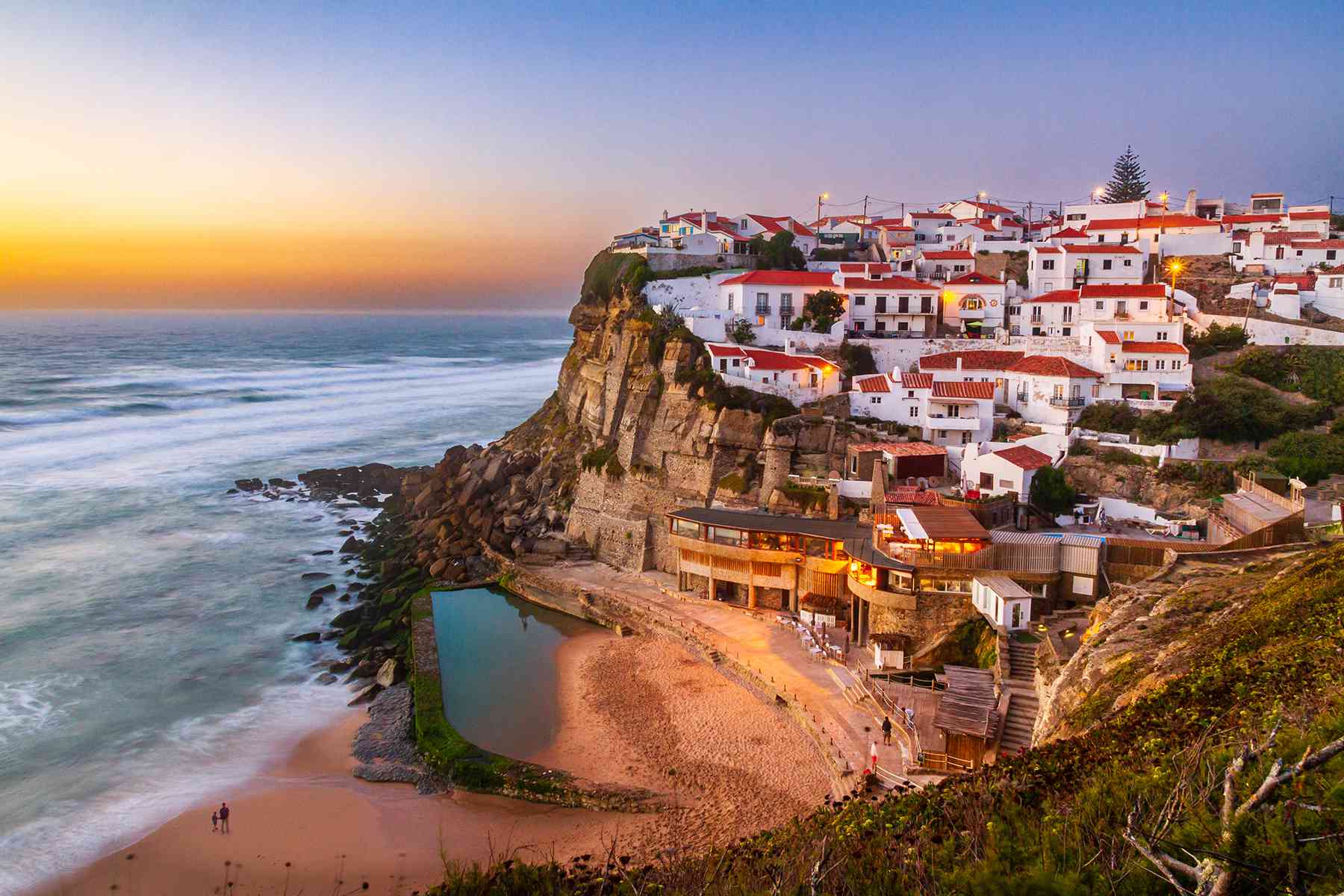
You hear the Atlantic before you see it - a low, constant murmur that rises as you round the final curve of the coastal road. Then the view opens: a tumble of white houses, their terracotta roofs glowing in the afternoon light, clinging to a sheer cliff face above the ocean. This is Azenhas do Mar, a village of fewer than eight hundred inhabitants in the municipality of Sintra, where the architecture seems to defy gravity and the rhythm of daily life is dictated by the tide.
At Global Chic Voyage, we've always believed that the most memorable places are those that retain a sense of remove - not isolation, but a deliberate distance from the circuits of mass tourism. Azenhas do Mar, less than an hour's drive northwest of Lisbon, occupies that rare territory. It is known among the Portuguese, revered even, yet it remains largely off the itineraries of travelers who race between Porto and the Algarve. The village's name derives from azenhas, the water mills that once dotted the landscape during the Arab occupation of the Iberian Peninsula, grinding grain with the force of streams that ran down to the sea. Fishing, shellfish gathering, and small-scale agriculture sustained the community for centuries. It was only in the mid-1930s, after the arrival of the Sintra tramway, that Azenhas do Mar began its transformation into a seaside retreat.
A Pool That Appears and Disappears
The natural pool at the base of the cliff is the village's most singular feature. Carved into the rock - local lore places the work in the mid-twentieth century - it fills with seawater when the tide is low, creating a sheltered basin where swimmers can float in water so clear it mirrors the sky. When the tide rises, the pool vanishes entirely, subsumed by the waves that crash against the rocky wall with a force that sends spray high into the air.
Timing a visit to coincide with low tide requires consulting a tide chart, a small act of planning that feels fitting for a place so governed by natural rhythms. On calm days, when the Atlantic is more green than gray, the pool becomes a gathering place - families with young children, couples, solo travelers who have made the pilgrimage from Lisbon or Sintra. There is no lifeguard, no attendant, no fee. You descend the steps cut into the cliff, lay your towel on the rocks, and slip into water that is cold even in summer.
The scene is framed by the village itself, which rises in tiers above the pool. The buildings follow the Português suave architectural style that emerged in the 1940s, a softer, more humanistic interpretation of modernism that favored clean lines and functional forms without the severity that characterized much of mid-century design elsewhere in Europe. The result is a visual harmony that feels unforced: white plaster walls, red-tiled roofs, narrow balconies where laundry hangs in the breeze.
Observing From the Viewpoint
Before descending into the village, most visitors stop at the Azenhas do Mar Viewpoint, a roadside pull-off that offers a panoramic perspective. From this vantage, the full drama of the setting becomes apparent. The cliff drops vertically to the ocean, and the houses seem to cling to the rock face as if placed there by hand, one by one, over generations. The composition is almost painterly - the horizontal line of the sea, the vertical thrust of the cliff, the irregular cluster of buildings that mediates between the two.
Photography here is inevitable, but no image fully captures the sensory experience: the wind that gusts up from the water, carrying the scent of salt and seaweed; the cries of gulls wheeling overhead; the way the light changes as clouds move across the sky, alternately illuminating and shadowing the village. It is a place that rewards slow observation, the kind that allows you to notice details - a blue door, a potted geranium on a windowsill, the way the waves form patterns as they retreat from the shore.
Regional Flavors Perched Above the Ocean
Restaurante Azenhas do Mar occupies a prime position on the cliffside, adjacent to the natural pool. The dining room is modest, the menu focused on what the ocean provides: grilled sardines, octopus salad, arroz de marisco (seafood rice), bacalhau prepared in the traditional manner. Tables near the windows offer unobstructed views of the water, and on weekends, securing a seat can require patience or a reservation made days in advance.
The restaurant embodies a particular Portuguese approach to dining - unpretentious, ingredient-driven, deeply tied to place. The fish is sourced locally, often landed that morning. The wine list favors producers from the surrounding region, where the maritime climate and limestone soils yield whites with a mineral edge and reds with a bracing acidity. Service is straightforward, sometimes brusque, but always efficient. You come here not for culinary innovation but for the pleasure of eating well in a setting that feels earned, the reward for having made the journey.
Strolling through the village after a meal, you encounter other small establishments - cafés serving bica (espresso) and pastel de nata, shops selling ceramics and textiles, a small chapel with a facade of painted tiles. The scale is intimate, walkable. There are no chain stores, no tour buses idling in the square. The economy here is modest, sustained by visitors but not overwhelmed by them.
Proximity to Other Landmarks
Azenhas do Mar's location within Sintra makes it an ideal base for exploring a stretch of coast that is rich in both natural beauty and historical resonance. Cabo da Roca, the westernmost point of continental Europe, lies a short drive to the south. The headland is marked by a lighthouse and a stone monument inscribed with lines from the sixteenth-century poet Luís de Camões: "Here, where the land ends and the sea begins." The site is windswept, dramatic, and often crowded, but it retains a certain gravitas - the sense of standing at a threshold, looking out toward the vastness of the Atlantic.
Equally compelling is Praia da Ursa, a beach accessible only by a steep, winding trail that descends from the cliffs. The descent takes twenty to thirty minutes, depending on fitness and caution, and the path can be treacherous after rain. The beach itself is a crescent of sand flanked by towering rock formations that rise from the water like sentinels. At low tide, you can walk among the rocks, exploring tide pools and caves. The isolation and rugged beauty make it one of the most photographed beaches in Portugal, though the effort required to reach it ensures that it is never as crowded as the more accessible beaches farther south.
From the historic center of Sintra, a bus journey of approximately thirty minutes brings you to Azenhas do Mar, making it feasible to visit all three sites - the village, the cape, and the beach - in a single day. Alternatively, renting a car offers greater flexibility and the freedom to explore the network of back roads that wind through the hills and along the coast.
A Place That Inspired a Nobel Laureate
The landscape of Azenhas do Mar has long attracted artists and writers drawn to its combination of natural beauty and quiet melancholy. José Saramago, the Portuguese novelist who won the Nobel Prize in Literature in 1998, is known to have been inspired by the village. His work, characterized by its philosophical depth and its engagement with Portuguese history and identity, often reflects a sensibility shaped by places like Azenhas do Mar - settings where the past is palpable and the scale of human endeavor is measured against the indifference of the sea.
Walking through the village, it is easy to see what might have drawn him. There is a quality of timelessness here, a sense that the essential character of the place has not changed despite the passage of decades. The same cliffs, the same waves, the same light. The houses may have been repainted, the restaurant may serve a more diverse clientele than it did in Saramago's time, but the fundamental relationship between land and sea, between human habitation and natural force, remains unchanged.
This continuity is part of what makes Azenhas do Mar compelling. In an era when so many coastal villages have been transformed by development, when authenticity has become a marketing term, Azenhas do Mar retains a certain integrity. It is not a museum village, preserved under glass, but a living community that has adapted to the presence of visitors without being defined by them.
The Energy of the Sea, Away From the Crowds
At Global Chic Voyage, we often speak of the importance of listening to a place - of tuning in to its particular frequency. In Azenhas do Mar, that frequency is set by the ocean. The sound of waves is constant, a presence that shapes the atmosphere even when the water itself is out of sight. It is a sound that invites contemplation, that creates a space for thought and reflection.
The village offers little in the way of organized activities or entertainment. There are no spas, no nightlife, no curated experiences. What it offers instead is the opportunity to slow down, to spend an afternoon watching the tide come in, to eat simply and well, to walk along the cliffs and feel the wind. It is a place for those who find relaxation not in distraction but in immersion - in being fully present in a setting that demands nothing more than attention.
For travelers weary of the churn of major tourist destinations, Azenhas do Mar presents an alternative. It is a reminder that luxury is not always synonymous with abundance, that sometimes the most valuable thing a place can offer is the space to simply be. The village's small scale, its lack of pretension, its rootedness in the rhythms of nature - these are qualities that cannot be manufactured or replicated. They can only be experienced, and only by those willing to venture slightly off the well-worn path.
As you stand at the viewpoint at dusk, watching the sun sink toward the horizon and the white houses turn gold in the fading light, you understand why the Portuguese have cherished this place for generations. Azenhas do Mar is not hidden in the sense of being secret - it is too well-known for that - but it remains, in a deeper sense, apart. A village where the past is present, where the sea sets the terms, and where the quiet pleasure of arrival is matched only by the reluctance to leave.
Spot something wrong? Email editors@globalchicvoyage.com. We log every correction publicly.
RELATED
SEE ALL →
30 Jul 2026 / 5 min
15 Jul 2026 / 5 min
7 Jul 2026 / 5 min
3 Jul 2026 / 5 min