
A Parisian Gastrothèque Lands in a Covent Garden Courtyard
Jody Williams brings her West Village bistro concept back to London, this time in the cobblestoned embrace of Neal's Yard.
SI
27 Jul 2026 · 5 MIN READ · UPDATED 17 AUG 2026
The Return of a Transatlantic Bistro
There is a particular quality of light in Neal's Yard on a summer afternoon, the kind that filters through cobblestones and Georgian facades and lands, dappled, on red awnings. It is here, in one of Covent Garden's most photogenic enclaves, that New York restaurateur Jody Williams has chosen to stage her second London act. The venue is Buvette, a gastrothèque that first made its name in Manhattan's West Village back in 2011 and now, after a brief Notting Hill interlude that closed in 2023, has found what feels like its proper London home.
Williams, who co-owns five Manhattan establishments with her wife Rita Sodi, describes her concept not as a bistro but as something more fluid: a place where breakfast croissants and café au lait flow seamlessly into evening cassoulet and Beaujolais. The term "gastrothèque" is her own invention, a portmanteau that gestures toward the flexibility she prizes. At Global Chic Voyage, we've long observed how the most compelling dining spaces resist easy categorization, and Buvette occupies precisely that liminal territory between café, bar, and restaurant.
The setting itself does much of the work. Neal's Yard, with its history as the birthplace of Britain's whole-food movement in the 1970s, lends the venture a certain countercultural pedigree. Monmouth Coffee and Neal's Yard Dairy still anchor the square, and Williams has woven that heritage into her design philosophy. The building itself is four centuries old, and she has treated it with a curator's eye rather than an decorator's hand.
Flea Market Aesthetic Meets Four-Century-Old Bones
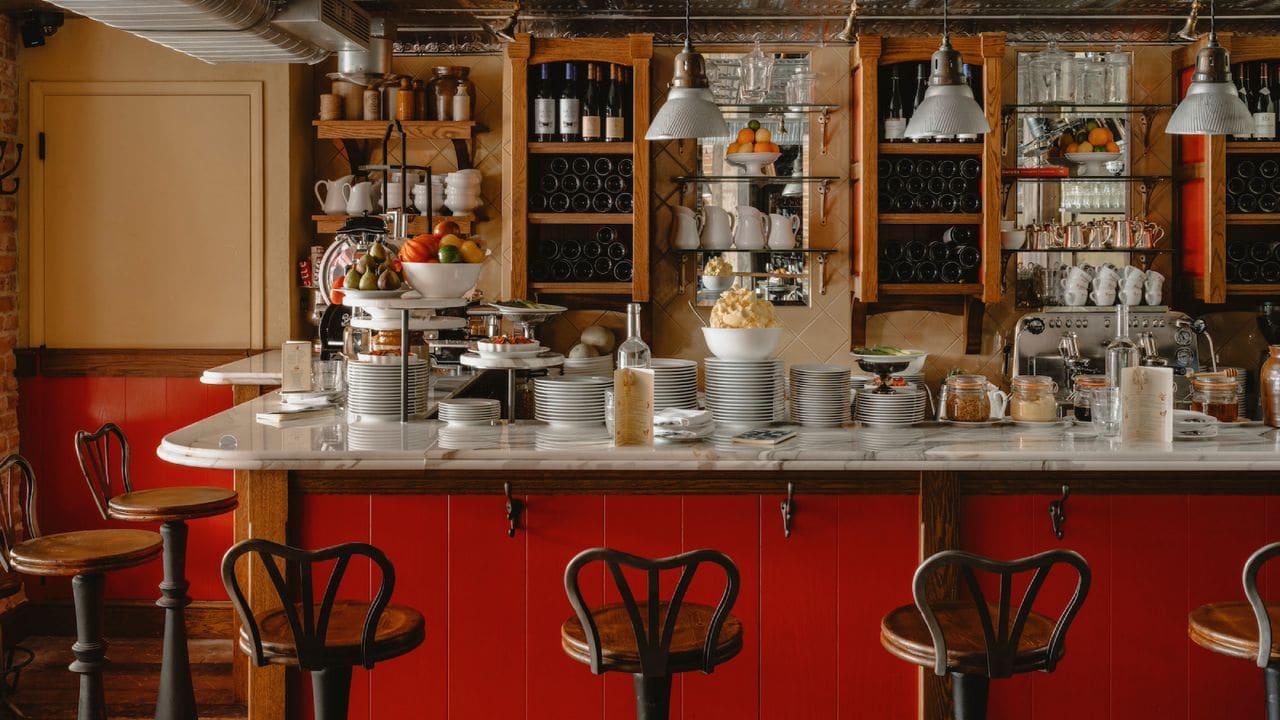
Step inside and you encounter exposed brick, warm wood finishes, and a tin ceiling embossed with metallic garlands. Williams has spoken about her inspiration coming from flea markets and antique fairs, and that sensibility is evident in the layered, collected feel of the space. Close-set tables for two dominate the floor, while a marble counter offers solo diners a perch from which to observe the choreography of service.
The dimensions are intimate to the point of compression. This is not a room designed for lingering over three-hour lunches. Instead, Buvette functions best as a punctuation mark in a day's itinerary: a breakfast meeting before the office, a pre-theatre bite ahead of the Donmar, or a solo hour with a book and a glass of wine. The tight quarters, rather than feeling claustrophobic, create a sense of Parisian density, the kind of proximity that fosters accidental eavesdropping and the occasional brush of elbows.
What Williams has achieved here is a kind of spatial compression that mirrors the menu itself. Everything is scaled down, edited, concentrated. The aesthetic is not about grandeur but about precision, the careful arrangement of small, beautiful things.
Bourgeois Cuisine in Miniature
Williams holds a James Beard Award for Best Chef in New York City, but her culinary education was unconventional. She taught herself to cook and spent five years in Italy and Japan before opening her first restaurant. That background has left her unbound by tradition, free to reinterpret French bourgeois cuisine through a contemporary lens.
The menu reads as a love letter to bistro classics: coq au vin, charcuterie, steak tartare, tarte Tatin. But the execution departs from convention in one crucial respect. Williams presents everything as small plates, a format that allows for grazing and sharing but also, at times, complicates the experience.
A croque-monsieur arrives bubbled with golden-brown Gruyère, its surface blistered and gooey. This is not a dish to share. The same holds for the escargots, which come garlicky and accompanied by slices of sourdough toast meant for dunking. A tartine is spread with a generous, almost reckless amount of butter and draped with anchovy and caper, its saltiness balanced by tang.
Not every dish translates seamlessly to the small-plate format. A pot of moules topped with a pile of French fries makes excavating the mussels from their shells an awkward endeavor, though the curry sauce beneath rewards persistence. The fries, once liberated, become vehicles for that sauce, and the dish resolves itself into something greater than the sum of its parts.
The Belle Époque on a Drinks Menu
Even diners who opt for tap water should take a moment to admire the drinks list, which is illustrated as a homage to the Belle Époque. The design is as considered as the food, and in a venue where every surface has been curated, it is a reminder that Williams and her team think in terms of total experience rather than isolated elements.
This attention to detail extends to the awning that shades the pavement tables, the way light falls through the windows in the afternoon, the choice of glassware. These are the markers of a restaurateur who understands that luxury, in its most enduring form, is not about opulence but about coherence. Every element speaks to the same vision: a Parisian gastrothèque filtered through a New York sensibility and planted in a London courtyard.
A Second Chance in a Better Setting
Williams's first London venture, in Notting Hill, lasted three years before closing. Covent Garden, by contrast, already feels like a more natural fit. The neighborhood's theatrical energy and its history as a market district align with the fluidity Williams seeks. Neal's Yard, in particular, offers the kind of pedestrian-scale intimacy that makes dropping in for a croissant or a glass of wine feel less like a decision and more like a detour.
At Global Chic Voyage, we have watched casual Italian dining dominate London's restaurant scene over the past year, but the appetite for French bistro cooking remains undiminished. If anything, there is a renewed hunger for the kind of space that Buvette offers: unpretentious, well-executed, and rooted in a clear point of view. The fact that London now imports such concepts from New York, which itself imports them from Paris, speaks to the circular nature of culinary influence in the 21st century.
Williams has not simply transplanted her West Village original. She has adapted it, allowing the architecture and history of Neal's Yard to shape the experience. The result is a gastrothèque that feels both transported and site-specific, a small bar in the French tradition that has found its place in a 400-year-old building in the heart of London. Whether it endures longer than its Notting Hill predecessor will depend on whether Covent Garden's diners embrace the concept of the in-between meal, the hour carved out of a day for something neither grand nor hurried, but simply well made.
Credit: Buvette
Spot something wrong? Email editors@globalchicvoyage.com. We log every correction publicly.
RELATED
SEE ALL →
13 Jul 2026 / 5 min
7 Aug 2026 / 5 min
30 Jul 2026 / 5 min
30 Jul 2026 / 5 min