
A Paris Favourite Finds New Life on South Audley Street
Five years after Cyril Lignac brought his Franco-Asian repertoire to London, Bar des Prés relocates to a quieter, more intimate Mayfair address.
VJ
13 Jul 2026 · 5 MIN READ · UPDATED 17 AUG 2026
The Quieter Side of Mayfair
South Audley Street unfolds like a secondary act in the West End theatre of London luxury. It lacks the frenetic energy of Bond Street or the tourist crush of Regent Street, yet it holds something more valuable: discretion. Here, flagships stand shoulder to shoulder with galleries and restaurants that depend not on foot traffic but on the loyalty of those who return season after season. It is onto this stage that Cyril Lignac has chosen to relocate Bar des Prés, five years after the chef first ventured beyond France.
At Global Chic Voyage, we have long observed how restaurateurs navigate the tension between replication and reinvention when they expand beyond a beloved original. The challenge is particularly acute in London, where diners are quick to detect inauthenticity but equally unforgiving of slavish adherence to a formula that worked elsewhere. Lignac's decision to move his London outpost to 41 South Audley Street signals an evolution rather than a simple change of address. The new space, designed by Lázaro Rosa Violán Studio, speaks to a maturing relationship with the city, one that prizes intimacy over the initial need to announce arrival.
A Culinary Language Refined Over Half a Decade
The menu remains rooted in the Franco-Asian idiom that has defined Bar des Prés since its Saint-Germain debut. Lignac's approach is not fusion in the haphazard sense; it is a careful layering of technique and ingredient, where French discipline provides the grammar and Japanese influence supplies the accent. Crunchy crab and avocado galette arrives with the warm, complex heat of Madras curry. Sea bass is dressed with yuzu and dry miso, a pairing that balances acidity and umami without overwhelming the delicacy of the fish. Beef gyoza, sharpened with ginger and soy, nods to izakaya tradition while retaining the refinement expected of a Mayfair dining room.
Sushi and sashimi anchor the seafood offerings, prepared with the precision that London's more discerning diners have come to expect from high-end Japanese-inflected restaurants. Yet it is in the desserts that Lignac's French roots assert themselves most clearly. Vanilla mille-feuille layered with pecan praline and profiteroles drenched in chocolate sauce are unabashedly decadent, offering a sweet counterpoint to the savoury restraint that precedes them.
The bar programme extends the Franco-Asian dialogue into glassware. The Tokyo Garden, a composition of Tanqueray 10 gin, shiso, sake, lychee, and yuzu, exemplifies the careful balancing act required to marry botanical and citrus notes without tipping into cloying sweetness. For those who prefer their exploration in the form of terroir, the wine list is deliberately concise, curated to guide rather than overwhelm, with a focus on French regions presented through a lens of editorial rigour.
Interiors That Reward the Second Glance
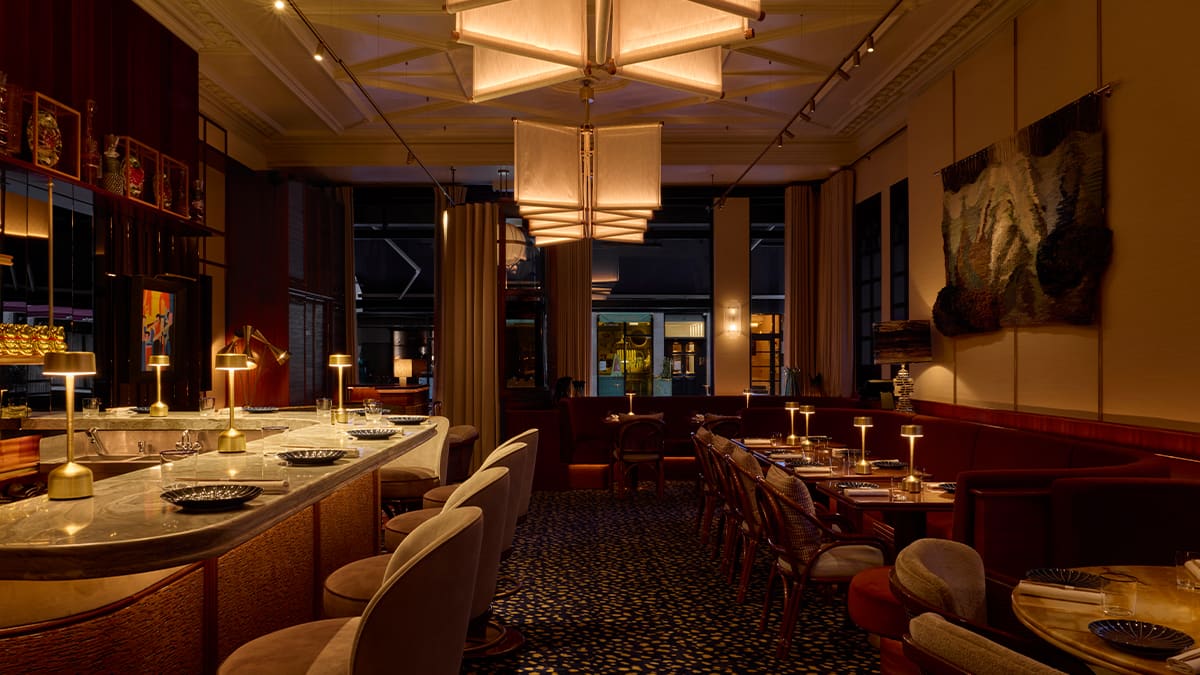
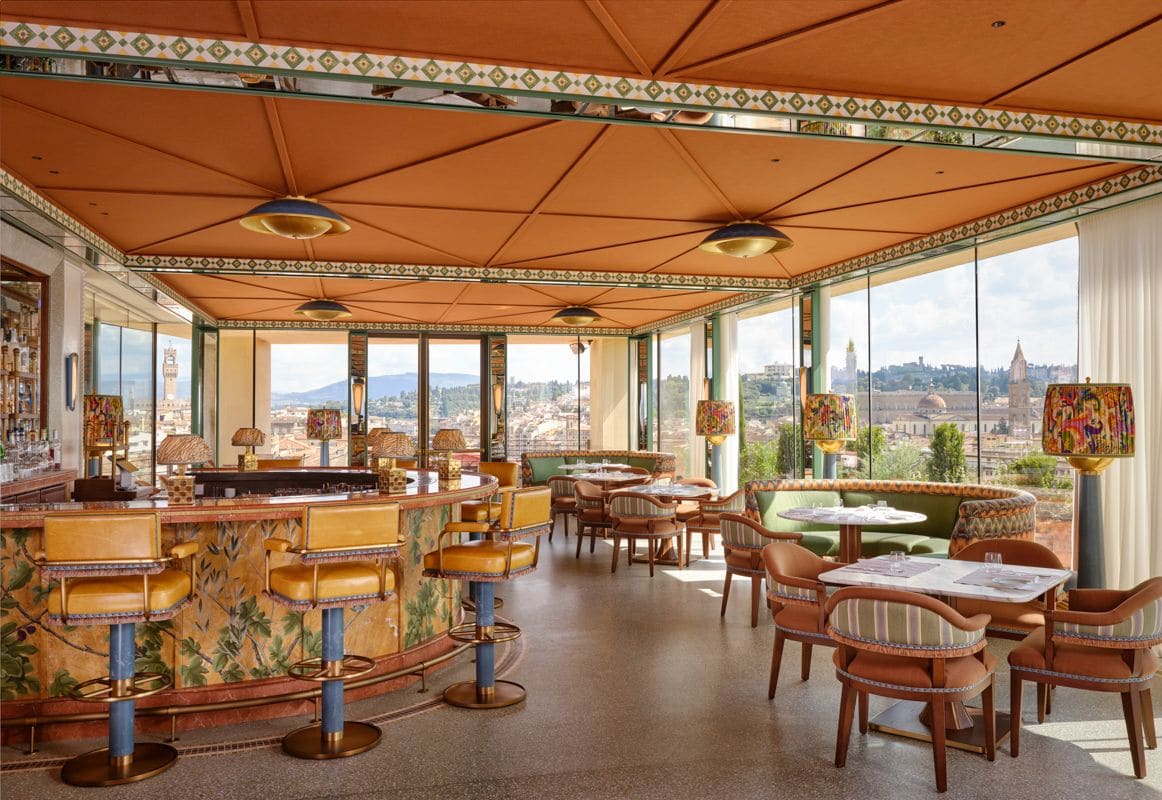
Lázaro Rosa Violán Studio has crafted an environment where materials speak in counterpoint. Marble and polished wood provide the structural vocabulary, while embroidered textiles in deep red and blue hues introduce warmth and tactility. Silk-toned walls soften the edges, and sculptural lighting draws the eye upward, creating visual interest without competing for attention with the plates arriving from the kitchen.
The layout favours intimacy over grandeur. Various private dining spaces are tucked throughout the restaurant, the largest of which, known simply as the Salon, accommodates up to thirty guests and sits discreetly at the back. This is a space designed for those who value privacy without sacrificing the energy of a working restaurant, where conversations can unfold without the self-consciousness that accompanies more exposed seating.
What Rosa Violán has achieved here is a sense of layered discovery. First-time visitors may initially register the marble and wood, the sculptural lighting, the deep jewel tones. But it is on subsequent visits that the finer details emerge: the quality of the textile work, the way natural light filters through at certain hours, the acoustic care that allows for conversation without raising voices. These are the considerations that separate a well-appointed dining room from one that guests return to not out of obligation but genuine affection.
The Relocation as Statement
Lignac himself has noted that London holds particular significance for Bar des Prés as the first location opened beyond France. The relocation to South Audley Street, then, is not a retreat but a recalibration. The initial outpost served its purpose: it introduced London to Lignac's culinary vocabulary and established a foothold in a notoriously competitive market. The new address suggests a chef confident enough to move away from high-traffic visibility toward a more considered presence.
This shift mirrors a broader trend we have tracked across luxury dining in global cities. Chefs who once prioritized conspicuous locations are increasingly opting for addresses that attract a self-selecting audience, one that seeks out quality rather than stumbling upon it. South Audley Street, with its mix of established names and quiet prestige, offers exactly this: a neighbourhood where reputation precedes signage.
The decision also speaks to Lignac's understanding of how London diners have evolved over the past five years. The city's appetite for Franco-Asian cooking has deepened, moving beyond novelty toward genuine appreciation for the technical skill required to execute such a menu with consistency. By relocating to a space that emphasizes intimacy and refinement, Lignac acknowledges this maturation and positions Bar des Prés to serve diners whose palates have developed alongside the restaurant itself.
What the Move Reveals About Mayfair's Culinary Geography
Mayfair remains one of London's most densely concentrated luxury dining districts, yet within that concentration exist distinct micro-climates. South Audley Street occupies a particular niche: less ostentatious than Berkeley Square, less tourist-facing than the streets immediately surrounding Claridge's, yet no less prestigious. It is a street where regulars outnumber first-timers, where reservations are made weeks in advance not because of hype but because of earned reputation.
For a restaurant like Bar des Prés, this geography matters. The decision to relocate here suggests an intention to cultivate a loyal following rather than chase transient acclaim. It is a strategy that requires confidence in the product and patience in building community, two qualities that are often in short supply among restaurateurs eager to capitalize on momentum.
At Global Chic Voyage, we have watched other chefs attempt similar pivots with varying degrees of success. The ones who thrive are those who understand that relocation is not merely logistical but philosophical. It requires rethinking not just the physical space but the relationship with diners, the pacing of service, even the composition of the menu. Lignac's willingness to undertake this recalibration five years into the London venture speaks to a long-term vision, one that prioritizes sustainability over spectacle.
The Broader Implications for Franco-Asian Dining in London
London's relationship with Franco-Asian cuisine has always been complicated by the city's deep reservoirs of both French and Japanese culinary expertise. Diners here have access to Michelin-starred French classics and to some of the finest Japanese restaurants outside Tokyo. For a hybrid cuisine to succeed, it must offer something beyond the sum of its influences: a distinct voice, a coherent philosophy, a reason to exist.
Lignac's approach succeeds because it does not attempt to obscure its dual heritage. The menu at Bar des Prés does not pretend to be authentically Japanese or purely French. Instead, it acknowledges both traditions openly and uses that transparency as a foundation for creativity. This honesty resonates in a dining landscape increasingly wary of appropriation disguised as innovation.
The relocation to South Audley Street allows Bar des Prés to continue this conversation in a setting better suited to its ethos. The new space, with its emphasis on intimacy and material quality, reinforces the seriousness of Lignac's culinary project. It signals that this is not a trend-chasing exercise but a sustained commitment to a particular way of cooking and hosting.
As London's luxury dining scene continues to fragment into ever more specialized niches, restaurants that can articulate a clear identity while remaining open to evolution will be the ones that endure. Bar des Prés, in its new Mayfair incarnation, appears positioned to do exactly that. The crab galette, the yuzu-dressed sea bass, the Tokyo Garden cocktail, all remain. But the context has shifted, and with it, the potential for deeper engagement with a city that rewards those patient enough to earn its trust.
Photo: Bar des Prés
Spot something wrong? Email editors@globalchicvoyage.com. We log every correction publicly.
RELATED
SEE ALL →
13 Jul 2026 / 5 min
7 Aug 2026 / 5 min
30 Jul 2026 / 5 min
30 Jul 2026 / 5 min