
A Dutchman Comes Home to the Canopy: Mandai Rainforest Resort Names New General Manager
Michel Scheffers, a hospitality veteran with a quarter-century across Asia's luxury landscape, takes the helm at Singapore's only rainforest-immersed resort
AM
30 May 2026 · 5 MIN READ · UPDATED 17 AUG 2026
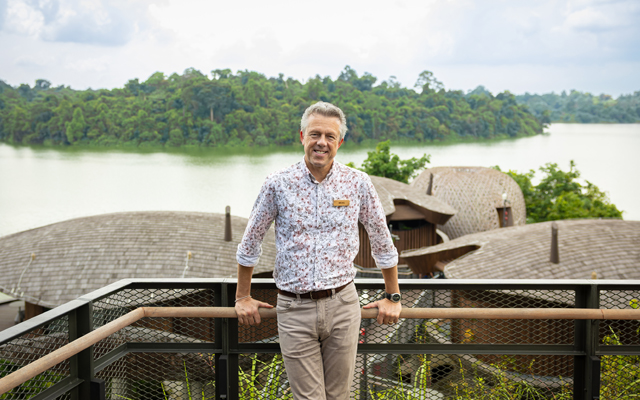
The Man Who Returns to Green
There is a particular kind of executive who, after decades shuttling between glass towers and beachfront compounds, finds himself drawn not to another skyline but to the forest edge. Michel Scheffers is that sort. Banyan Tree has appointed him general manager of Mandai Rainforest Resort, and the choice feels less like a corporate reshuffle than a homecoming—albeit to a home that is all canopy and birdsong, where the air smells of wet leaves and the morning chorus begins before dawn.
Scheffers brings more than 25 years of hospitality leadership to the role, according to Banyan Tree, with senior positions across Asia's luxury tier: Onyx Hospitality Group, Shangri-La, Hilton. His résumé reads like a regional atlas—Thailand, Singapore, India, the Maldives, Hong Kong—each posting a chapter in the ongoing education of a hotelier who has learned that luxury, at its most compelling, is not about marble lobbies but about context, about knowing when to step back and let place do the work.
A Resort That Asks Questions
Mandai Rainforest Resort is not trying to be a beach club. It is Singapore's only property genuinely embedded in primary rainforest, a 338-room experiment in what happens when you build hospitality not around a pool deck but around biodiversity. The resort sits within the Mandai Wildlife Reserve precinct, adjacent to the Singapore Zoo, Night Safari, River Wonders, and Bird Paradise—a constellation of conservation-focused attractions that together form one of the most ambitious rewilding projects in urban Asia.
The challenge for any general manager here is philosophical as much as operational. How do you run a luxury resort that is also, by design, a lesson in humility? How do you sell comfort without selling separation from the very ecosystems guests have come to experience? These are not rhetorical questions. They are the daily work of a property that must reconcile high thread counts with the fact that hornbills nest overhead and the forest does not care about your checkout time.
At Global Chic Voyage, we have watched the Mandai precinct evolve over the past three years, and what strikes us is not the architecture—handsome though it is—but the operational restraint. The resort does not pretend the rainforest is a backdrop. It treats it as the primary stakeholder, which means that guest experience is designed around minimal disturbance, that lighting is kept low to preserve nocturnal rhythms, that food waste is composted on-site and menus are built around regional, seasonal ingredients. This is not greenwashing. It is a different kind of luxury proposition, one that asks guests to adjust their expectations rather than the other way around.
The Arc of an Asian Hospitality Career
Scheffers' trajectory across Asia's luxury sector offers useful context. The Maldives taught him the choreography of high-touch service in isolated environments. Hong Kong taught him the cadence of urban luxury, where efficiency is an art form and guests expect both anonymity and anticipation. Thailand and India taught him the weight of cultural heritage in hospitality, the way a property can become a bridge between tradition and contemporary comfort.
What Mandai asks of him is synthesis. The resort operates at the intersection of conservation, education, and leisure—a triad that requires a general manager who can speak fluently across all three registers. It is not enough to run a smooth operation; the operation must also model environmental stewardship and communicate complex ecological ideas without condescension. This is hospitality as pedagogy, and it demands a particular kind of humility from leadership.
We have seen other appointments in the region where a strong résumé was assumed to be transferable, only to discover that context matters more than pedigree. Mandai is not a resort that can be managed by template. It requires someone who understands that luxury, in this setting, is not about insulation from place but immersion in it—and that immersion, done well, is harder work than insulation.
Why This Appointment Matters Beyond Singapore
The Mandai model is being watched. Not because it is replicable—few cities have 80 hectares of primary rainforest to build around—but because it represents a broader question facing luxury hospitality in Asia: how do you grow without extracting? How do you attract high-yield guests without erasing the ecological and cultural systems that make a place worth visiting in the first place?
Singapore has long been a laboratory for these questions, a city-state that has had to innovate around scarcity. The Mandai Wildlife Reserve is the latest iteration of that innovation, a 400-hectare precinct that integrates wildlife conservation, public education, and commercial hospitality into a single, coherent ecosystem. The resort is not an add-on; it is structurally embedded in the conservation mission, with revenue streams designed to support the broader precinct's ecological goals.
Scheffers' appointment signals that Banyan Tree is taking that integration seriously. The choice of a general manager with deep regional experience, rather than a specialist parachuted in from a Western market, suggests an understanding that this kind of hospitality requires local fluency, cultural dexterity, and a long-term view. It is not a short-term turnaround play. It is a bet on a different kind of guest—one who is willing to trade the infinity pool for the early-morning macaque sighting, who understands that luxury can mean proximity to wildness rather than distance from it.
The Forest as Stakeholder
What we find most compelling about the Mandai project is not the resort itself but the precedent it sets. If you treat the forest as a stakeholder—if you build operational protocols around its rhythms rather than your own—you end up with a different kind of hospitality. One that is quieter, slower, more attuned. One that does not promise escape but presence.
This is not a model that scales easily. It requires management that can hold complexity, that can balance commercial imperatives with ecological ones without defaulting to greenwashing or performative sustainability. It requires a general manager who understands that the forest is not a feature. It is the client.
Scheffers inherits that responsibility now. The question is not whether he can run a luxury resort—his track record suggests he can. The question is whether he can run one that operates on the forest's terms, that bends toward biodiversity rather than asking biodiversity to bend toward it. That is the real work ahead, and it is work that will be watched not just by the industry but by the canopy itself.
Spot something wrong? Email editors@globalchicvoyage.com. We log every correction publicly.
RELATED
SEE ALL →
8 Aug 2026 / 5 min
8 Aug 2026 / 5 min
8 Aug 2026 / 5 min
7 Aug 2026 / 5 min