Where the Land Speaks Louder Than Luxury
In the far reaches of the Scottish Highlands, a new kind of hospitality asks guests to listen as much as they look
A Different Threshold
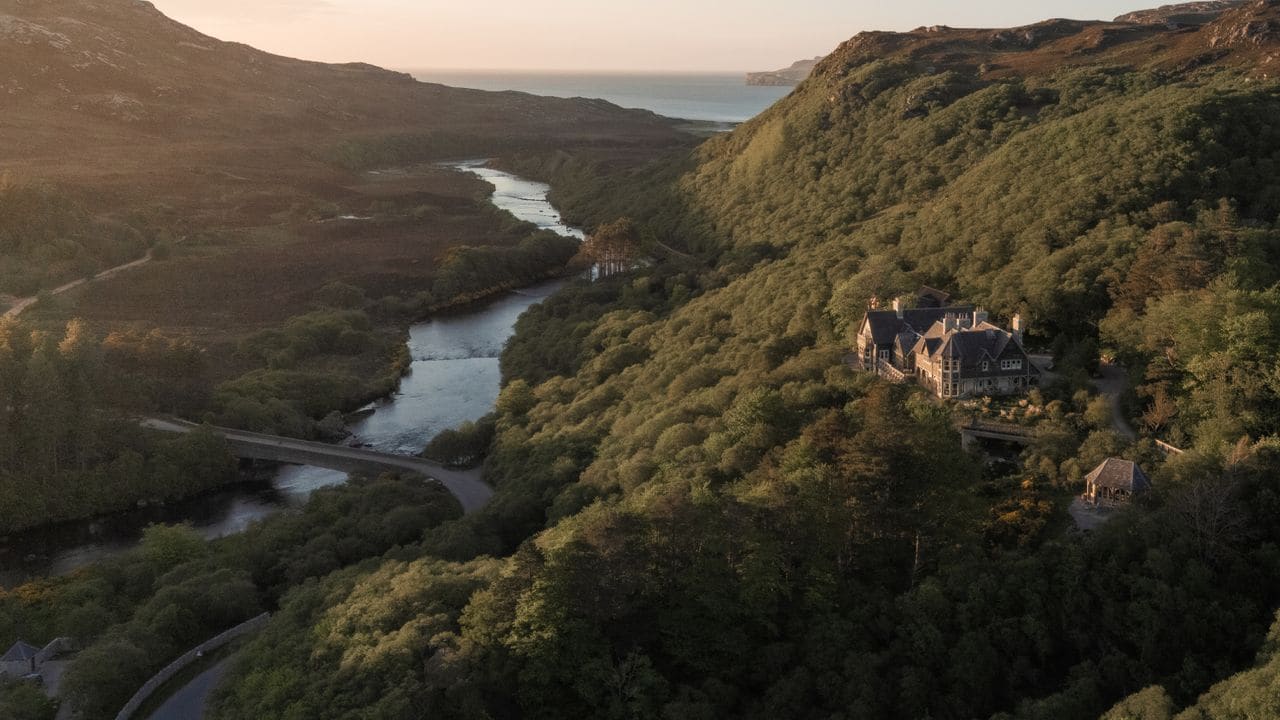
At the mouth of Loch Hope, where two mountains stand watch over Scotland's northern edge, a Victorian shooting lodge has been transformed into something the Highlands have not quite seen before. The building sits where the rain that falls on Ben Hope eventually makes its way to the sea, and the name itself came with the land rather than from any branding exercise. Hope Lodge opened this May, and it represents a shift in how we might think about luxury hospitality in wild places.
At Global Chic Voyage, we've watched Scotland's luxury landscape evolve over decades. Gleneagles has long served as the country's glorious playground, while The Fife Arms delivers Victorian fantasy with baronial flair. Hope Lodge offers something else entirely: a model of hospitality that feels rooted in its specific geography while looking resolutely forward. It is place-based in a way that goes beyond tartan and shortbread, and it raises questions about what it means to stay somewhere that exists, fundamentally, for the land rather than for guests.
This is not a simple story of a beautiful hotel in a beautiful setting. Sutherland's landscape carries weight. The so-called wilderness here is harrowed ground, emptied of people in the nineteenth century when landowners cleared communities for sheep farming and later for game hunting. Visitors often describe the region as beautifully empty, but that emptiness is not natural. It is the result of displacement, and any conversation about conservation here must acknowledge that history.
The Architecture of Intention
The main lodge is a refurbished 1870s structure with seven bedrooms and several communal spaces. It can operate as a private rental or function more like a traditional hotel. Nearby stands An Cala, a two-bedroom cabin tucked into the woods, and down by the river sit cottages that have been meticulously restored. Across the road, reached by tunnel, is The Clachan, a cluster of new buildings that serves as the property's operational heart. Here you find staff quarters, kitchen, treatment rooms, gym, and an underground car park designed to keep vehicles out of sight.
Guests arrive at The Clachan first, where they are oriented not only to the property but to the broader conservation mission of Wildland, the organization behind Hope Lodge. Wildland is the hospitality arm of a conservation effort that spans three Scottish estates and represents a two-hundred-year commitment to land regeneration. The founder is Anders Hoch Povlsen, a Danish entrepreneur whose fashion empire Bestseller has made him Scotland's largest private landowner. The ambition is audacious: to restore degraded ecosystems across vast swathes of the Highlands. The paradox is equally undeniable: private wealth attempting to heal wounds partly caused by private wealth.
Edinburgh practice GRAS has overseen the architectural work, both old and new, over fourteen years. The restoration of the original lodge required forensic attention to period details, while the contemporary structures were designed to sit quietly within the landscape. The stone used throughout, indoors and out, comes from a disused quarry on the site itself. Hope sits within a designated geopark, and the local Moine Schist is among the oldest geological formations in Europe. These buildings are meant to last two centuries, perhaps longer, and they read as if they have grown from the ground rather than been imposed upon it.
Interiors That Whisper
South African studio Cécile and Boyd, known for their work with Singita's safari lodges across Africa, designed Hope's interiors. The result is a mood rather than a style. It is not the Scandi-Scot aesthetic that has become shorthand for contemporary Highland design, nor is it particularly Scottish in the traditional sense. Instead, the interiors layer stone, wood, leather, and woven grass with antiques that feel collected rather than curated. Some pieces are grand, others humble, and together they create a sense of time passing slowly.
There is a softness here that avoids the potential severity of a Victorian hunting lodge. Joinery by Edinburgh craftsman Laurence McIntosh adds warmth without fussiness. The art on the walls depicts only landscape and wildlife, with no human figures or structures. The intention, according to the design team, is to immerse guests in Highland nature without distraction. It is a soothing environment, and an extraordinarily comfortable one. The interiors feel enveloping without being heavy, domestic without being cluttered.
The Highland Safari
Hope bills itself informally as a Highland safari experience, though the safari here is less about spotting wildlife and more about communing with the land. Activities range from introductory lectures on conservation to cold-water plunges before breakfast, from guided hikes and paddle-boarding excursions to loch-side picnics, fishing, foraging, sauna sessions, and sound baths. Elegant dry robes, neoprene shoes, hampers, flasks of drinks suited to each activity - all appear as if conjured by invisible hands.
Service throughout is exceptional, threading the delicate line between host, educator, companion, and guide. The team of guides carries much of Hope's ambition to be more than a luxury retreat. Their expertise in ecology, geology, and natural history is matched by a manner that makes stripping down for a cold plunge or asking about ticks feel entirely natural. These guides are crucial to the experience, and their role is more significant than it might first appear. They are the interpreters of this landscape, the ones who can help guests understand what it means to be here.
The Questions the Land Asks
Conservation and hospitality do not always sit comfortably together. Hospitality can trample over conservation with small footprints and large expectations. At Hope, the relationship is more carefully considered, though it remains complex. The tension is not hidden: this is a project funded by private wealth, situated on land with a troubled history, offering luxury to a global clientele while pursuing ecological restoration. It is a paradox that the property does not fully resolve, nor does it pretend to.
What Hope does offer is an opportunity for engagement that goes beyond the typical luxury retreat. Staying here will inevitably raise questions for any guest curious about Scotland's social, economic, and political fabric. While these issues need not dominate the experience, neither should they be entirely absent. Hope is, after all, fundamentally about relationships with reality. It offers escape, certainly, but it also offers a form of reckoning - with the land, with history, with one's own place in the world.
The programming encourages this kind of reflection. Between the plunges and picnics, between the hikes and the hearthside evenings, there is space to think. The landscape itself demands it. Those two mountains standing sentinel, the loch that drains into the sea, the stone pulled from the earth beneath your feet - all of it insists on attention.
A New Benchmark
Hope Lodge joins a small but growing number of properties worldwide that attempt to marry genuine environmental commitment with high-level hospitality. It is a difficult balance to strike. Too often, sustainability becomes a marketing angle rather than a guiding principle. Too often, luxury resorts treat the landscape as backdrop rather than protagonist. Hope does better than most, in part because the conservation mission predates and supersedes the hospitality offering. The lodge exists to serve the land, not the other way around.
Whether this model represents the future of Scottish luxury travel remains to be seen. What is certain is that Hope has introduced a new standard, one that other properties will find difficult to match. It combines comfort and indulgence with environmental engagement in a way that feels both serious and relaxed. It acknowledges complexity without drowning in it. And it offers guests something more valuable than a beautiful room with a beautiful view: it offers them a role, however brief, in a longer story.
The Weight of a Name
There is something fitting about a lodge called Hope sitting at the edge of Europe's largest conservation project. Hope is a fragile thing, easily crushed by cynicism or overwhelmed by scale. But it is also resilient, and it grows stronger when grounded in action. Wildland's two-hundred-year commitment is an act of hope, as is the decision to share this landscape with guests who might return home with a different understanding of their relationship to the natural world.
The best house parties, as the Scots know, are the ones where you leave changed. Hope Lodge aspires to that standard. It offers exceptional comfort, certainly, and the kind of service that makes everything feel effortless. But beneath the dry robes and the perfectly timed picnics, beneath the stone and the soft interiors, there is an invitation to pay attention. To listen to what the land has to say. To consider what it means to be here, in this specific place, at this specific moment.
Whether that invitation is accepted depends on the guest. But the fact that it is extended at all, in a context of genuine luxury, marks Hope as something worth noting. The Highlands have always been a landscape of questions. Now they have a lodge that is brave enough to ask them.