Palm Beach Whispers: Where Old Money Still Speaks Softly
Beyond the gilded gates and presidential compounds lies an island that has perfected the art of discretion - and the theatre of wealth.
The Island That Built Itself on Whispers
There is a particular quality to the light on South Ocean Boulevard in the late afternoon, when the sun slants through the Australian pines and catches the spray from lawn sprinklers tending to emerald grass that should not, by rights, exist in this climate. The houses set back from the road offer little more than glimpses: a coral-stone pillar, a glimpse of Spanish tile, the shadow of a hedge trimmed to architectural precision. This is how Palm Beach prefers to present itself - not as spectacle, but as suggestion.
The island stretches just sixteen miles long and less than a mile wide at most points, yet it has housed more concentrated wealth per square foot than perhaps anywhere else in America. Unlike the megayacht exhibitionism of Monaco or the Instagram-ready excess of Dubai, Palm Beach has cultivated something more elusive: the aesthetics of restraint married to bottomless resources. Here, billionaires still observe the old codes. They whisper rather than shout. They commission rather than collect. They summer elsewhere and winter here, maintaining the seasonal rhythms their grandparents established a century ago.
This is not a place that reveals itself easily to the casual visitor. The island operates on frequencies that require tuning, on references that presume a certain fluency in the semiotics of American aristocracy. Yet for those willing to move slowly, to observe rather than consume, Palm Beach offers a peculiar sort of masterclass in how wealth shapes landscape, architecture, and the rituals of daily life.
The Architecture of Discretion
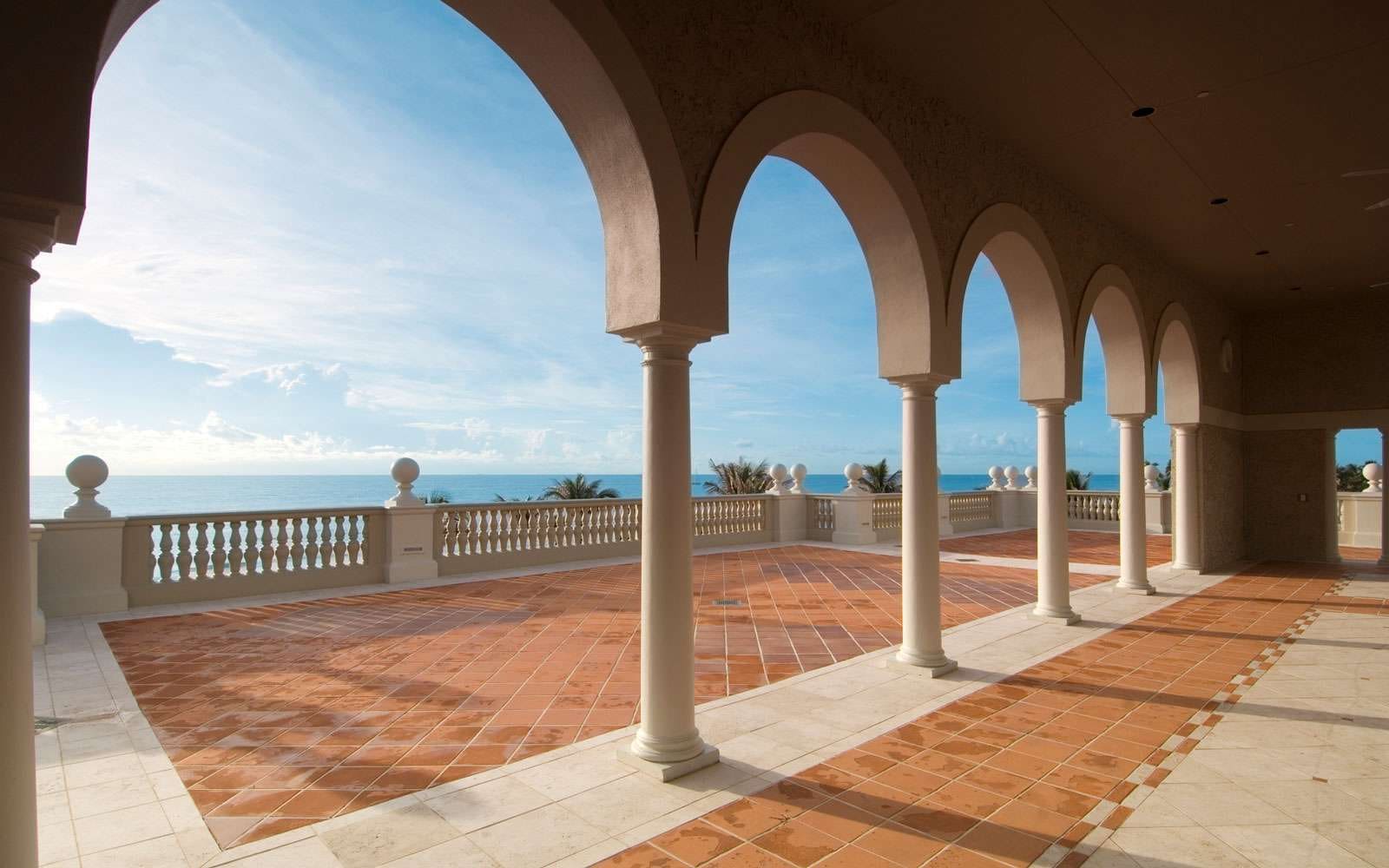
Addison Mizner changed everything when he arrived in 1918, recovering from an injury and convinced that South Florida's climate could be tamed into a version of the Mediterranean he had studied in Spain. His fantasy architecture - a hybrid of Moorish arches, Spanish courtyards, and Venetian loggias - gave Palm Beach its signature aesthetic. More importantly, he gave its residents permission to build theatrically while living privately.
Walk Worth Avenue today and you will see his influence in every arcade and courtyard, every loggia and bell tower. The street itself is a study in controlled revelation: shops open onto hidden courtyards, passageways lead to unexpected gardens, nothing presents itself all at once. This is retail as labyrinth, commerce as treasure hunt. The stores stock what you would expect - Hermès, Chanel, the Italian jewelers whose names you recognize from magazine back pages - but the real pleasure is in the architecture of discovery, the way the street unfolds in layers.
The residential estates follow similar principles. Even Mar-a-Lago, now the most public address on the island, was built by Marjorie Merriweather Post as a private kingdom, 128 rooms facing the ocean with its back turned firmly to the world. The great houses of Palm Beach were never meant to be seen from the street. They reveal themselves gradually: first a gate, then a drive, then a courtyard, and only finally the house itself, positioned to capture ocean breezes and frame views of manicured gardens that extend to private beaches.
The Rituals of a Particular Class
The social architecture matters as much as the physical. Palm Beach operates on a calendar as fixed as any religious liturgy. Season begins after Thanksgiving and ends before Easter. During these months, the island's population swells, the clubs open their full dining rooms, and the benefit circuit begins its relentless rotation. There are galas for hospitals, for museums, for animal welfare, for children's causes - an endless succession of black-tie evenings where the same faces appear in slightly different configurations, wearing different jewels but maintaining the same careful social calculus.
The clubs remain central to this ecosystem. The Everglades Club, founded in 1918, still occupies Mizner's original Moorish fantasy building on Worth Avenue. The Bath and Tennis Club guards its ocean frontage and its membership rolls with equal vigilance. These are not places you can simply join; you must be invited, proposed, seconded, and approved by committees whose deliberations remain opaque. The exclusivity is the point, of course. In a world where almost anything can be purchased, access to certain spaces cannot.
Yet there is something almost quaint about Palm Beach's social structures in 2026, a sense that the island is performing a version of aristocracy that the rest of America abandoned decades ago. The dress codes, the calling cards, the elaborate etiquette around invitations and seating arrangements - these rituals persist here with a seriousness that might seem absurd elsewhere but which, on this narrow strip of land, acquire the weight of tradition.
Where Nature Bends to Will
The landscape itself is an artifact of wealth. Every palm tree was planted, every beach was nourished with imported sand, every garden was coaxed into existence through irrigation systems that defy the sandy soil and salt air. The island's original vegetation - scrub pine, palmetto, sea grape - has been almost entirely replaced by a more cultivated vision of tropical paradise.
The Lake Trail, which runs for five miles along the Intracoastal Waterway, offers the most democratic view of this constructed landscape. Joggers and cyclists share the path in the early morning, when the light is still soft and the heat has not yet settled. On one side, the waterway glitters, dotted with yachts moored at private docks. On the other, hedges and walls guard the estates, offering only occasional glimpses of the houses beyond. It is a pleasant route, impeccably maintained, and utterly controlled - nature as amenity, landscape as backdrop for wealth.
The beaches, too, reveal the hand of careful management. Palm Beach has fought erosion for decades, pumping in sand, building seawalls, protecting the shoreline that gives the island its reason for existence. The public beaches, clustered at the south end near Phipps Ocean Park, are clean and well-appointed, but they lack the sense of wildness you find on less-managed stretches of Florida coast. Even the ocean here seems to understand its place in the aesthetic order.
The Presidential Paradox
The island's relationship with political power has always been complicated. It has housed winter White Houses and presidential retreats since the 1940s, when the Kennedy family established their compound on North Ocean Boulevard. The presence of presidents and former presidents has added a layer of security theatre to an island already obsessed with privacy. Motorcades disrupt Worth Avenue traffic. Secret Service agents scan crowds at charity galas. The machinery of power intrudes on the carefully maintained illusion of escape.
Yet this, too, has become part of Palm Beach's identity - a place where wealth and power intersect so routinely that neither seems remarkable. Heiresses lunch with cabinet members. Real estate developers host senators. The boundary between social and political capital blurs until the distinctions hardly matter. What matters is access, influence, the ability to make things happen with a phone call or a quiet word at the right dinner party.
This concentration of power and money in such a small geographic space creates its own distortions. The island exists in a bubble, insulated from the economic pressures that shape life for most Americans. Here, the questions are not whether but which: which house, which club, which charity to support, which cause to champion. The baseline assumption is abundance. Everything else is detail.
The Cost of Paradise
There is an uncomfortable truth at the heart of Palm Beach's appeal: it is an island built on exclusion. The labor that maintains the lawns, cleans the houses, serves the meals at the clubs - most of it comes from West Palm Beach, across the bridges, where housing is cheaper and the demographic reality is entirely different. The workers arrive each morning and depart each evening, keeping the machinery of luxury running while remaining largely invisible to those who benefit from their labor.
This geographic and economic separation is not unique to Palm Beach, of course. It is the pattern of American inequality writ small, made visible by the narrow bridges that connect the island to the mainland. But the contrast is particularly stark here, where wealth is so concentrated and so conspicuous, even in its attempts at discretion.
The island also faces pressures that money alone cannot solve. Sea level rise threatens the beaches and the low-lying estates. Hurricane risk grows with each warming decade. The very factors that made Palm Beach desirable - its barrier island geography, its tropical climate - now carry new vulnerabilities. The question is whether the island's residents will adapt their vision of paradise or simply spend more to maintain the illusion a little longer.
The Enduring Theater
Palm Beach remains fascinating not despite its contradictions but because of them. It is a place that fetishizes privacy while hosting some of the most public displays of wealth in America. It clings to social codes from another era while adapting seamlessly to new money and new technologies. It presents itself as a refuge from the world while concentrating world-shaping power and resources within its narrow boundaries.
For the visitor, the island offers a glimpse into how a certain stratum of American society chooses to live when given nearly unlimited resources and a shared commitment to particular aesthetic and social values. It is not always comfortable to witness. The disparities are too obvious, the exclusions too deliberate. But it is undeniably compelling - a living museum of American aristocracy, still operating according to its own internal logic, still whispering its secrets to those who know how to listen.
The light is different here, filtered through money and history and the particular microclimate of a barrier island. Whether that makes it more beautiful or simply more rarefied is a question each visitor must answer for themselves.