The Island Archipelago Where California Meets the Galápagos
Five volcanic islands off the Southern California coast harbor endemic species and undisturbed ecosystems found nowhere else on Earth.
An Archipelago Apart
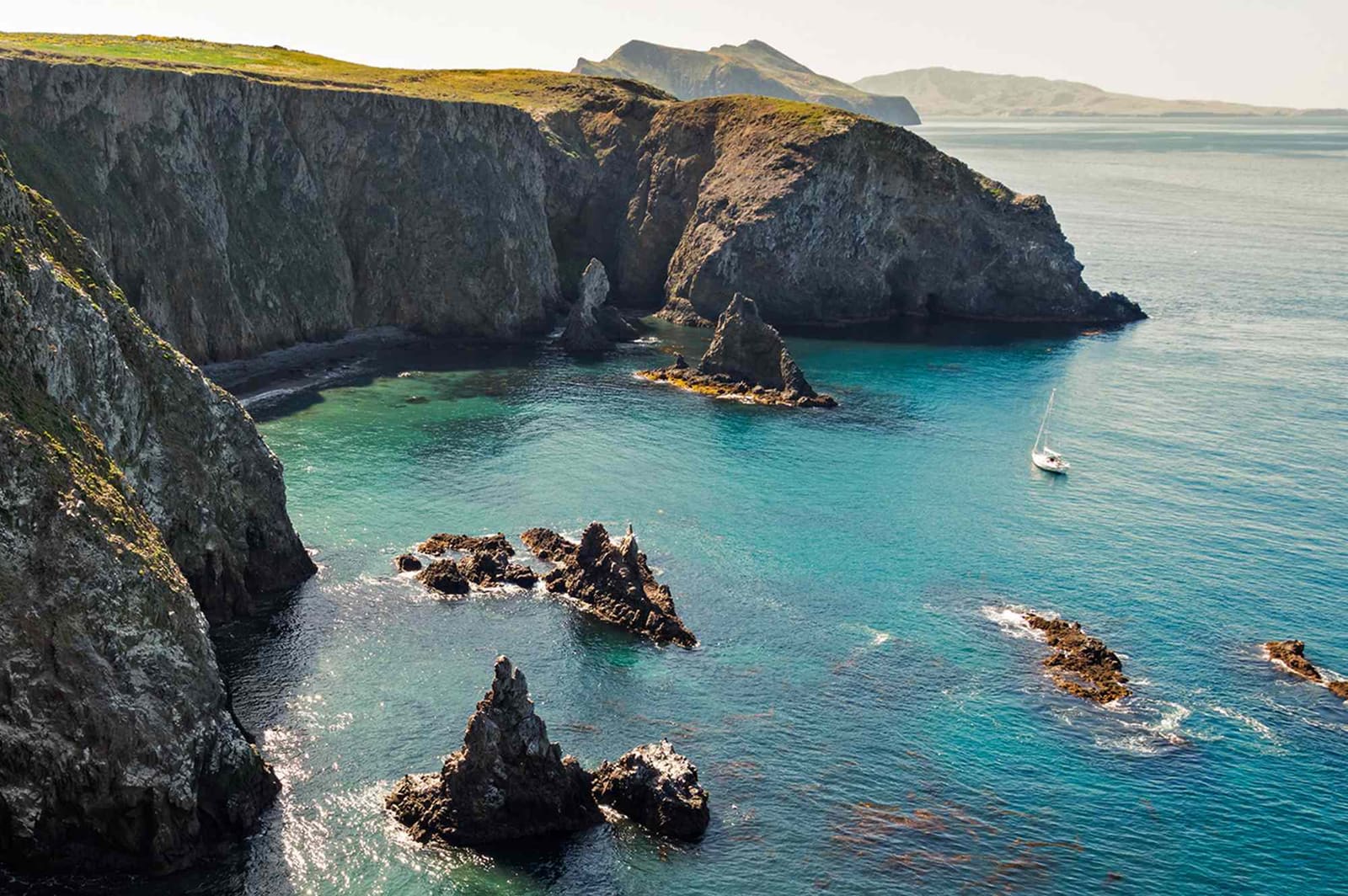
The boat cuts through the morning fog, leaving the Santa Barbara Harbor behind. Within an hour, the outline of Anacapa Island materializes, its volcanic cliffs rising straight from the Pacific like cathedral walls. This is not the California most travelers know. There are no boardwalks here, no beachfront hotels, no highway pullouts with interpretive signs. The Channel Islands exist in a state of isolation that has shaped not just their landscape but the very DNA of the creatures that call them home.
At Global Chic Voyage, we've long held that the most compelling destinations are those that demand something of their visitors: effort, patience, a willingness to meet a place on its own terms. The Channel Islands archipelago, often called the Galápagos of North America, asks all three. Accessible only by boat or small plane, these five islands and their surrounding waters form a national park that receives a fraction of the visitors that crowd Yosemite or Yellowstone, yet harbor biological diversity that rivals any protected landscape in the American West.
Where Evolution Took a Different Turn
The comparison to the Galápagos is not mere marketing poetry. Like their equatorial counterparts, the Channel Islands have served as evolutionary laboratories, isolated long enough for species to diverge in remarkable ways. The island fox, no larger than a house cat, exists in six genetically distinct subspecies, one for each of the larger islands. The island scrub jay, found only on Santa Cruz Island, is larger and more vividly blue than its mainland relatives, an example of island gigantism playing out in real time.
Beneath the waterline, the divergence becomes even more pronounced. Giant sea bass, which can weigh over two hundred pounds, patrol kelp forests that rise like underwater cathedrals. Harbor seals haul out on remote beaches where their ancestors have rested for millennia. In winter months, gray whales pass through the Santa Barbara Channel on their annual migration, their exhalations visible from the island bluffs on calm days.
The endemic species count reads like a naturalist's fever dream: eight plant species found nowhere else, a dozen animal subspecies unique to individual islands, entire ecosystems that function according to rules written in isolation. This is what happens when land separates from the mainland long enough for adaptation to outpace migration, when the Pacific acts as both barrier and incubator.
The Architecture of Remoteness
The park's inaccessibility is not an obstacle to be overcome but the very thing that has preserved it. There are no bridges to these islands, no ferry schedules running every hour. Visitors must book passage on authorized boat operators or arrange flights on small aircraft, planning around weather windows that can close without warning when swells rise or fog settles. Once ashore, infrastructure is minimal by design: primitive campgrounds, ranger stations, hiking trails that range from gentle coastal walks to scrambles over volcanic rock.
Santa Cruz, the largest island, offers the most developed visitor experience, which is to say it offers very little development at all. A historic ranch complex has been converted into a visitor center, but beyond that, the island belongs to its native inhabitants. Painted Cave, one of the largest sea caves in the world, can only be reached by kayak, its entrance yawning wide enough to swallow the boats that venture inside, its walls echoing with the sound of waves against stone.
Anacapa, closest to the mainland, presents itself as three narrow islets connected by reefs exposed at low tide. Its lighthouse, automated now, still warns ships away from rocks that have claimed vessels since the Spanish colonial era. Santa Rosa stretches windswept and treeless, a landscape that feels more Patagonian than Californian. San Miguel, the westernmost island, is often shrouded in fog, its beaches crowded with six species of seals and sea lions that have learned to coexist in a raucous, barking détente.
The Chumash Memory
Long before the national park designation, before American settlers arrived, before Spanish galleons sailed this coast, the Chumash people built a maritime culture across these islands. They crafted plank canoes called tomol, sewn together with plant fiber cordage and sealed with naturally occurring tar, vessels sophisticated enough to navigate the unpredictable channels between islands and mainland. Archaeological sites scattered across the archipelago reveal thousands of years of continuous habitation, middens full of abalone shells and tool-making debris, pictographs painted in caves.
The Chumash understood what modern visitors are only beginning to relearn: that these islands are not separate from the mainland but part of a larger coastal ecosystem, connected by currents and migration patterns and the movement of people across water. The tomol crossings, revived in recent decades by Chumash descendants, trace routes that are as much cultural as geographical, acknowledging that remoteness is relative, that what seems isolated to one culture was home to another.
Why Fewer Visitors Means More
The Channel Islands receive fewer than four hundred thousand visitors annually, a number that Yosemite surpasses in a busy month. This is not a problem to be solved but a feature to be appreciated. The limited access acts as a natural throttle, ensuring that the islands can absorb human presence without being fundamentally altered by it. There are no hotels because hotels would require infrastructure that would undermine the very qualities that make the place worth protecting.
For travelers accustomed to luxury defined by thread count and turndown service, the Channel Islands offer a different proposition: luxury as absence, as the space to encounter a landscape largely unchanged by human intervention. The discomfort of a tent on hard ground, the inconvenience of limited fresh water, the surrender of connectivity required when cell service drops away, these are not deprivations but the price of admission to a place operating on its own terms.
The islands we've watched draw repeat visitors are not those that cater to every comfort but those that offer something increasingly rare: genuine wildness, the sense of being somewhere that exists independent of human desire, that was here long before us and will remain long after. The Channel Islands, perched at the edge of one of America's most populous states yet fundamentally apart from it, have managed to preserve that quality not despite their inaccessibility but because of it.
Planning a Crossing
Reaching the islands requires advance planning of a sort that feels almost quaint in an age of instant booking and last-minute travel. Boat operators out of Ventura and Santa Barbara run regular trips during calmer months, typically spring through fall, with winter crossings dependent on weather. The journey itself can range from one to three hours depending on destination, with seas that vary from glassy calm to swells that test even experienced sailors.
Day trips allow visitors to sample individual islands, hiking the trails and exploring tide pools before returning to the mainland by evening. Overnight camping, available by permit, opens the possibility of experiencing the islands at dawn and dusk, when wildlife is most active and the quality of light transforms familiar landscapes into something otherworldly. Kayaking tours offer access to sea caves and kelp forests, while diving trips reveal underwater ecosystems as complex as any terrestrial forest.
The parks service maintains a deliberately light touch, providing safety infrastructure and basic facilities while leaving the islands themselves largely unmanaged. This means visitors must come prepared, carrying their own water, packing out all waste, understanding that rescue in case of emergency may take time. It is a model of tourism that privileges preservation over convenience, long-term ecological health over short-term visitor satisfaction.
The fog is lifting as the boat returns to the mainland, the islands receding into the haze behind. On deck, passengers are quiet, processing what they've seen, perhaps understanding that they've visited a place that exists outside the normal circuits of American tourism. The Galápagos comparison, initially jarring, begins to make sense: not because the landscapes are similar but because both represent what happens when isolation and protection combine, when a place is allowed to remain itself rather than becoming what visitors expect it to be. The Channel Islands, visible from the crowded beaches of Southern California yet fundamentally apart, remind us that remoteness is not always measured in miles.