A Century-Old Inn on Chicago's North Shore Reclaims Its Place
The Deer Path Inn has earned recognition as the Midwest's finest resort, a quiet validation of its nearly hundred-year commitment to gracious hospitality.
The Weight of Recognition
There is a particular quality to historic properties that have survived nearly a century without losing their essential character. The Deer Path Inn, standing along Chicago's North Shore, carries that weight with the kind of quiet assurance that comes only from genuine longevity. In 2026, the property received recognition as the premier resort destination in the Midwest, an accolade that speaks less to reinvention than to steadfast preservation of what has always worked: unhurried service, thoughtful spaces, and an atmosphere that recalls an era when travel was less about efficiency than experience.
At Global Chic Voyage, we've watched countless historic properties struggle with the tension between heritage and contemporary expectation. Some lean too heavily into nostalgia, becoming museum pieces. Others modernize so aggressively they erase the very qualities that made them worth preserving. The properties that succeed are those that understand continuity, not as stasis, but as a form of curation. They know which traditions merit preservation and which can evolve without disrupting the essential character.
Architecture as Memory
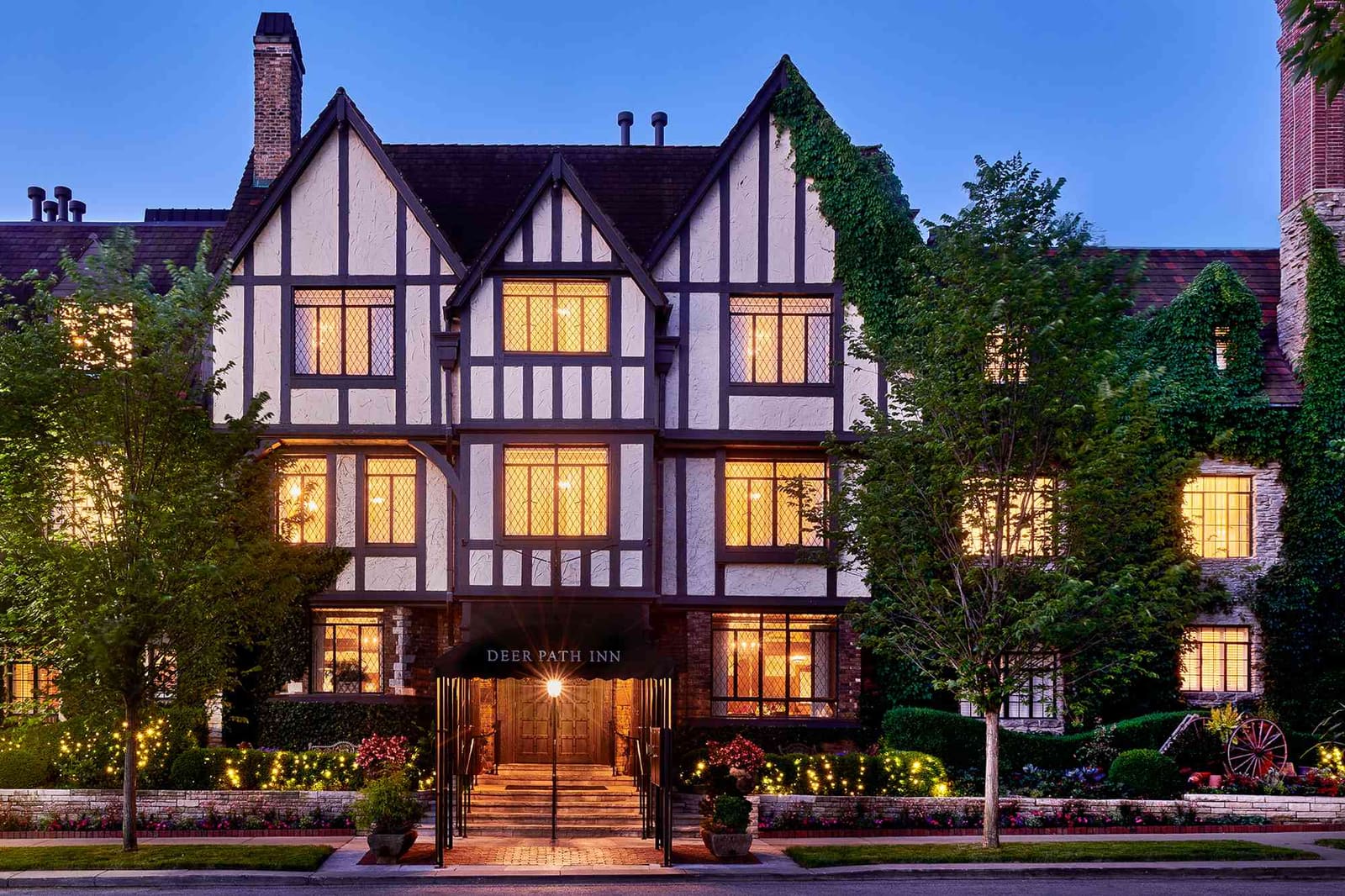
The inn's architecture speaks in the vernacular of English Tudor revival, a style that flourished in American resort design during the early twentieth century. Half-timbered facades, steep gables, and leaded windows create an aesthetic that is both transplanted and somehow appropriate to the wooded landscape of the North Shore. This is not accidental. The region's early developers deliberately cultivated a picturesque quality, building villages that evoked the English countryside as an antidote to Chicago's industrial vigor.
What distinguishes the Deer Path Inn is the integrity with which these elements have been maintained. The bones of the building remain legible. Fireside lounges retain their original proportions, with millwork and stonework that have been carefully preserved rather than stripped away during successive renovations. The effect is immersive without being theatrical. You are not asked to pretend you have stepped into another century, but you are invited to experience space organized according to different priorities: comfort over efficiency, conversation over connectivity.
The Rituals That Anchor
Afternoon tea remains a cornerstone of the inn's daily rhythm, offered in a setting that understands the ceremony is as important as the refreshment. This is not tea service as a novelty or a marketing exercise. It is tea as a structured pause, a deliberate slowing that creates space for conversation and observation. The ritual has roots in British hospitality tradition, but in the context of the American Midwest, it functions differently. Here, it becomes a quiet assertion that not all experiences need to be hurried, that there is value in pausing long enough to notice the quality of light through leaded glass or the way a well-brewed pot of Darjeeling can anchor an afternoon.
The lake views that frame many of the inn's public and private spaces offer another form of ritual. Water has a way of organizing time differently than land. The shifting light on the lake's surface, the seasonal changes in shoreline vegetation, the passage of migratory birds create a natural calendar that operates independently of the human schedules that dominate most travel experiences. Properties that understand this give their guests permission to recalibrate, to move at a pace determined by observation rather than itinerary.
What Endurance Reveals
Nearly a century in continuous operation is not merely a marketing point. It is evidence of adaptability. The inn has weathered economic depressions, shifts in travel patterns, the rise and fall of different hospitality philosophies, and the profound disruptions of the past several years. Survival at this scale requires both flexibility and a clear sense of identity. You must know which elements are negotiable and which are not.
The recognition the Deer Path Inn has received in 2026 suggests that travelers are increasingly drawn to properties that offer coherence. In an era when much of hospitality feels algorithmically optimized, designed to appeal to the broadest possible demographic, there is growing appetite for places that know exactly what they are. The inn does not attempt to be all things. It does not chase trends. It offers a specific experience, rooted in a particular tradition, executed with consistency.
The North Shore Context
Chicago's North Shore operates as a distinct cultural geography. Affluent, wooded, marked by careful preservation ordinances and a strong sense of local identity, the communities along this stretch of Lake Michigan have long served as retreats for the city's professional class. The Deer Path Inn functions within this ecosystem, serving both as destination for visitors and as a gathering place for residents who value its continuity.
This dual role is significant. Properties that serve only transient guests can become disconnected from their localities, existing as bubbles that offer no genuine sense of place. Those that maintain ties to their communities, that function as venues for local events and gatherings, develop a different kind of authenticity. They are woven into the social fabric. Their survival becomes a matter of local pride, not merely commercial viability.
Forward Without Forgetting
The challenge for any historic property is evolution. How do you modernize infrastructure, update amenities, respond to shifting guest expectations, all while preserving the qualities that made the property significant in the first place? There is no single answer. Each property must find its own balance, informed by its specific context and history.
What the Deer Path Inn's recent recognition suggests is that there is a path forward for properties willing to honor their past without being imprisoned by it. The inn has not remained static. It has adapted. But those adaptations have been made in service of the core experience, not in pursuit of novelty for its own sake. The result is a property that feels both historical and entirely relevant, a place where the past informs the present without overwhelming it.
As we look across the landscape of American resort hospitality, we see increasing fragmentation. Boutique properties multiply, each seeking differentiation through design gimmicks or hyper-local narratives. Chain properties standardize, offering predictability at the cost of character. In this environment, properties like the Deer Path Inn occupy valuable middle ground. They offer the reassurance of longevity, the comfort of established tradition, and the quiet confidence that comes from knowing exactly who they are and whom they serve.
The Midwest's finest resort is not a declaration of superiority so much as an acknowledgment of fit. The Deer Path Inn succeeds because it understands its region, its history, and the particular form of gracious hospitality that has sustained it for nearly a century. In an industry often obsessed with reinvention, there is something deeply satisfying about a property that has found its voice and chosen to refine rather than reinvent it.