
Why One Bintan Resort Is Betting on Slow-Travel Families This Holiday Season
At Homm Laguna Bintan, a new school-break package speaks to a quiet shift in how families are choosing to spend their downtime—one cupcake, one tide pool, one unhurried afternoon at a time.
ML
9 Jun 2026 · 5 MIN READ · UPDATED 17 AUG 2026
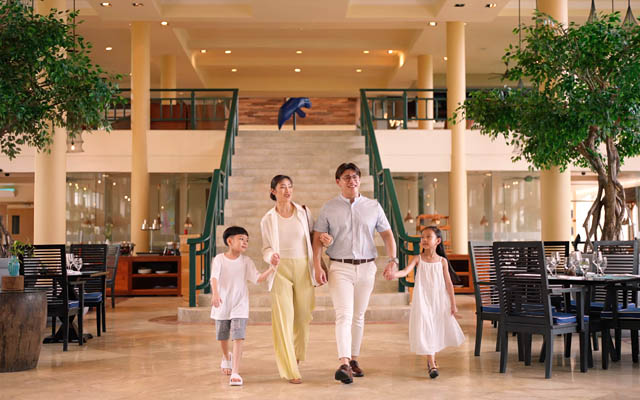
The Afternoon the Clock Stopped Mattering
There's a particular kind of quiet that descends on a resort beach in the late afternoon—when the day-trippers have departed, when the water has stilled to glass, when a child crouched at the tideline is absorbed entirely in the architecture of a sandcastle. It's the kind of moment that doesn't photograph well, that resists the language of itinerary, and yet it's increasingly what families are seeking when they book a getaway. Not the curated highlight reel. The unstructured in-between.
At Global Chic Voyage, we've watched this shift gather momentum across Southeast Asia's family travel sector. Parents are opting out of the theme-park sprint in favor of properties that offer space—literal and temporal—for children to explore at their own pace. Homm Laguna Bintan's latest school holiday programme is a quiet but telling example of how resorts are responding.
A Package Built Around Presence, Not Programming
The offer itself is straightforward: families booking direct accommodation by the end of June receive a nightly resort credit that can be applied to dining, activities, or select experiences across the property. But the substance lies in what those credits unlock—a curated menu of hands-on, unhurried activities designed for younger guests and their parents to engage together.
The Junior Chefs Experience invites children into the kitchen, not as spectators but as participants—mixing, measuring, tasting. Cupcake decorating classes trade precision for play. Exploration sessions around the resort's grounds emphasize observation over instruction, encouraging children to notice the textures of coastal vegetation, the rhythms of tidal change, the small dramas of insect life.
These are not activities designed to fill time. They're designed to slow it down.
The Broader Pivot Toward 'Doing Less' Travel
What Homm Laguna Bintan is articulating—whether consciously or not—is a response to a larger recalibration in family travel values. The pandemic's forced pause gave many households a chance to reconsider what rest actually looks like, and for a growing cohort, it doesn't look like a packed itinerary. It looks like margin. Like the freedom to let a morning unfold without a fixed endpoint. Like the luxury of boredom, which is increasingly understood as the precondition for creativity and genuine play.
This isn't a rejection of resort programming. It's a refinement of it. Families still want access to beach experiences, water sports, nature-based excursions—but they want them as options, not obligations. The value proposition shifts from "we've filled every hour for you" to "we've created the conditions for you to fill your own hours, at your own rhythm."
It's a model that aligns with broader conversations happening in wellness and hospitality design: the recognition that true luxury, especially for families, is not abundance of activity but sufficiency of time.
Why Bintan Keeps Drawing the Slow-Travel Cohort
Bintan's appeal for this kind of travel is geographic as much as philosophical. Close enough to Singapore to feel accessible, far enough to feel removed. The island's scale allows for exploration without overwhelm—children can range without parents losing sight, families can venture into mangroves or along coastline without the logistical weight of a multi-day expedition.
The island has also cultivated a reputation for properties that privilege space and natural setting over built spectacle. Homm Laguna Bintan fits this mold: a resort whose architecture defers to landscape, whose programming assumes that a well-designed environment is itself an activity.
For families seeking a break that doesn't require constant navigation—of crowds, of transport, of competing demands—Bintan offers a particular kind of relief. And properties like Homm are learning to design for that relief rather than against it.
What This Signals About the Next Chapter of Family Hospitality
If there's a broader implication here, it's that family travel is entering a more nuanced phase. The old binary—luxury resort versus budget guesthouse, all-inclusive versus self-catered—is giving way to a more complex set of questions. What is the texture of time at this property? What is the quality of attention it encourages? Does it assume that children need to be entertained, or does it trust that they are capable of entertaining themselves given the right conditions?
Homm Laguna Bintan's school holiday offer is modest in scope, but it's legible as part of a larger pattern: resorts learning to sell not what they do for families, but what they allow families to do for themselves. The cupcake class is not the product. The unhurried afternoon that follows—the one where a child discovers something small and wondrous in the sand, where a parent has time to notice—that's the product.
And it's a product that can't be rushed, can't be packaged into a highlight reel, can't be optimized for efficiency. Which is precisely why, in an age of relentless acceleration, it's becoming one of the most valuable things a resort can offer.
The Unscheduled Hours
We think often, at Global Chic Voyage, about what makes a family trip memorable in the long term. It's rarely the big set pieces—the waterslide, the dolphin encounter, the fireworks show. It's the unscheduled hours. The ones that didn't make it onto the itinerary. The ones where a child looked up from the tideline and said something surprising, or where a parent realized they hadn't checked their phone in three hours.
Homm Laguna Bintan's school holiday programme won't generate the kind of viral content that theme parks do. But for the families who choose it, that might be exactly the point. They're not looking for content. They're looking for time. And increasingly, the resorts that understand the difference are the ones families return to.
Spot something wrong? Email editors@globalchicvoyage.com. We log every correction publicly.
RELATED
SEE ALL →
29 Jul 2026 / 5 min
27 Jul 2026 / 5 min
20 Jul 2026 / 5 min
13 Jul 2026 / 5 min