
Where Rhinos Outnumber Guests and Mountains Frame the Horizon
Inside a new tented camp on Kenya's Solio Reserve, conservation meets quiet luxury across 45,000 acres of savanna.
SI
9 Jul 2026 · 5 MIN READ · UPDATED 17 AUG 2026
A Landscape Built for Solitude
There is a particular quality to light when it falls across open savanna at the base of Mount Kenya - amber and unhurried, settling over grassland that stretches so far you begin to lose your sense of scale. It is into this vastness that JW Marriott has introduced its newest property, a tented camp that sits so lightly on the land you might mistake it for a mirage. Nineteen canvas-and-timber structures dot the 45,000-acre Solio Game Reserve, each one positioned to feel less like accommodation and more like a temporary claim on wilderness.
At Global Chic Voyage, we have long believed that the best retreats are those that ask you to slow down, to recalibrate your rhythm to the place itself. This camp does exactly that. The reserve is home to one of the continent's most significant rhino populations, both black and white, and the property's design reflects a philosophy we have seen gaining ground across Africa's luxury safari sector: architecture that defers to landscape, hospitality that prioritizes immersion over insulation.
Canvas, Timber, and the Craft of Restraint
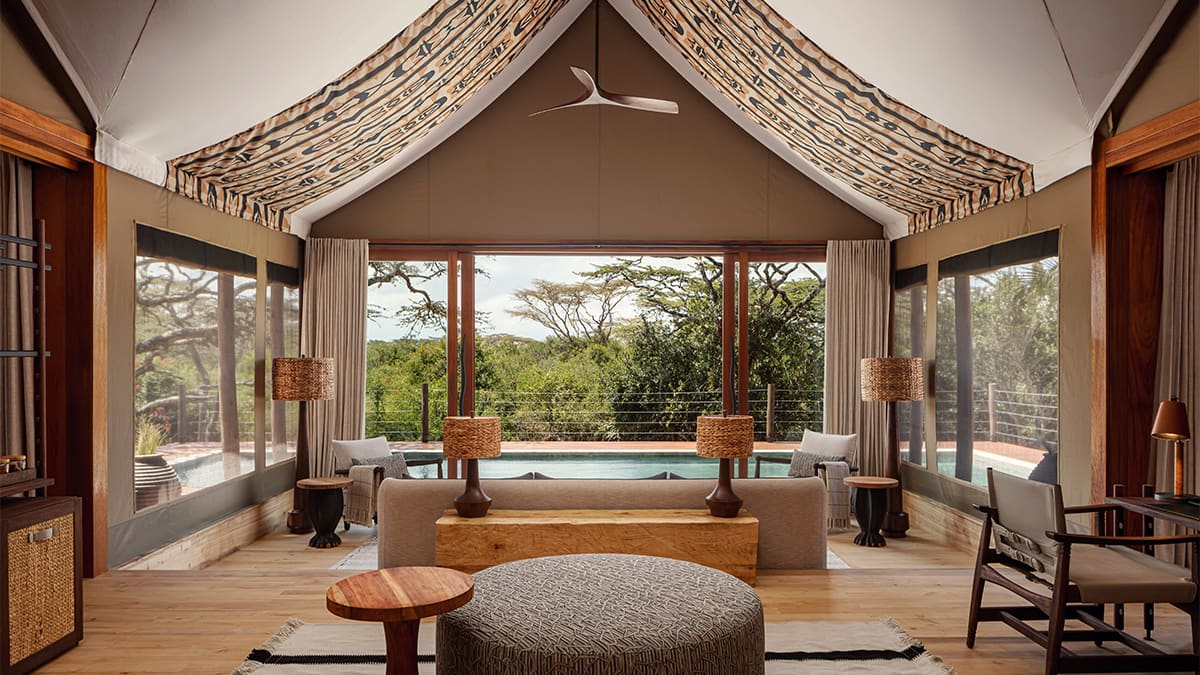
The tents themselves - eighteen one-bedroom units and a single two-bedroom option - were conceived by LW Design, a firm known for its sensitivity to context. Timber frames support canvas walls in tones that echo the surrounding grasses and earth. Inside, the palette deepens: warm ochres, forest greens, textiles and objects sourced from Kenyan artisans including Kitengela Glass and Safari Bronze. These are not simply decorative gestures. They root the interiors in a specific place, a specific tradition of making.
Each tent opens onto a private outdoor area anchored by a plunge pool - a luxury that takes on new meaning when your view includes nothing but acacia trees and the possibility of wildlife at the waterhole below. The two-bedroom configuration is designed for families or small groups who want space to scatter and reconvene, though we suspect most guests will spend little time indoors. The real draw here is not the thread count or the minibar. It is what lies beyond the threshold.
Encounters That Redefine Proximity
Solio Reserve is, above all, a working conservancy. Its rhino population is carefully managed, with individuals relocated to other parks across East Africa as part of broader conservation strategies. For guests, this translates into something rare: the chance to observe these animals not in isolation but as part of a functioning ecosystem. Leopards, lions, zebras, and more than three hundred bird species share the reserve, and the camp offers both day and night game drives to track their movements.
Night drives, in particular, reveal a different savanna - one populated by spotted hyenas, bush babies, and the occasional aardvark. The shift from diurnal to nocturnal rhythms is disorienting in the best way, a reminder that the landscape you thought you understood by daylight is, in fact, several landscapes layered atop one another.
Walking and cycling safaris are also available, and while they require a different kind of attention - more vigilance, less speed - they offer a level of immersion that motorized drives cannot. You hear more. You notice the small dramas unfolding at ground level, the insects and birds and the way wind moves through tall grass. Professional Canon cameras and on-site experts are available for those who want to document what they see, though we have found that some moments are better left unrecorded, held only in memory.
Beyond the Drive: Bespoke Immersion
For guests inclined toward deeper exploration, the camp arranges a menu of experiences that extend beyond the reserve's borders. Helicopter excursions offer aerial perspectives of the landscape, tracing the contours of valleys and ridges invisible from the ground. Trout fishing on Mount Kenya appeals to a different temperament - patient, contemplative, content with the slow accumulation of small pleasures. Sunset painting sessions, led by local artists, invite you to translate what you see into color and form, an exercise in looking that often reveals more than photography ever could.
Perhaps the most meaningful excursion, however, is the visit to the Solio Rhino Orphanage. Here, rhino calves and other animals are rehabilitated before reintroduction into the wild. It is a sobering and ultimately hopeful experience, one that underscores the fragility and resilience of the species you have been observing from a distance. The camp's team accompanies these visits, providing context and facilitating direct engagement with conservation work that is often abstract to outsiders.
A Table Rooted in the Soil Beneath It
The camp's culinary program is refreshingly tied to place. An on-site garden supplies herbs, fruits, and vegetables, and guests can dine among the plants themselves in a multi-course experience that blurs the line between farm and table. Mavuno, the property's signature restaurant, builds its seasonal menus around Kenyan ingredients and open-fire cooking techniques - methods that predate the luxury hospitality industry by centuries and lend the food a smoky, elemental quality.
Ember Bar and Lounge offers a more casual setting for shared plates and drinks, while bush dining - whether under acacia trees or beneath a canopy of stars - remains the most atmospheric option. There is something about eating outdoors in this environment that changes the meal itself. Food tastes sharper, more vivid, as though your senses have been tuned to a higher frequency.
Rituals of Rest and Recalibration
Wellness here is not about spa menus so much as it is about creating space for the body to remember what rest feels like. The treatment offerings are straightforward, but the half-day Solio Passage experience stands out: volcanic stone therapies, glacial hydrotherapy soaks, and bodywork designed to reset both mind and body after days spent in the sun and dust. It is less about pampering than about restoring equilibrium, a distinction we appreciate.
Elsewhere on the property, a serene pool offers a place to cool off during the heat of midday, while a library and games room provide refuge for those who need a break from the intensity of the landscape. A fire pit becomes the natural gathering point in the evenings, a place where strangers become companions and the day's sightings are recounted with the kind of detail that only emerges in hindsight.
The Economics of Immersion
Rates at Mount Kenya Rhino Reserve Safari Camp begin at $1,499 per person, per night, according to JW Marriott. That figure includes full board dining, game drives, and transfers to and from Nanyuki airstrip, which simplifies logistics considerably. It is not an inexpensive proposition, but it reflects the true cost of operating a camp of this caliber in a remote location, particularly one embedded within an active conservation project.
We have watched the safari sector evolve over the past decade, moving away from the colonial-era model of luxury-as-excess toward something more nuanced: luxury as access, as education, as responsibility. This camp fits squarely within that shift. It does not seek to dominate the landscape or to insulate guests from it. Instead, it offers a kind of hospitality that is contingent on respect - for the animals, for the land, for the communities that have lived alongside both for generations.
What We Carry Home
There is a moment, common to many safari experiences, when the scale of what you are witnessing overwhelms the framework you brought with you. You realize that the rhino standing thirty meters away does not care about your itinerary, your camera settings, or your Instagram feed. It exists entirely outside the logic of your everyday life, and that is precisely why you came. The best camps understand this. They do not try to mediate the experience or soften its edges. They simply hold space for it to unfold.
Mount Kenya Rhino Reserve Safari Camp does this well. It is a place built for looking outward, for sitting still, for letting the rhythm of the reserve dictate your days. And when you eventually leave - dusty, sunburned, quietly changed - you carry with you not just photographs or souvenirs, but a recalibrated sense of proportion. The world, you remember, is larger and stranger and more resilient than the small corners we inhabit. And sometimes, if we are fortunate, we get to step into that largeness for a while.
Photo: JW Marriott
Spot something wrong? Email editors@globalchicvoyage.com. We log every correction publicly.
RELATED
SEE ALL →
31 Jul 2026 / 5 min
15 Jul 2026 / 5 min
15 Feb 2026 / 5 min
27 Jul 2026 / 5 min