
Where Limestone Lanes and the Adriatic Meet
In Puglia's sun-bleached hinterland, one resort has perfected the alchemy of village soul and modern indulgence - without building a single ruin.
SI
17 Jun 2026 · 5 MIN READ · UPDATED 17 AUG 2026
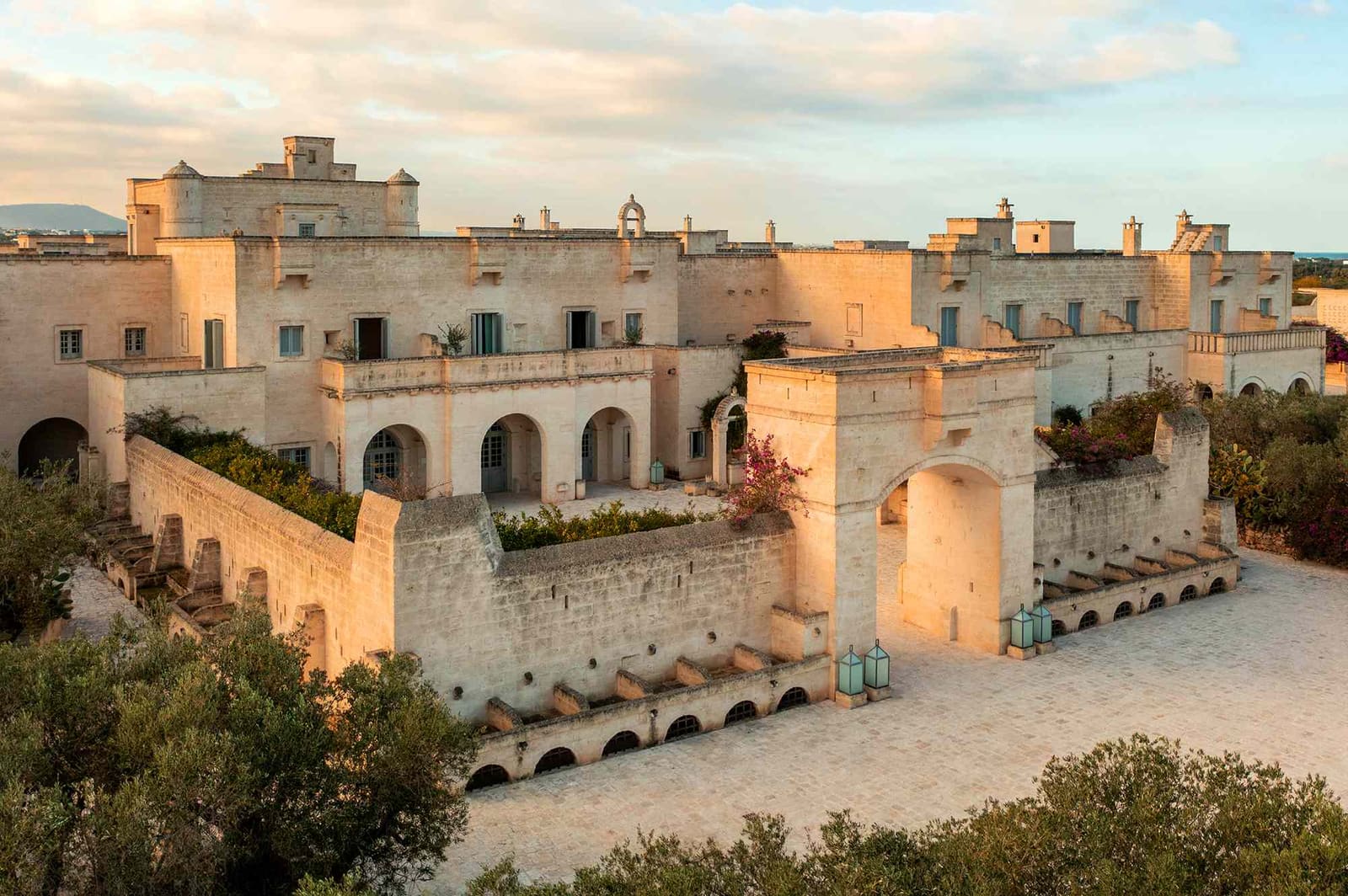
The Architecture of Memory
Walk the narrow lanes at dusk and you might forget this place was imagined rather than inherited. Limestone walls glow amber in the slanting light; wrought-iron lanterns throw shadows across cobbles worn smooth by thousands of footfalls. Borgo Egnazia, tucked into the olive groves an hour north of Lecce, does not masquerade as an ancient village - it recreates the feeling of one, down to the irregularity of doorways and the scent of wild fennel threading through the courtyards. At Global Chic Voyage, we have watched southern Italy's hotel scene swing between slick minimalism and museumified farmhouses; this property occupies a third, more elusive territory: it builds memory from scratch.
The resort's low-slung geometry mirrors the masserie and borghi that dot Puglia's Valle d'Itria - fortified hamlets where families once sheltered behind thick walls and pressed their own oil. Here, though, the defensive posture has softened into hospitality. Suites open onto private patios edged with jasmine; staircases spiral up to rooftop terraces where breakfast arrives in wicker baskets. Every surface bears the mark of a hand: terracotta tiles shaped on wooden forms, door handles forged by local smiths, plaster troweled in the wavelike strokes that Puglian masons have used for centuries.
The Fabric of Place
What sets Borgo Egnazia apart is not spectacle but specificity. The design team studied the proportions of nearby Alberobello's trulli, the vaulted ceilings of Ostuni's old town, the way sunlight pools in Cisternino's piazzas at noon. They distilled those observations into a vocabulary of arches, courtyards, and pergolas that feels less like pastiche than like a village that might have evolved over generations - if that village had been blessed with flawless drainage and underfloor heating.
The palette is Puglia's own: chalk-white plaster, honey-toned stone, the grey-green of olive leaves, the burnt sienna of earth after rain. Fabrics lean toward linen and raw cotton; furniture is spare, almost monastic, but softened by cushions in indigo and terracotta. In the suites, freestanding bathtubs nestle beside windows that frame cypresses and distant glimpses of the Adriatic. The effect is less luxury-hotel opulence than the quiet wealth of a well-loved family compound - one where every object has been chosen for beauty and utility in equal measure.
The Rituals of Arrival and Ease
Borgo Egnazia unfolds in concentric layers. At its heart lies the main piazza, ringed by restaurants, a wine bar, and the reception hall with its soaring barrel vault. Beyond that, the villas and townhouses step down through gardens fragrant with rosemary and lavender, each cluster arranged around its own courtyard or pool. The beach club, a ten-minute shuttle ride through olive groves, occupies a stretch of sand where the Adriatic shades from turquoise to cobalt. Here, canvas cabanas and teak loungers replace the stone and plaster of the main resort, but the spirit - unhurried, tactile, rooted in landscape - remains constant.
We have found that the most successful retreats are those that balance solitude and conviviality, and Borgo Egnazia calibrates that balance with care. Mornings might begin with yoga on a rooftop, followed by a slow breakfast of burrata and fig jam in the privacy of your suite. By afternoon, the piazza hums with life: children chasing footballs across the cobbles, couples lingering over Primitivo in the shade of an ancient oak, the faint clatter of pans from the open kitchen. Evenings draw guests to candlelit tables where the menu leans heavily on Puglian tradition - orecchiette with cime di rapa, grilled octopus with lemon and wild herbs, almond pastries dusted with powdered sugar.
The Spa as Philosophy
The resort's Vair spa extends the architectural logic underground, into a series of vaulted chambers carved from stone. Treatments draw on Puglian ingredients - olive oil, sea salt, grape must - and on rituals that predate the Roman conquest. The signature experience involves a sequence of warm pools, steam rooms scented with eucalyptus, and a final plunge into water cooled by the aquifer that runs beneath the property. Afterward, wrapped in thick robes, you are led to a quiet room where herbal tea steeps in ceramic cups and the only sound is the distant trickle of water.
What strikes us about Vair is its refusal of the theatrical. There are no Himalayan salt walls, no chromotherapy pods, no soundscapes of whale song. Instead, the design relies on proportion, temperature, and the inherent pleasure of moving through spaces that feel at once ancient and freshly made. It is wellness as restoration rather than performance - a philosophy that extends to the resort's cooking classes, its guided walks through the olive groves, its evenings of live music in the piazza.
The Hinterland as Stage
Borgo Egnazia sits at the edge of the Itria Valley, a landscape of conical trulli, dry-stone walls, and vineyards that produce some of Italy's most compelling wines. The resort organizes excursions to nearby towns - Ostuni, the White City, with its labyrinth of whitewashed alleys; Martina Franca, baroque and elegant; Polignano a Mare, clinging to its cliff above the sea. But the real revelation, for many guests, is the immediate surroundings: the network of footpaths that wind through ancient olive groves, the farmsteads where cheese is still made by hand, the roadside shrines where candles flicker in the twilight.
We have noticed that Puglia attracts a different sort of traveler than Tuscany or the Amalfi Coast - one less interested in ticking off landmarks than in absorbing the rhythm of a place. Borgo Egnazia understands this. Its concierge will arrange a visit to a family-run frantoio to taste new-pressed oil, or a morning at the fish market in Savelletri, or a picnic among the ruins of a Byzantine chapel. These experiences are offered not as curated adventures but as invitations to slow down and pay attention.
The Question of Authenticity
A resort built to resemble a medieval village inevitably raises questions about authenticity. Is this a theme park, a stage set, a Disneyfied version of the Puglian past? The answer, we think, depends on what you mean by authentic. Borgo Egnazia does not claim to be old; it claims to honor the principles - craftsmanship, proportion, connection to landscape - that made the old villages beautiful. The masons who laid its stones learned their trade from fathers and grandfathers who built the trulli of Alberobello. The olive trees in the groves are centuries old, transplanted with care. The recipes in the kitchens come from nonnas in nearby towns.
In this sense, the resort is less a replica than a continuation - a demonstration that the aesthetic and social logic of the Puglian borgo can accommodate contemporary comfort without collapsing into nostalgia or kitsch. It is a gamble, and one that will not satisfy purists who insist that only the genuinely ancient has value. But for those willing to accept that tradition is a living practice rather than a museum exhibit, Borgo Egnazia offers something rare: a place that feels both timeless and entirely of the present moment.
The Light at Day's End
We return, finally, to the quality of light - the way it pools in courtyards at noon, filters through linen curtains in the late afternoon, gilds the stone walls as the sun drops toward the Adriatic. Puglia's light is different from the soft haze of Tuscany or the sharp brilliance of the Greek islands; it has a warmth and clarity that painters have tried for centuries to capture. Borgo Egnazia is built to frame that light, to channel it through archways and reflect it off whitewashed plaster, to make you aware of its passage across the hours.
On our last evening, we sat on a rooftop terrace as the sky deepened from rose to violet. Below, the piazza filled with the murmur of conversation, the clink of glasses, the laughter of children playing one last game before bed. Swallows wheeled overhead; the scent of jasmine drifted on the breeze. It was a scene that could have unfolded in any Puglian village over the past five hundred years - or in none of them, because this particular village, with its flawless plumbing and its Michelin-starred kitchen, has never existed before. The paradox no longer troubled us. We were simply grateful to be there, in that light, in that moment, in a place that had been imagined with such care that it felt like coming home.
Spot something wrong? Email editors@globalchicvoyage.com. We log every correction publicly.
RELATED
SEE ALL →
31 Jul 2026 / 5 min
27 Jul 2026 / 5 min
9 Jul 2026 / 5 min
9 Jul 2026 / 5 min