
Where Geothermal Waters Meet Wanderlust
A curated journey through America's most evocative hot springs, where volcanic legacy and modern escapism converge.
SI
6 Jul 2026 · 5 MIN READ · UPDATED 17 AUG 2026
The Ritual of Heat and Stone
There is a particular quality to the air above a hot spring at dusk. The steam rises in slow, wavering columns, carrying with it the faint mineral tang of water that has traveled through rock for centuries. At Global Chic Voyage, we've watched travelers trade the frenetic pace of modern life for this elemental encounter, wading into pools fed by underground furnaces older than any human settlement on the continent.
The United States harbors hundreds of geothermal springs, scattered across volcanic zones and fault lines from the Pacific Northwest to the Appalachian foothills. Some have been channeled into resorts with Scandinavian-inspired architecture; others remain wild, accessible only by trail. What unites them is a quality difficult to articulate in the language of wellness tourism: they ask for stillness, and they reward patience.
Desert Sanctuaries in the Southwest
The high deserts of New Mexico and Colorado conceal some of the country's most dramatic thermal landscapes. Here, springs emerge from red-rock canyons and scrubland plateaus, their waters tinted turquoise or rust by dissolved minerals. The contrast between arid surroundings and abundant hot water lends these sites an almost mythic character.
In northern New Mexico, springs tucked along the Rio Grande Gorge offer views of basalt cliffs carved over millennia. The experience is visceral: soaking in water heated to near-scalding temperatures while desert wind cools your face, the Milky Way spreading overhead once night falls. These are not manicured spa environments but geological phenomena that happen to be accessible, and therein lies their appeal.
Colorado's mountain valleys harbor a different expression of the same geothermal forces. Springs here often sit at elevations above eight thousand feet, surrounded by aspen and lodgepole pine. In winter, the juxtaposition becomes theatrical: snowflakes dissolving on contact with steaming water, the forest silent under its white burden. The state's historic mining towns built bathhouses around these resources a century ago, and many of those structures remain, their Victorian ironwork now flanked by contemporary wellness facilities.
Pacific Northwest Abundance
The Cascade Range, running from Northern California through Oregon and Washington, represents one of the continent's most active volcanic zones. Hot springs here are plentiful, ranging from roadside soaking pools to backcountry destinations requiring multi-day treks.
Oregon's High Cascades offer particularly varied options. Some springs have been developed into rustic resorts where timber lodges overlook mineral pools fed by underground aquifers. Others remain entirely natural, accessible via Forest Service roads that turn to mud in spring. The state's ethos of low-impact recreation has preserved many sites in near-original condition, though this means amenities are minimal and etiquette codes strict.
Washington's Olympic Peninsula adds another dimension: hot springs emerging within temperate rainforest, where Roosevelt elk browse sword ferns and moss drapes every branch. The water here tends toward milder temperatures, its chemistry influenced by the region's heavy precipitation. Soaking becomes an act of integration with an ecosystem defined by abundance, where decay and growth occur simultaneously at astonishing speed.
California's Geothermal Corridor
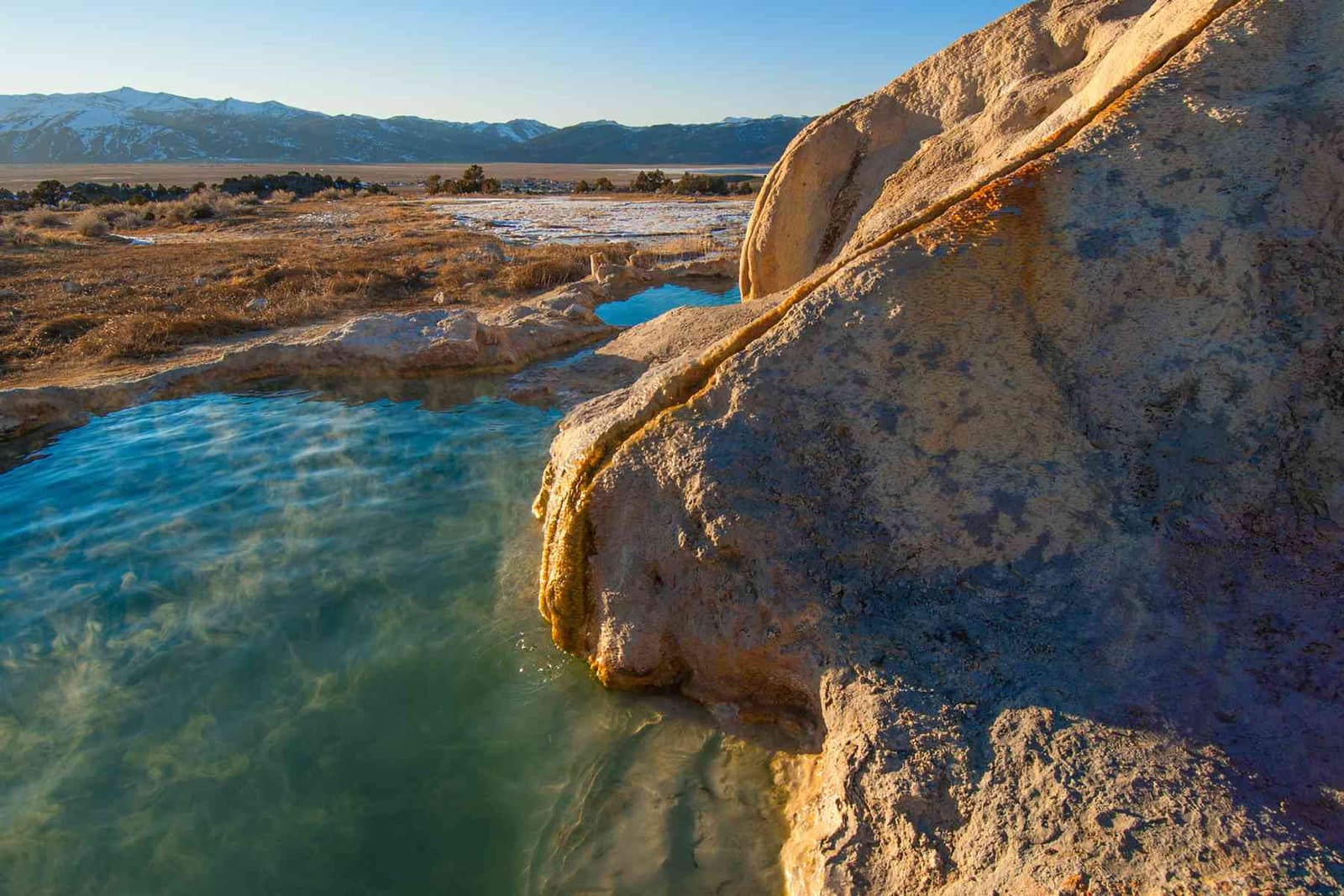
The Eastern Sierra Nevada corridor, stretching from Mammoth Lakes south past Bishop, concentrates more accessible hot springs than perhaps any comparable distance in North America. These springs occupy a landscape of contradictions: arid valleys shadowed by snow-covered peaks, alkali flats adjacent to cold mountain streams.
Mammoth's geothermal activity is substantial enough to have powered attempts at electrical generation. For travelers, this manifests as springs tucked into volcanic gorges and meadows, some developed with changing facilities and maintained pools, others left wild. The region's high elevation means comfortable soaking temperatures even in summer, when lower-altitude springs become uncomfortably hot.
Further south, the Owens Valley's springs often feature dramatic backdrops: the Sierra escarpment rising four thousand vertical feet in a single sweep, its granite faces catching alpenglow while you soak. These are springs shaped by tectonic violence, sitting along the fault system that continues to lift the range skyward millimeters each year.
Rocky Mountain Immersions
Montana, Idaho, and Wyoming harbor hot springs that reflect the region's broader character: remote, weather-tested, requiring commitment to reach. Many occupy wilderness areas where soaking is seasonal, accessible only after snowmelt opens high-country trails.
Idaho's Sawtooth Range and River of No Return Wilderness contain springs reached via multi-hour hikes or, in some cases, by raft after floating whitewater sections. These destinations attract a particular traveler: those for whom the spring itself is less the point than the journey required to reach it. The reward is often a crude stone pool beside a glacial river, the water's heat shocking against the snowmelt current.
Wyoming's hot springs are inevitably compared to Yellowstone's geothermal features, though the park's thermal areas are largely off-limits for bathing due to extreme temperatures and conservation mandates. Beyond park boundaries, however, the same volcanic system feeds soakable springs in the Teton region and along the Montana border, many on public land with minimal development.
The Architecture of Soaking
We've observed a design evolution at developed hot spring resorts over the past decade. Where once the model was either rustic-bordering-on-primitive or Las Vegas-style excess, a middle path has emerged: facilities that honor the site's geology while providing contemporary comfort. This often means locally sourced stone and timber, pools shaped to mimic natural contours, and careful attention to sightlines so that built structures don't dominate the landscape.
The best examples feel inevitable, as though the pools and pavilions grew organically from their surroundings. Architects working in this idiom study Japanese onsen design, Scandinavian sauna culture, and the historic bathhouse traditions of Central Europe, then adapt those precedents to American contexts. The result is a vernacular still in formation, one that respects both the geological feature and the regional ecosystem.
Seasonal Considerations
Spring timing matters profoundly. Winter soaking holds particular magic, the contrast between hot water and freezing air creating an almost hallucinogenic intensity. Many dedicated enthusiasts prefer December through February, when crowds thin and snow transforms familiar landscapes into something otherworldly.
Summer brings different pleasures: the ability to combine soaking with alpine lake swimming, evening sessions timed to catch meteor showers, the scent of sun-warmed pine. High-elevation springs remain comfortable even in July, while lower sites may require visiting at dawn or dusk to avoid excessive heat.
Autumn offers perhaps the most balanced experience. Water temperatures feel ideal as air cools, fall colors provide visual drama, and many springs see their lowest visitor numbers between Labor Day and Thanksgiving. This is the season we most often recommend for first-time hot spring travelers: conditions are forgiving, and the experience undiluted by crowds or weather extremes.
Etiquette and Preservation
The culture surrounding natural hot springs in the United States remains largely self-regulating, built on principles of low-impact use and mutual respect. Most unimproved sites operate under informal codes: pack out all trash, respect quiet hours, keep groups small, avoid introducing soaps or lotions into the water.
These norms exist not merely as courtesy but as practical conservation. Many springs occupy fragile ecosystems where thermophilic bacteria and unique plant communities have evolved in isolation. Human impact, when multiplied across thousands of annual visitors, can degrade water quality and damage surrounding terrain. The springs that have survived a century of recreational use are those where visitors have collectively chosen restraint.
The Slow Cure
Modern wellness culture has enthusiastically embraced hot springs, cataloging their purported benefits: improved circulation, muscle relaxation, stress reduction, skin health. The actual chemistry varies dramatically by source; some springs contain therapeutic concentrations of minerals, while others are essentially heated groundwater. What seems universal, though, is the psychological effect of deliberate slowness.
Soaking enforces a pace foreign to contemporary life. You cannot multitask in water heated to 104 degrees Fahrenheit. Your body regulates itself, heart rate rising then settling into a new rhythm. Time becomes elastic; what felt like fifteen minutes was forty-five. This enforced deceleration may be the real therapeutic agent, more potent than any dissolved mineral.
Planning Your Immersion
The logistics of hot spring travel depend entirely on your chosen destination. Developed resorts offer booking systems, on-site lodging, and amenities ranging from spa treatments to farm-to-table dining. These require advance reservations, particularly during peak seasons, and often implement timed entry to manage capacity.
Undeveloped springs on public land require different preparation: topographic maps, awareness of road conditions, sometimes permits from the managing Forest Service or BLM district. Many have no cell service, and weather can shift rapidly in the mountain environments where most are located. The trade-off for this added complexity is often solitude and a more immediate connection to the landscape.
We recommend approaching your first hot spring trip with modest ambitions: choose a developed site with good access, visit during shoulder season, and allow enough time to simply be present rather than rushing through an itinerary. The springs will still be there tomorrow, and the day after. They've been there for millennia, and they reward those who move at their pace rather than demanding they match ours.
Photo: Getty Images
Spot something wrong? Email editors@globalchicvoyage.com. We log every correction publicly.
RELATED
SEE ALL →
14 Jul 2026 / 5 min
10 Jul 2026 / 5 min
9 Jul 2026 / 5 min
29 Jul 2026 / 5 min